
What Causes Orange Peel Defects in Powder Coating?
Orange peel defects in powder coating can undermine both surface appearance and long-term protection, especially in demanding industrial environments. Understanding their causes helps manufacturers improve coating consistency and reduce rework.
While evaluating finish quality, many engineers also ask, “How long does an anti-corrosion coating last in humid production areas?” Its service life depends heavily on preparation, formulation, curing control, and defects that allow moisture penetration.
Why Orange Peel Is More Than an Appearance Problem
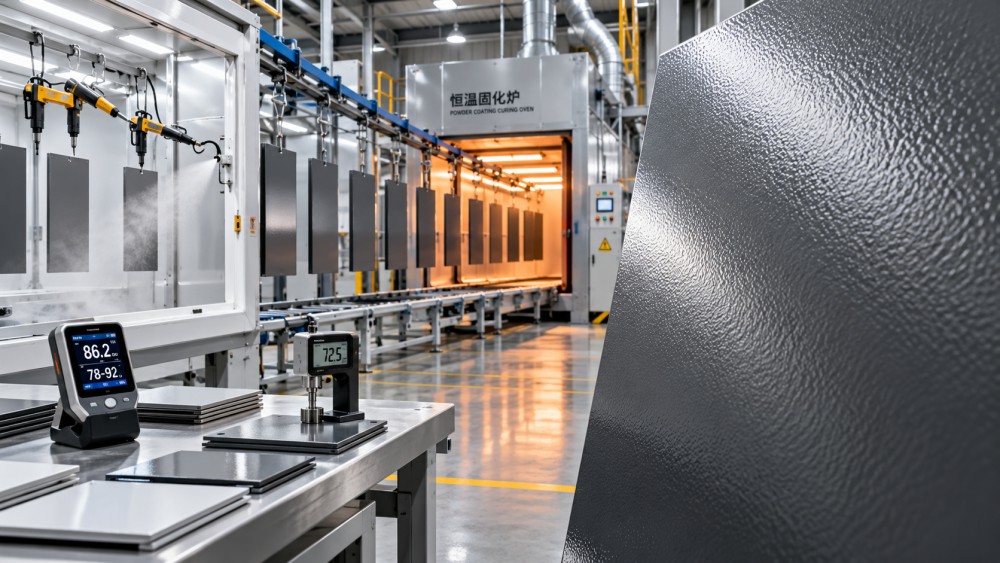
Orange peel is an uneven, wavy powder-coated surface that resembles citrus skin. It may be subtle under normal lighting, yet become highly visible on flat panels, branded equipment, and decorative metal products.
For production teams, the defect is not merely cosmetic. It can signal weak powder flow, inconsistent film formation, poor curing, surface contamination, or unstable electrostatic application conditions.
These process weaknesses may also affect gloss, color consistency, cleanability, corrosion performance, and customer acceptance. A visually rough coating can increase inspection failures, rework costs, and delivery risks.
The core search intent behind this topic is practical troubleshooting. Engineers want to identify the actual cause quickly, separate coating defects from equipment issues, and prevent repeated failures on production lines.
Procurement managers and plant leaders are also concerned with the commercial effect. They need to know whether an orange peel problem requires powder replacement, oven adjustment, gun maintenance, pretreatment improvement, or supplier intervention.
The most useful approach is to treat orange peel as a system-level quality indicator. Powder formulation, part geometry, substrate condition, spray settings, grounding, airflow, and oven performance must be assessed together.
What Does Orange Peel Look Like in Powder Coating?
Orange peel usually appears as small waves, ripples, dimples, or raised texture across the cured film. It differs from craters, pinholes, fisheyes, blisters, and heavy dry spray.
A mild texture may be acceptable for some industrial enclosures, structural components, and outdoor equipment. However, it is usually unacceptable on visible consumer products, appliance panels, furniture, and precision assemblies.
The defect often becomes more apparent under side lighting or reflected light. Quality teams should inspect panels at consistent angles, distances, and illumination levels to avoid subjective decisions.
Surface roughness measurements, gloss readings, coating thickness records, and retained sample panels can support visual inspection. These records make it easier to identify changes between shifts, batches, and suppliers.
Do not assume every textured finish is defective. Some powders are intentionally formulated with structured, wrinkle, hammer-tone, or fine-texture appearances that can resemble orange peel when judged without specification context.
The key question is whether the finished surface matches the approved standard. If the texture is unplanned, inconsistent, or excessive, it should be investigated as a coating process deviation.
Improper Powder Flow and Levelling
Insufficient powder flow and levelling is one of the most common causes of orange peel. During curing, powder particles must melt, spread, merge, and form a continuous smooth film.
If the molten powder cannot level before gelation, the particle boundaries remain visible. The result is a rough surface with a low-quality appearance, even when coverage and adhesion seem acceptable.
Powder chemistry strongly affects levelling behavior. Resin type, pigment loading, filler content, particle size distribution, additives, and storage history can all influence how the film flows in the oven.
Old powder may absorb moisture, partially agglomerate, or become contaminated. Poorly stored material can lose application consistency, especially in humid warehouses or plants with fluctuating temperatures.
Reclaimed powder requires particular attention. Excessive fines, altered particle distribution, cross-contamination, and unstable virgin-to-reclaim ratios can reduce flow and create visible texture variations.
Production teams should review powder certificates, batch history, shelf life, storage conditions, reclaim settings, and test-panel results before changing major equipment settings. Material problems should be confirmed rather than assumed.
Excessive or Uneven Film Thickness
Applying too much powder can create orange peel because a thick film may not level uniformly. It can also trap heat differently and produce inconsistent melt behavior across the component.
Very high film builds are especially risky around edges, corners, recesses, welds, and complex geometries. These areas may attract powder differently because of electrostatic field behavior.
Excessive thickness may be caused by high gun output, slow conveyor speed, repeated passes, poor operator technique, incorrect automatic reciprocator settings, or aggressive voltage and current parameters.
Uneven coating thickness can be equally damaging. Thin areas may appear smooth but offer weaker protection, while thick areas show orange peel, gloss variation, poor edge definition, or cure inconsistencies.
Dry-film thickness should be measured at representative locations, including difficult-to-coat zones. Averages alone can hide major variation between parts, rack positions, or spray booth sides.
Use the powder supplier’s recommended thickness range as the starting point. Increasing film build to improve hiding power or corrosion resistance can be counterproductive when it compromises appearance and cure quality.
Incorrect Curing Temperature or Time
Powder coating requires a controlled cure schedule. The part must reach the required metal temperature and remain there long enough for the powder to melt, flow, crosslink, and develop final properties.
Under-curing can leave a rough, poorly levelled surface because the powder may gel before it has sufficient time to flow. It can also reduce chemical resistance and coating durability.
Over-curing may create different problems, including discoloration, gloss loss, brittleness, or degradation. Although over-baking does not always cause orange peel directly, it can complicate defect diagnosis.
Oven air temperature is not the same as part metal temperature. Heavy steel fabrications, castings, thin aluminum panels, and mixed loads heat at different rates within the same oven.
Thermal profiling is essential when defects occur intermittently. Data loggers attached to representative parts can reveal cold zones, hot zones, rapid temperature spikes, poor airflow, and loading-related variations.
Operators should verify the actual cure window for each powder chemistry. Polyester, epoxy, epoxy-polyester hybrid, polyurethane, acrylic, and low-bake formulations may require different schedules and process tolerances.
Substrate Contamination and Pretreatment Failures
Contamination beneath the coating can disrupt film formation and make a surface appear uneven. Oils, lubricants, fingerprints, silicone, weld residues, dust, salts, and cleaning chemical carryover are common causes.
Even when contamination does not create obvious craters, it can interfere with powder attraction and melting. The coating may flow differently across affected areas, producing uneven texture or localized roughness.
Pretreatment quality is particularly important for steel, galvanized steel, aluminum, and mixed-metal assemblies. Cleaning, rinsing, conversion coating, drying, and handling must be controlled as one connected process.
Residual moisture from inadequate drying can generate surface problems during curing. Water, cleaning residues, and entrapped chemicals may affect powder flow or create defects that resemble orange peel.
Quality teams should inspect wash stages, chemical concentration, spray pressure, rinse conductivity, bath contamination, drying temperature, and part handling. A coating booth cannot compensate for poor pretreatment.
Simple water-break testing, cleanliness checks, tape tests, contact-angle methods, and controlled panel trials can help confirm whether substrate preparation contributes to the observed defect.
Application Settings, Grounding, and Electrostatic Effects
Powder application equipment strongly influences film uniformity. Incorrect voltage, current limit, gun distance, powder output, atomizing air, and fluidizing air can all contribute to orange peel.
High electrostatic voltage can cause back ionization or excessive powder attraction in some areas. This may produce a rough, uneven deposit that does not level well during the curing stage.
Low voltage can create poor transfer efficiency and inconsistent coverage. Operators may then compensate by increasing powder output, which can lead to over-application and unstable film thickness.
Grounding is often overlooked. Parts, hooks, conveyors, and fixtures need low-resistance grounding so powder is attracted evenly and deposited consistently across the entire component surface.
Dirty hooks, paint buildup, damaged hangers, and poor conveyor contacts can create variable grounding from part to part. This is a frequent source of unexplained finish inconsistency.
Gun-to-part distance should remain stable, especially for automatic systems. Excessively close spraying can overload surfaces, while excessive distance may cause dry deposition, overspray, and reduced transfer efficiency.
Booth Airflow, Humidity, and Powder Handling Conditions
Environmental control matters because powder coating is a dry process that still responds to moisture, temperature, and air movement. Unstable conditions can change powder behavior and application quality.
High humidity can affect powder flow, fluidization, charging behavior, and storage stability. It can be especially problematic where bags are opened frequently or powder is kept near wash and pretreatment areas.
Excessive booth airflow may disturb the powder cloud and lead to uneven deposition. Insufficient airflow can increase contamination, reduce visibility, and allow overspray to recirculate around coated parts.
Powder feed hoses should be clean, dry, properly sized, and free from sharp bends. Worn hoses, unstable venturi pumps, and clogged injectors can create pulsing powder flow.
Fluidized hoppers require the correct air volume and clean, dry compressed air. Poor fluidization can create surging, inconsistent powder density, and uneven film build across the workpiece.
Compressed air should be monitored for water, oil, and particulate contamination. These contaminants can enter application equipment and create repeatable quality problems that are mistaken for powder defects.
How Orange Peel Affects Corrosion Protection in Humid Areas
Orange peel does not automatically mean a coating will fail corrosion testing. However, severe texture can indicate insufficient levelling, uneven thickness, incomplete curing, or contamination that reduces long-term reliability.
In humid production areas, moisture exposure is persistent. Condensation, washdown, process steam, cleaning chemicals, and airborne salts can exploit weak points in a coating system over time.
Many buyers ask, “How long does an anti-corrosion coating last in humid production areas?” There is no single reliable service-life number without considering the substrate, coating system, exposure, and maintenance.
A correctly prepared and properly cured powder coating can provide years of protection in moderately humid indoor settings. Severe humidity, chemical exposure, abrasion, and damaged edges can shorten performance substantially.
For demanding environments, a conversion coating or suitable pretreatment beneath a corrosion-resistant powder system is often essential. Duplex systems, such as zinc-rich protection plus topcoat, may be needed for higher risk applications.
Orange peel should therefore be assessed with other quality indicators. Measure film thickness, adhesion, cure response, edge coverage, porosity, and corrosion-test performance rather than relying on appearance alone.
A Practical Troubleshooting Sequence for Production Teams
Start by defining the defect clearly. Compare affected parts with approved samples, record gloss and thickness, identify the affected surfaces, and determine whether the issue occurs on every part or intermittently.
Next, isolate the timing. Check whether orange peel started after a powder batch change, oven maintenance event, new part geometry, parameter adjustment, reclaim increase, or pretreatment chemical change.
Review dry-film thickness before making major corrections. If thickness is above specification, reduce powder output, adjust gun settings, verify conveyor speed, and inspect automatic spray-program consistency.
Then verify the cure process using a thermal profile. Confirm part metal temperature, dwell time, airflow balance, load density, and temperature uniformity across different positions in the oven.
Inspect powder condition and handling. Confirm storage temperature, humidity exposure, shelf life, sieve condition, reclaim ratio, hopper fluidization, feed stability, and possible contamination from other colors or chemistries.
Finally, inspect pretreatment and grounding. A controlled troubleshooting process prevents teams from changing multiple variables at once, which often hides the real root cause and prolongs production disruption.
How to Prevent Recurring Orange Peel Defects
Prevention begins with documented process windows. Define acceptable ranges for powder thickness, gun voltage, current, powder output, conveyor speed, oven cure conditions, humidity, and grounding resistance.
Maintain approved reference panels for each important finish. These panels help inspectors distinguish normal powder texture from unacceptable orange peel, gloss variation, color shift, and surface roughness.
Use routine calibration and preventive maintenance for coating guns, pumps, hoses, fluidizing equipment, ovens, gauges, and thickness meters. Process drift is easier to control before defects become visible.
Train operators to recognize the relationship between spray settings and final appearance. Fast correction depends on understanding that a smooth finish is created through deposition, melt flow, and curing together.
Work closely with powder suppliers when introducing new colors, substrates, geometries, or coating specifications. Supplier test panels and technical data can establish realistic expectations before full-scale production begins.
For critical corrosion applications, include laboratory testing in qualification plans. Salt spray, humidity, cyclic corrosion, adhesion, impact, and chemical-resistance tests provide stronger evidence than appearance checks alone.
Conclusion
Orange peel defects in powder coating usually result from a combination of poor levelling, excessive film build, incorrect curing, contamination, unstable electrostatic application, or uncontrolled environmental conditions.
The fastest route to improvement is a structured investigation based on thickness, cure profile, powder condition, pretreatment quality, grounding, and documented application parameters. Visual inspection alone is insufficient.
For manufacturers operating in humid environments, finish quality and corrosion protection should be evaluated together. A smooth, correctly cured, well-adhered coating supports a longer service life and lower maintenance risk.
When asking how long an anti-corrosion coating lasts in humid production areas, focus on the complete coating system. Proper preparation and stable process control matter as much as the powder selected.