
How to Evaluate Powder Coating Line Suppliers for Throughput, Quality, and Lifecycle Cost
Selecting a powder coating lines supplier is not simply a comparison of conveyor lengths, oven sizes, and quoted prices. It is a procurement decision that can shape output capacity, coating consistency, rework levels, energy exposure, maintenance workload, and the factory’s ability to meet customer or regulatory requirements over many years.
A line that appears inexpensive on a quotation may require excessive manual intervention, consume more fuel than expected, restrict future product changes, or create recurring quality losses that do not show up in the original capital budget. Conversely, a highly automated system can be difficult to justify if its complexity exceeds the plant’s product mix, labor availability, or maintenance capability. The right decision comes from matching the line to the real production process rather than purchasing the largest or most feature-rich design.
For procurement teams, the practical question is not “Which supplier has the lowest equipment price?” It is “Which supplier can demonstrate that this specific line will produce our parts reliably, at the required rate and finish standard, with manageable operating cost?”
Start with the Production Reality, Not the Supplier’s Standard Layout
Many coating projects begin with a requested output figure, such as parts per hour or square meters per shift. That number matters, but it is incomplete. A supplier needs a clear operating profile: part dimensions, hanging orientation, material type, wall thickness, coating specification, color-change frequency, annual volume, shift pattern, acceptable rejection rate, and expected production growth.
Throughput is governed by more than conveyor speed. The bottleneck may be pretreatment dwell time, loading density, oven curing time, cooling capacity, manual masking, powder recovery, or the rate at which operators can unload finished parts without damage. If different products share the line, the slowest or most demanding part family may define practical capacity.
A credible powder coating lines supplier should therefore ask detailed questions before proposing a configuration. Buyers should be cautious when a supplier offers a fixed “standard” layout with little interest in part drawings, production routing, coating powder type, or target film thickness. Standard modules can be useful, but their interfaces and process assumptions must still fit the job.
Request a documented capacity calculation rather than a headline output claim. It should explain carrier pitch, load density, conveyor speed, treatment stages, oven residence time, loading assumptions, and allowances for color changes or routine stoppages. The calculation does not guarantee factory performance, but it makes hidden assumptions visible before purchase.
Judge Throughput as Stable Output, Not Maximum Conveyor Speed
Suppliers often describe capacity using the highest conveyor speed the system can technically achieve. In production, that figure may be irrelevant if the parts do not reach metal temperature for proper curing, if the pretreatment stage is overloaded, or if loading stations cannot keep pace. Stable output means the number of conforming parts leaving the line over a normal working period, including routine changeovers, powder replenishment, cleaning, and minor interventions.
The conveyor design deserves close attention. Overhead monorail systems, power-and-free conveyors, floor conveyors, and manual handling arrangements each suit different parts and process patterns. A continuous conveyor may work well for high-volume, repeatable products. A power-and-free system can offer routing flexibility where part families need different dwell times, but it introduces more controls and mechanical components. The supplier should explain why the selected arrangement suits the actual mix rather than presenting flexibility as automatically beneficial.
Loading density is another common source of disagreement. Closely spaced parts can improve apparent output, but they can also create Faraday cage effects, poor powder penetration, uneven airflow, contact marks, and inconsistent curing. The best line design balances carrier density with coating access, heat transfer, and safe handling. This is particularly relevant for tubular frames, deep recesses, assemblies with enclosed corners, and parts with large differences in mass.
Pretreatment and Cleanliness Set the Ceiling for Coating Quality
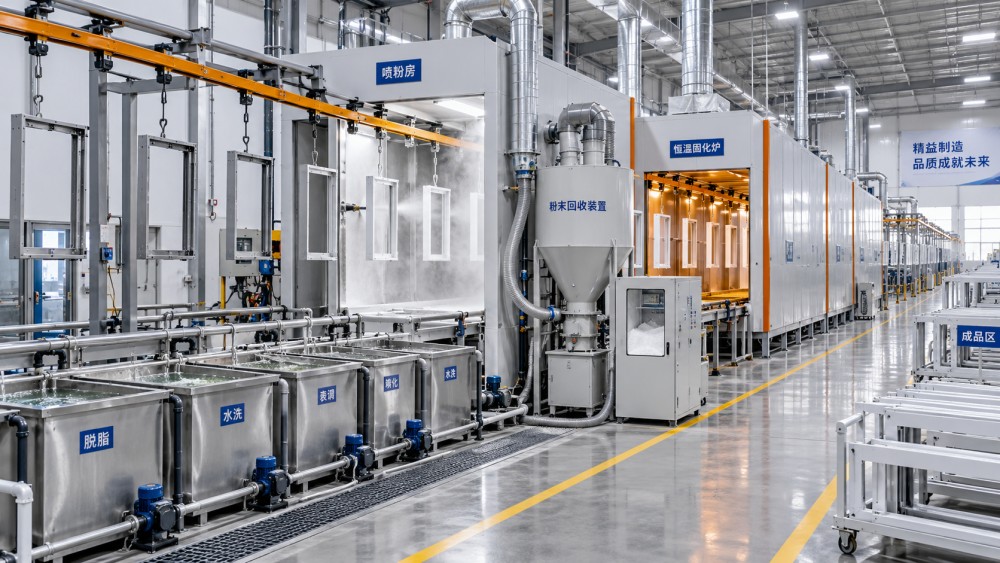
Powder application equipment receives much of the attention in a coating-line purchase, yet pretreatment frequently determines whether the finish performs as intended. Oil, welding residue, handling contamination, oxide layers, inadequate rinsing, or insufficient drying can undermine adhesion even when the powder booth and curing oven are well designed.
Buyers should ask suppliers to describe the pretreatment process stage by stage: cleaning, rinsing, conversion treatment where required, final rinse, drying, and wastewater handling. The appropriate chemistry and process sequence depend on substrate, contamination, corrosion requirements, local environmental conditions, and downstream expectations. A general industrial steel part, aluminum profile, galvanized component, and mixed-metal assembly may not need the same treatment route.
Important questions include how bath concentration is monitored, how sludge is managed, how rinse quality is controlled, and how operators recognize drift before defects appear. These are not minor operating details. A supplier that can discuss process control, test points, maintenance access, and operator routines is more valuable than one that only describes tank dimensions.
This broader process view is central to the coverage of Global General Industrial Auxiliary Systems (GIAS). Surface protection is influenced by adjacent auxiliary systems: cleaning precision, water and chemical control, identification for traceability, and consistent material handling. Coating defects often originate upstream, so equipment evaluation should not isolate the powder booth from the rest of the manufacturing process.
Examine the Booth, Powder Recovery, and Changeover Strategy
The powder booth must support the required finish while controlling overspray, contamination, and material loss. Its design should be evaluated against the powder types, colors, batch sizes, and finish requirements the factory actually expects to run. A system optimized for long campaigns of one color may be unsuitable for frequent color changes. A line producing textured, metallic, or special-effect finishes may need different cleaning discipline and powder management than a line using standard single-color coatings.
Ask whether recovered powder will be reused, how it is separated from fresh powder, what filtration arrangement is proposed, and how the supplier manages cross-contamination risk. Powder recovery can reduce material waste, but only where the powder and operating practice support stable reuse. It should not be treated as a universal saving without considering color-change frequency, product quality requirements, and the powder manufacturer’s guidance.
Automatic guns, reciprocators, and part-recognition systems can improve repeatability on consistent products. Their value is less clear where part geometry changes constantly or operators must make frequent adjustments. Procurement should ask for clarity on the boundary between automated control and manual touch-up. A supplier that specifies automation without explaining set-up time, programming responsibility, and fault recovery is leaving important cost questions unanswered.
Treat Curing as a Process-Control Question
An oven does not cure powder simply because the air temperature display reaches a setpoint. The relevant condition is the temperature history of the coated part, which varies with material thickness, part geometry, load mass, airflow, and conveyor dwell time. Heavy steel fabrications and thin sheet-metal components can respond very differently in the same oven.
A supplier should be able to explain the oven’s airflow concept, temperature zoning, access for cleaning and inspection, insulation approach, burner or electric heating arrangement, and controls. For mixed product ranges, buyers should ask how the design accommodates variation without creating under-cure or unnecessary overbake risk. Verification during commissioning may include temperature profiling appropriate to the coating system and the agreed acceptance criteria.
Energy claims deserve the same discipline. Fuel or electricity consumption depends on part mass, loading pattern, ambient conditions, shift utilization, oven losses, exhaust settings, maintenance condition, and idle periods. A responsible supplier can state the basis of its estimate and identify variables that may change it. Broad promises of “energy saving” without operating assumptions are not sufficient for lifecycle-cost evaluation.
Build Lifecycle Cost into the Comparison from the Beginning
The purchase price is only one element of total cost. A better comparison separates capital expenditure from recurring operational exposure: energy, powder consumption, pretreatment chemicals, water, compressed air, replacement filters, wear parts, cleaning labor, maintenance labor, planned downtime, waste treatment, and potential rework or scrap.
The most useful supplier comparison usually includes a common operating scenario prepared by the buyer. Give each bidder the same annual volume, working hours, part mix, color-change pattern, utility prices, and required quality controls. Their calculations may differ, but the differences become easier to challenge and understand.
Evaluate Delivery Capability Beyond the Equipment List
A complete coating line is a coordinated installation involving civil works, ventilation, electrical supply, gas or electrical heating, water treatment, drainage, controls, safety systems, and production handover. Scope gaps are common when quotations use terms such as “by others” without clear boundaries. These gaps can become costly after the equipment order is placed.
Before selecting a supplier, review the responsibility matrix. It should identify who supplies drawings, installation labor, foundation requirements, utility connection points, interlocks, operator training, commissioning materials, performance testing, documentation, and spare parts. If the project crosses borders, also confirm packaging, export documentation, local electrical practices, language requirements, and realistic access to service technicians.
Acceptance criteria should be agreed before fabrication begins. They may cover mechanical completion, safety functions, line speed, agreed product trials, process temperatures, coating appearance, film thickness measurement methods, and documentation. The specific criteria need to reflect the application and applicable standards; they should not be copied from an unrelated project.
Use Supplier References to Test Process Understanding
References are most useful when they resemble the planned application. A supplier with experience in small decorative components may not automatically be the right partner for heavy construction equipment, architectural aluminum, automotive subassemblies, electrical enclosures, or agricultural machinery. Ask about comparable part geometry, coating requirements, throughput range, color flexibility, and installation environment.
During reference checks, avoid asking only whether the customer is satisfied. More revealing questions are: Did the line achieve the intended production rhythm? What required adjustment after commissioning? How quickly were technical issues addressed? Were operators able to maintain the system with the available skills? Which consumables and spare parts proved difficult to source? These questions expose the difference between a well-presented proposal and a line that works reliably in daily production.
GIAS approaches supplier visibility in this practical way: equipment capability should be read alongside process knowledge, documentation quality, compliance considerations, and the support systems surrounding the main machine. For buyers comparing industrial auxiliary equipment, the most useful information often sits in the details that a brochure does not explain.
Make the Final Decision with a Weighted Technical Review
A weighted review helps prevent the lowest initial bid from dominating the decision. Throughput feasibility, coating-quality control, pretreatment suitability, lifecycle-cost assumptions, safety and environmental scope, service capacity, delivery clarity, and expansion potential should all be evaluated by procurement, engineering, production, maintenance, and quality representatives. The weighting will vary by project, but the discussion should be recorded before commercial negotiation begins.
The strongest powder coating lines supplier is rarely the one that claims to solve every problem with one standard design. It is the one that identifies trade-offs early, documents the assumptions behind capacity and energy estimates, defines responsibility at every interface, and can support the line after the commissioning team leaves.
Before issuing a purchase order, confirm the part mix, layout constraints, utilities, acceptance test method, maintenance plan, critical spares, and change-control process. Those details may feel less dramatic than the booth or oven specification, but they are often what determine whether the line delivers predictable coating quality and defensible lifecycle cost.