The Short Answer: Better for Some Parts, Not for Every Finish
Electrostatic powder coating is often the better choice when a manufacturer needs a durable, repeatable finish on metal parts produced in consistent volumes and can support the required curing process. It usually offers stronger resistance to chipping, abrasion, and many forms of corrosion than a conventional liquid-paint system, while also reducing solvent emissions and recoverable material waste.
That does not make liquid paint obsolete. Liquid coatings remain more practical for heat-sensitive substrates, highly complex assemblies, very thin-film requirements, field repair, and finishes that demand exceptional color matching, smoothness, or visual depth. The useful question is not whether powder coating is universally superior. It is whether the coating method fits the part, the production flow, the finish specification, and the cost of controlling the process.
For an industrial buyer, the wrong comparison is “powder versus paint” in isolation. The right comparison includes pretreatment, hanging or masking requirements, coating booth design, oven capacity, rework methods, inspection criteria, and the expected service environment of the finished part.
Why Powder Coating Often Performs Better in Industrial Service
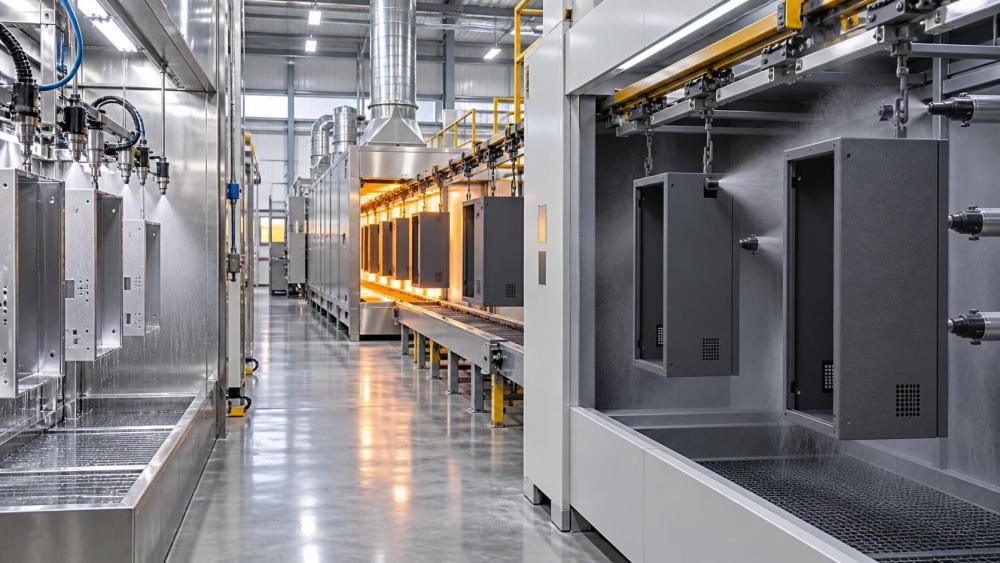
Powder coating applies dry, electrically charged particles to a grounded workpiece. The powder adheres electrostatically before the coated part enters an oven, where the material melts, flows, and cures into a continuous film. This process can produce a relatively thick and robust coating in one pass, particularly on steel, aluminum, and other conductive metal components.
Its practical advantage is not merely that it is “thicker.” A well-controlled powder coating system can form a tough, uniform protective layer with good edge coverage and resistance to handling damage. For fabricated enclosures, shelving, frames, machine guards, brackets, agricultural equipment, outdoor furniture, electrical cabinets, and many appliance components, that combination is highly valuable. These products are frequently moved, assembled, packaged, shipped, and installed in ways that expose coatings to impacts and scratching long before the end user sees them.
Liquid paint can also provide durable industrial protection, especially when specified as a high-performance system with suitable primers and topcoats. But achieving comparable durability may require multiple stages, flash-off time, solvent management, and more careful control of runs or sags. Powder coating can simplify that workflow where the part geometry and oven conditions are suitable.
Material utilization is another reason powder systems attract attention. Overspray from a liquid system generally becomes waste unless the process uses specialized recovery arrangements. In many powder lines, overspray can be collected and reused when color control, contamination management, and coating quality permit it. That can reduce material loss in stable, high-volume production, although recovery is not automatically beneficial for every operation. Frequent color changes, premium decorative finishes, or strict contamination limits may reduce the value of reclaiming powder.
Where Liquid Paint Still Has a Clear Advantage
Powder coating depends on heat to cure. That is a decisive limitation when a product includes heat-sensitive plastics, seals, adhesives, electronic assemblies, bonded components, or substrates that may distort or degrade in an oven. Some lower-temperature powder technologies exist, but they do not remove the need to verify substrate compatibility, thermal mass, cure schedule, and part temperature.
Liquid paint is also easier to use when coatings must be applied after assembly or when a finished product requires local repair. A scratch on a powder-coated component is not always simple to blend invisibly. Spot repairs may be acceptable for functional equipment, but they can be visually apparent on decorative parts. Liquid coatings are generally more flexible for touch-up, repainting, and service work performed outside a factory coating line.
Very large structures and irregular objects create another dividing line. A manufacturer can powder coat large items if it has a sufficiently sized booth, conveyor, and oven. Yet the capital cost and floor-space requirement can be substantial. Liquid coatings may be the more workable option for low-volume fabrication, oversized structures, installed equipment, or projects where parts cannot reasonably travel through a curing oven.
Appearance requirements deserve a more careful comparison than they usually receive. Powder coating can provide attractive matte, satin, textured, gloss, metallic, and specialty finishes. It is widely used where consistent production appearance matters. However, liquid paint may offer more control for certain ultra-smooth, thin, deep-gloss, multi-layer, custom-color, or finely blended decorative finishes. The answer depends on the visual standard, lighting conditions, viewing distance, and acceptable variation from part to part.
Part Shape Can Decide the Outcome Before Coating Begins
Electrostatic attraction is helpful, but it does not make powder reach every surface equally well. Deep recesses, narrow channels, sharp internal corners, enclosed cavities, and closely spaced features can create a Faraday-cage effect. Charged powder tends to deposit on more exposed surfaces rather than penetrate into recessed areas. A part may look fully coated at first glance while receiving insufficient coverage in locations where corrosion later begins.
Experienced finishers address this through gun settings, powder formulation, application technique, grounding quality, part orientation, and sometimes manual touch-up before curing. Those measures can improve results, but they add process complexity. Buyers should avoid assuming that a powder line will automatically produce uniform coverage on every metal geometry.
Liquid paint has its own geometry-related risks, including pooling, runs, drips, solvent popping, and inconsistent film build. Still, its fluid nature may suit crevices or complex areas that are difficult to charge electrostatically. The better process is therefore tied to the design of the workpiece, not simply the desired durability label.
- Powder coating is usually favorable for open metal parts, repeatable geometry, fixtures, housings, panels, frames, and components that can move through a controlled oven.
- Liquid paint deserves serious consideration for mixed-material assemblies, oversized items, intricate cavities, low-volume custom work, and products requiring routine field repair.
- Either process can fail when the coating cannot reach critical surfaces, film thickness is inconsistent, or the substrate is poorly prepared.
Pretreatment Matters More Than the Coating Debate Suggests
A powder-coated part with poor pretreatment can corrode prematurely. A properly specified liquid system on a well-prepared substrate can perform very well. The coating method does not compensate for oil, weld scale, fingerprints, dust, oxidation, salts, or residue left on the part before finishing.
This is especially important for steel components intended for humid, outdoor, marine-influenced, chemical, or frequently washed environments. Surface cleaning and conversion treatment affect adhesion and corrosion resistance at the interface between metal and coating. A buyer evaluating a finishing supplier should ask how parts are cleaned, rinsed, dried, inspected, and protected from recontamination before entering the booth.
For aluminum, galvanized substrates, and mixed-metal assemblies, pretreatment compatibility requires equal attention. A process designed around bare steel may not provide the same adhesion or corrosion performance on another material. Parts with welds, laser-cut edges, sharp edges, and trapped moisture can also create localized weak points. Coating thickness alone cannot solve all of these issues.
Where service conditions are demanding, the coating specification should describe more than color and gloss. It should establish the substrate, pretreatment route, coating chemistry, target film thickness, cure conditions, masking requirements, inspection methods, and acceptance criteria for cosmetic and functional surfaces. That level of definition prevents a supplier from treating a corrosion-protection requirement as a simple color application job.
Environmental and Operating Considerations
Powder coating is frequently selected because it contains little or no conventional liquid solvent in the applied material. This can simplify the management of volatile organic compound emissions compared with many solvent-borne liquid paints. It also reduces some handling and storage concerns associated with flammable solvents.
That advantage should be viewed as a process benefit, not a reason to stop evaluating environmental performance. Powder operations still require dust containment, housekeeping, filtration, grounding, worker protection, and control of ignition sources. Fine powder in the wrong concentration and environment can create a combustible-dust hazard. Booth cleaning and color-change procedures also influence both safety and production efficiency.
Liquid systems may involve VOC controls, solvent storage, waste handling, and emission-related permitting obligations depending on the coating chemistry and location. Waterborne liquid coatings can reduce solvent content, but they still require disciplined application, drying, and waste management. Compliance teams should assess the entire finishing operation, including pretreatment chemicals, rinsewater, exhaust, filters, cleaning materials, and off-spec product disposal.
Energy use is another point where general claims can mislead. Powder coating requires curing heat, and the energy demand depends on part mass, oven insulation, loading density, cure temperature, line speed, heat recovery, and idle time. A continuously loaded production line can use an oven efficiently. A line that repeatedly heats small batches or waits between jobs may not. Liquid coatings can also require heated drying or curing, so the relevant comparison is the actual production profile rather than a generic claim that one process always consumes less energy.
Cost Depends on Volume, Changeovers, and Rework
Powder coating equipment can require a meaningful initial investment: pretreatment equipment, drying stages, booth, spray guns, powder feed systems, reclaim equipment where appropriate, conveyor infrastructure, curing oven, filtration, and process controls. The installation also needs adequate space and reliable utilities. For a factory with repeatable part families and sustained volume, the investment may be justified by throughput, finish consistency, reduced waste, and lower dependence on solvent handling.
For low-volume or highly variable production, the economics can change quickly. Color changes take time, cleaning is critical, and coating every part family may require dedicated hooks, racks, masks, plugs, or fixtures. Large parts may demand customized material handling. A nominally fast coating process becomes inefficient when setup and changeover time exceed actual spraying time.
Liquid paint can be less capital-intensive for certain operations and more adaptable for short runs. Yet lower entry cost should not be mistaken for lower total cost. Overspray losses, labor-intensive finishing, drying time, environmental controls, defects, and rework can raise the cost per acceptable part. The appropriate calculation should include the full cost of producing an approved finish, not only the price of powder or paint per kilogram or liter.
A Practical Selection Path
When deciding whether electrostatic powder coating is better than liquid paint, begin with the non-negotiable constraints. Can the part safely complete the cure cycle? Is the substrate conductive and suited to the planned pretreatment? Does the geometry allow reliable powder coverage at the surfaces that matter? Can the product tolerate a powder finish visually and functionally? If the answer to those questions is yes, powder coating is often a strong candidate.
Then examine the operating case. High-volume, repeatable metal production generally favors a controlled powder line. Products with frequent color changes, mixed materials, low annual quantities, oversized dimensions, or expected field repair may justify liquid paint or a mixed finishing strategy.
The final decision should be based on representative coated parts, not panels alone. Inspect edges, recesses, weld areas, masked features, assembled interfaces, and surfaces exposed to the product's actual service conditions. Confirm cure performance and film build across the part, then evaluate how defects will be detected and corrected. A coating process is better when it produces the required protection and appearance consistently within the factory's real constraints, not when it wins a simplified comparison.