
When a factory team asks, “How much does a powder coating line cost?” they are rarely looking for a single number. They are trying to decide whether a new finishing operation is commercially realistic, whether an existing line should be upgraded, or whether a low initial quote will create expensive operating problems later.
In 2026, a powder coating line can range from roughly US$20,000–$80,000 for a basic manual or small-batch setup to US$250,000–$1 million or more for an automated conveyorized production line. Large custom installations with multi-stage pretreatment, automatic powder recovery, high-throughput ovens, advanced controls, and environmental equipment can exceed that range substantially.
These figures are planning ranges rather than fixed market prices. The final budget depends on part dimensions, throughput, coating specification, material handling, available utilities, local installation costs, energy source, and the degree of process control required. In practice, the purchase price of the equipment is only one part of the investment.
The budget starts with the kind of production you need to run
A compact fabrication shop coating brackets, gates, frames, or maintenance parts has very different needs from an appliance manufacturer processing hundreds of metal components per hour. Before comparing suppliers, buyers should define a few operating facts: the largest and heaviest part, expected daily output, number of colors, coating thickness requirements, surface condition of incoming parts, and the level of finish consistency customers expect.
A line designed around the wrong assumptions can be costly in either direction. Oversizing ties up capital and floor space. Undersizing creates bottlenecks at pretreatment, spraying, curing, unloading, or color change. It can also lead to inconsistent film thickness, poor adhesion, and avoidable rework.
The categories overlap because line architecture matters more than the label. A carefully equipped batch system may cost more than a basic conveyor line, while a long conveyor system with sophisticated pretreatment and automation may become a major capital project.
What is included in a powder coating line cost?
Quotes can look deceptively similar while covering very different scopes. One supplier may offer a booth, guns, and an oven. Another may include a full finishing process: wash stages, drying, conveyor, coating booth, powder recovery, curing oven, controls, safety systems, and commissioning. Buyers should request an itemized scope rather than comparing only the total at the bottom of a proposal.
A typical industrial powder coating line may include the following elements:
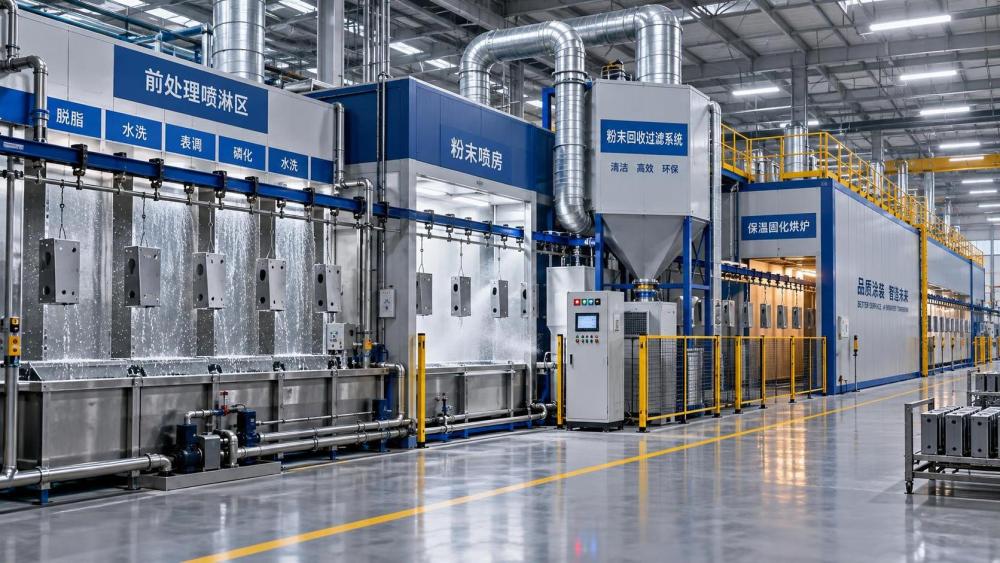
- Pretreatment equipment: spray washers, immersion tanks, rinse stages, conversion coating stages, drying equipment, and wastewater handling where needed.
- Material handling: monorail or power-and-free conveyor, hangers, fixtures, loading and unloading stations, and part tracking options.
- Powder application system: manual guns, automatic reciprocators, robotic applicators, pumps, hoppers, electrostatic controls, and color-change arrangements.
- Spray booth and recovery: cartridge filters, cyclone recovery, after-filters, powder collection, and ventilation.
- Curing equipment: batch ovens, conveyor ovens, gas-fired systems, electric ovens, infrared zones, or hybrid curing solutions.
- Control and safety infrastructure: PLC controls, sensors, interlocks, fire protection interfaces, grounding provisions, and electrical distribution.
Not every operation needs every option. For example, a shop applying one color to simple steel parts may operate effectively with manual guns and limited powder recovery. A producer that changes colors frequently, coats complex geometries, or must document process conditions for major customers will need more capable systems.
Pretreatment is often the cost buyers underestimate
Powder coating does not hide poor surface preparation for long. A part may look acceptable immediately after curing, yet develop blistering, corrosion, or adhesion failure later because oil, weld scale, rust, or salts were not adequately removed.
This is why pretreatment frequently changes the economics of a coating project. Basic cleaning may involve manual wiping, blasting, or a simple wash stage. More demanding applications may require multi-stage alkaline cleaning, rinsing, iron phosphate, zinc phosphate, zirconium-based conversion coating, passivation, and a dry-off oven. Aluminum, galvanized steel, castings, and mixed-metal assemblies often need different process attention.
For outdoor furniture, construction hardware, electrical enclosures, transportation components, and corrosion-sensitive industrial products, it is risky to select a line based on spray booth and oven price alone. The prep process should be matched to the expected service environment and relevant customer or market requirements. A cheaper line that produces early coating failure can be far more expensive than a better-designed pretreatment section.
Automation raises the purchase price—but may lower cost per part
Manual systems require less capital, are easier to adapt to short runs, and work well where skilled operators handle varied parts. They are often the sensible choice for custom metalwork and low-volume production. However, manual application depends heavily on operator technique, part positioning, gun settings, and consistent grounding.
Automated powder coating lines add cost through conveyors, reciprocators or robots, automatic guns, programmable controls, sensors, powder feed systems, and integrated recovery. Yet automation can reduce variability, improve transfer efficiency, stabilize film thickness, and support higher output with less repetitive manual handling.
The right question is not whether automation is “better.” It is whether the expected production volume can justify it. A line running only a few hours per week may not recover the cost of advanced automation. A line operating multiple shifts, however, can lose money every day through inconsistent application, excessive powder use, rework, and labor-intensive loading.
Color changes have a financial impact
Frequent color changes can make an apparently high-capacity line perform like a much smaller one. Cleaning the booth, reclaim equipment, hoses, guns, and feed system takes time; it also creates powder loss and contamination risk. Manufacturers with long single-color runs can benefit from powder recovery systems. Businesses serving many custom colors may prefer a booth design that allows fast cleaning, dedicated feed paths, or a practical “virgin powder only” approach for certain colors.
Discuss the actual production mix with suppliers. A line that is efficient for black, white, and gray production may not be efficient for a job shop changing between ten colors in a day.
The curing oven is an energy decision, not simply a heat box
Oven size, heat source, insulation quality, airflow design, exhaust requirements, and cure profile all influence both capital cost and ongoing operating expenses. The oven must bring the entire part—not just the air surrounding it—to the required metal temperature for the specified cure time. Thick castings, large fabricated structures, and mixed-load batches behave very differently from thin sheet-metal parts.
Gas-fired ovens often offer attractive operating economics where gas infrastructure is available. Electric systems may be appropriate where local energy conditions, emissions policies, building limitations, or precise control needs favor them. Infrared or hybrid solutions can be useful for specific geometries and faster heat-up requirements, but they should be evaluated against the product mix rather than chosen solely for a headline cycle time.
Energy costs should be modeled using realistic loading patterns. An oven that is oversized for the actual workload may spend considerable energy heating empty space. Conversely, an undersized oven can limit conveyor speed and become the hidden constraint on a line’s output.
Installation, utilities, and site work can add 20% to 50% or more
Equipment quotations do not always include freight, import duties, civil work, electrical upgrades, gas piping, compressed air capacity, drainage, ventilation ducting, wastewater treatment, fire-system modifications, or local permits. For global buyers, these omitted items can materially change the project total.
A realistic powder coating line cost should therefore be divided into at least three budgets: equipment supply, site integration, and startup support. In older buildings, structural changes or insufficient power supply may be more difficult than installing the coating equipment itself.
Before placing an order, confirm floor layout, ceiling clearance, access for unloading large oven sections, crane or forklift paths, drainage routes, utility connection points, and space for maintenance. Do not forget room around the equipment. Filters need access, conveyors need service clearance, and operators need a safe path to load, inspect, and rework parts.
Compliance and safety should be designed in early
Powder coating is often selected because it can reduce solvent-related emissions compared with conventional liquid coating. That does not remove the need for environmental and safety planning. Powder dust management, grounding, ventilation, explosion-risk considerations, fire protection, chemical handling, wastewater from pretreatment, and worker exposure controls all remain important.
Requirements differ by country, region, building type, and industry. Procurement teams should ask suppliers what standards their equipment is designed to support and then verify the applicable local requirements independently. A system may be technically sound but still need modifications to satisfy a local authority, insurer, or customer audit.
For exporters and manufacturers serving regulated supply chains, process documentation also matters. Recording oven temperature profiles, pretreatment chemistry, coating batch information, film thickness checks, adhesion tests, and cure verification can strengthen quality traceability and simplify root-cause analysis when a complaint occurs.
A practical way to compare supplier proposals
Instead of asking only for the lowest price, give each supplier the same production brief. Include part drawings or photographs, maximum dimensions and weight, material types, target output, coating colors, desired coating performance, available utilities, floor plan, and any compliance restrictions. Ask them to state assumptions clearly.
Then compare proposals on a like-for-like basis:
- Is the stated throughput based on actual part spacing and cure time?
- What pretreatment chemistry and number of stages are included?
- Does the quoted booth include recovery, filtration, and cleaning provisions?
- What powder utilization or transfer-efficiency assumptions are being made?
- What are the oven heating source, insulation specification, and expected energy demand?
- Which installation, commissioning, training, and acceptance-test activities are excluded?
- Are spare parts, maintenance intervals, remote support, and local service availability defined?
A lower quote is not necessarily a poor decision. It may be entirely appropriate if the operation is simple, volumes are low, and the team understands the limits of the design. Problems arise when a basic line is purchased for an application that requires repeatability, corrosion performance, or throughput it was never designed to deliver.
How much should you budget beyond the machine price?
For early planning, many buyers set aside a contingency for installation, utilities, fixtures, initial chemicals, powder inventory, training, and production ramp-up. The percentage varies widely by site condition and line complexity, but treating these expenses as an afterthought is a common budgeting mistake.
There is also a working-capital dimension. New lines need test panels, sample runs, process tuning, maintenance supplies, replacement filters, and sometimes a period of lower-than-target output while operators learn the system. A thoughtful commissioning plan protects both product quality and delivery commitments during this transition.
Making the investment decision with confidence
The most useful answer to “How much does a powder coating line cost?” is therefore a range linked to a production objective. A small manual operation may begin below six figures. A robust batch system with meaningful surface preparation may require a larger investment. Automated conveyorized lines typically move into the hundreds of thousands of dollars because they combine transport, process control, recovery, curing, and safety infrastructure.
Buyers should focus on the cost per acceptable coated part over the line’s expected life—not only the initial equipment number. Powder consumption, energy use, labor, downtime, rework, corrosion claims, maintenance access, and changeover time all shape that result. For industrial manufacturers, the coating line is not simply a finishing purchase. It is a process-control investment that affects appearance, durability, traceability, delivery reliability, and the confidence customers place in the finished product.