
How High-Efficiency Ultrasonic Cavitation Improves Precision Cleaning Results
Precision cleaning is often judged at the end of the process: a part passes or fails a cleanliness inspection, coating adhesion test, leak test, bonding step, or assembly check. By that stage, however, the real causes of inconsistent cleaning may be difficult to trace. Parts may look visibly clean while retaining polishing compound in blind holes, fine particles in threads, machining oil in capillary features, or detergent residues on sensitive surfaces.
For technical evaluators, high efficiency ultrasonic cavitation is one of the most useful concepts for separating a genuinely capable cleaning process from a tank that merely produces noise and surface agitation. The objective is not maximum ultrasonic energy in isolation. It is controlled cavitation that reaches the contamination, acts with sufficient intensity, and does so consistently without eroding delicate features or damaging functional surfaces.
This distinction matters across advanced manufacturing. A stamped bracket may tolerate a relatively robust wash process. A precision-machined valve component, medical device subassembly, optical part, electronic housing, or battery-production fixture may not. In these applications, cleaning quality is connected to yield, traceability, surface treatment performance, packaging reliability, and downstream inspection results. Auxiliary equipment is rarely the most visible part of a production line, yet it frequently determines whether the primary process can remain stable.
Cavitation Is the Cleaning Mechanism, Not Just an Ultrasonic Effect
Ultrasonic cleaning works by transmitting high-frequency mechanical energy through a liquid. This creates alternating pressure cycles. During low-pressure phases, microscopic cavities or bubbles form in the liquid; during subsequent compression, many of them collapse. Near a contaminated surface, that collapse can generate localized fluid movement, pressure effects, and micro-jets that help break the bond between soil and substrate.
The practical value of cavitation is its ability to work where brushes, sprays, and bulk liquid flow have limited access. It can assist cleaning inside drilled passages, under overlapping geometries, around fine threads, and within intricate machined features. That does not mean ultrasound automatically cleans every inaccessible area. The liquid still needs a path into the feature, trapped air must be managed, and the chemistry must be capable of wetting and releasing the actual contaminant.
A common mistake is to describe a system as high-efficiency simply because it uses a high-power generator. Effective cavitation depends on the interaction of generator control, transducer design, tank construction, liquid condition, basket loading, part orientation, frequency selection, and process timing. If one of these elements is poorly controlled, more input power may create uneven results rather than better cleaning.
In practice, high efficiency means that usable cavitation is distributed through the working zone and remains sufficiently repeatable from batch to batch. It also means the energy is appropriate for the part. Aggressive cavitation can be beneficial for heavy oils or tenacious residues, but the same condition may be unsuitable for soft metals, fragile coatings, fine wire structures, highly polished surfaces, or parts containing vulnerable assemblies.
Why Cleaning Results Vary Even When the Tank Settings Do Not
A cleaning recipe can appear stable on the control panel while the actual process changes in the tank. Cleaning liquid ages. Oils accumulate. Detergent concentration drifts. Dissolved gases and suspended particles alter how energy behaves in the bath. A basket loaded with dense metal parts absorbs and reflects ultrasonic energy differently from a lightly loaded basket of thin components. Even a well-designed system needs operating discipline.
This is why validation should focus on the complete cleaning window rather than on a single successful trial. A part cleaned immediately after a fresh bath has been prepared may not represent production conditions after repeated cycles. Likewise, a test coupon placed in the most energetic zone of a tank says little about parts positioned at the basket corners or behind a dense fixture.
Geometry creates another source of variation. Cavitation is more useful when the cleaning fluid can enter, circulate, and drain from the target area. Deep blind holes, narrow channels, internal cavities, and nested components can retain air pockets. Once air is trapped, the liquid cannot contact the contamination effectively, regardless of generator capacity. Part rotation, inclination, immersion sequence, wetting chemistry, vacuum-assisted filling in some specialized processes, or changes in fixture design may solve more than increasing ultrasonic power.
Temperature must also be judged in relation to the chemistry and contaminant. Heating can improve detergent action and reduce the viscosity of certain oils, but excessive temperature can accelerate bath degradation, affect volatile components, or become incompatible with adhesives, elastomers, coatings, and assembled parts. There is no universally correct temperature, frequency, or cleaning duration. The correct setting is the one that meets the defined cleanliness requirement with an acceptable process margin and no unintended material effect.
Frequency Selection Is a Risk-and-Access Decision
Lower ultrasonic frequencies are generally associated with stronger, more energetic cavitation events. They can be effective for robust parts and heavier contamination. Higher frequencies tend to produce smaller cavitation bubbles and are often considered when cleaning finer features, sensitive surfaces, or smaller particulate contamination. That broad principle is useful, but it should not be treated as a universal rule.
The part material, surface finish, contamination type, fixture contact points, bath chemistry, and acceptance method all affect the decision. A process designed around particle removal may need different behavior from one intended to remove oil films before coating or laser marking. A part that must remain visually flawless may demand a different balance from a component where internal cleanliness matters more than cosmetic appearance.
Multi-frequency or sweep-frequency operation can be relevant where standing-wave effects create persistent high- and low-energy zones. By varying the operating condition, the system may improve energy distribution and reduce the chance that the same locations are repeatedly overexposed. Still, the presence of a sweep function should not be accepted as proof of uniform cleaning. It needs to be assessed with the actual tank, fluid, fixtures, and production load.
What should be evaluated beyond nominal power
Precision Cleaning Is Usually a System, Not a Single Tank
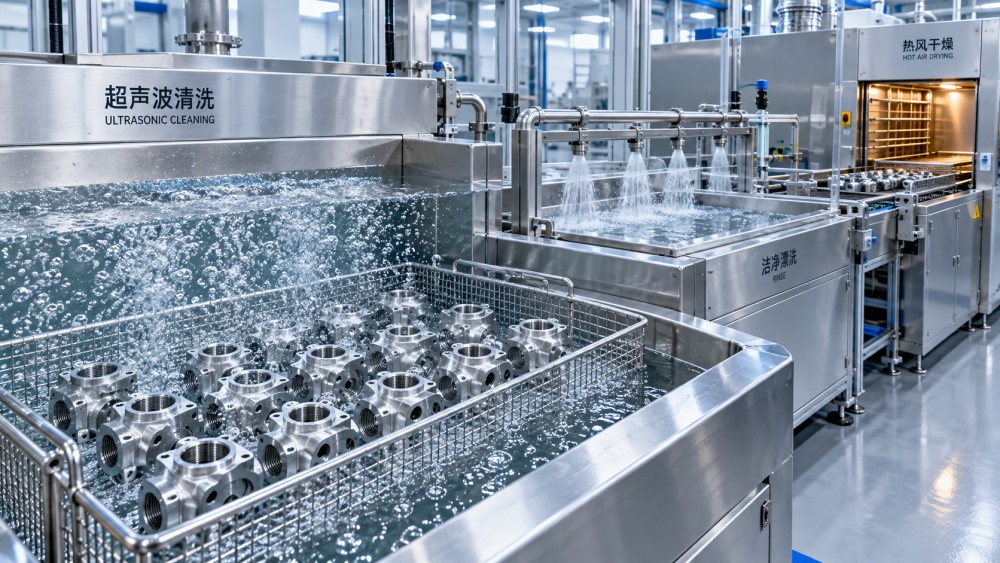
Ultrasonic action is strongest when it is integrated into a sensible process sequence. For machining oils, the sequence may include pre-cleaning or gross soil removal, ultrasonic washing, one or more rinses, drying, and protected handling. For particle-sensitive components, filtration and rinse management can be as consequential as the ultrasonic stage. Removing particles from a surface only to redeposit them later is an expensive way to create unstable quality.
The interface with upstream and downstream operations deserves attention. A component arriving from grinding may carry a different contamination profile from one arriving after polishing, heat treatment, molding, or manual handling. A downstream coating process may be sensitive to molecular films that are not visible under ordinary inspection. Laser marking, adhesive bonding, vacuum processing, precision assembly, and electrostatic coating can all expose cleaning weaknesses that were not obvious at the wash station.
For this reason, GIAS treats ultrasonic cleaning as part of the broader auxiliary-system chain that supports manufacturing consistency. Cleaning precision sits alongside process identification, weighing accuracy, vacuum stability, and surface preparation. These systems may be specified by different departments, but a failure in one can affect the performance of the next. Technical assessment is more reliable when engineers, quality teams, and procurement staff use a shared definition of what “clean” must mean for the final application.
Define the Acceptance Method Before Selecting the Equipment
The most productive equipment discussion begins with the acceptance criterion, not the machine brochure. Is the concern visible residue, gravimetric residue, particulate contamination, non-volatile residue, ionic contamination, surface energy, coating adhesion, or a downstream functional test? Each question leads to different sampling, handling, cleaning, and verification requirements.
In automotive and precision-manufacturing supply chains, technical cleanliness requirements are often structured with reference to customer specifications and recognized frameworks such as ISO 16232 or VDA 19 where applicable. These documents do not remove the need for product-specific agreement. They help establish a disciplined approach to extraction, analysis, reporting, and contamination control. A supplier should not assume that compliance with a general cleanliness method automatically proves suitability for a particular component or assembly.
A useful evaluation plan normally includes representative parts, realistic contamination, defined basket orientation, normal production loading, and agreed inspection conditions. It should also state what happens when the bath reaches its intended service limit. This is less glamorous than comparing generator ratings, but it is where repeatability is won or lost.
The Trade-Off: More Cavitation Is Not Always Better
High-efficiency ultrasonic cavitation should be understood as targeted process performance, not maximum intensity. Overly aggressive treatment can contribute to surface alteration, damage to fragile joints, loosening of poorly retained particles that then redeposit elsewhere, or accelerated wear in fixtures and baskets. The risk is especially relevant for soft metals, thin sections, decorative finishes, electronic assemblies, and components with trapped interfaces.
There is also an economic trade-off. Long cleaning cycles may hide a weak process design, while excessively short cycles may only work under fresh-bath conditions. Better results can come from improving drainage, changing part orientation, separating gross soil removal from final cleaning, maintaining filtration, or preventing contamination at the source. Cleaning should not become the default repair step for uncontrolled upstream operations.
When evaluating a system, ask to see how the supplier approaches process development: how they define the usable load area, how they account for bath aging, how they handle different part geometries, and how they recommend validation. A convincing answer is rarely just a power figure. It is a clear explanation of the relationship between contamination, chemistry, acoustic energy, handling, rinsing, drying, and acceptance testing.
The best ultrasonic cleaning process is usually the least aggressive process that consistently meets the real cleanliness requirement. That principle keeps attention on what matters: reliable removal of the contaminants that can compromise the next manufacturing step, without creating new damage, variation, or inspection uncertainty.