
Ultrasonic Cavitation Effect: How It Removes Contaminants from Precision Parts
A precision component can look perfectly clean and still fail its next process step. A machined valve body may retain cutting fluid in a cross-drilled passage. A stamped electrical contact may carry fine polishing residue that later interferes with plating. A medical or laboratory component may have no visible marks at all, yet release particles during assembly. These are the situations in which ordinary spray washing, soaking, or manual wiping often reaches its limit.
The ultrasonic cavitation effect is what gives an ultrasonic cleaning system its unusual ability to remove contaminants from recesses, blind holes, threads, internal channels, and other difficult geometries. It is not simply “vibration in a tank.” The cleaning action comes from controlled formation and collapse of microscopic bubbles in a liquid. When the process is properly designed, those collapses create localized mechanical energy at the part surface, helping the cleaning chemistry detach oils, particles, polishing compounds, and process residues.
For a technical evaluator, that distinction matters. An ultrasonic cleaner should not be assessed only by tank size, generator power, or a supplier’s claim that it provides deep cleaning. The real question is whether the cavitation field, liquid chemistry, part presentation, rinsing sequence, and cleanliness verification method work together for the contamination actually present.
Cavitation Is a Bubble Event, Not a Simple Scrubbing Action
Ultrasonic transducers convert electrical energy into high-frequency mechanical oscillation. That oscillation passes through the cleaning liquid as alternating pressure waves. During the low-pressure portion of a cycle, microscopic cavities or bubbles can form. During the following high-pressure portion, many of those bubbles collapse.
Near a solid surface, bubble collapse is not always symmetrical. The liquid movement associated with collapse can direct intense, highly localized forces toward the surface. In practical cleaning terms, this helps break the bond between a contaminant layer and the substrate. It also renews the liquid at the interface, allowing detergent or solvent components to reach contamination that would otherwise remain protected in a narrow gap.
This is why ultrasonic cleaning is particularly useful for parts whose contamination is not easily accessible by a spray nozzle. The process can reach into a fine thread root, a porous-looking cast surface, a small bore, or a tightly packed basket of components—although “can reach” should never be confused with “will always clean.” Cavitation still depends on liquid access. A sealed cavity, trapped air pocket, or poorly drained feature can remain a cleaning blind spot.
The energy is real, and it is not harmless by default. On robust steel tooling, the process may be relatively forgiving. On thin foils, soft coatings, fragile sintered structures, delicate wire bonds, or surfaces with pre-existing defects, aggressive cavitation can create unacceptable risk. The correct process is therefore a controlled compromise between cleaning force and material protection.
What Actually Determines Cleaning Performance
The ultrasonic cavitation effect is often discussed as though frequency alone determines the result. Frequency is important, but it is only one part of the process window. A system that performs well on machined stainless-steel fittings may perform poorly on powder-metal parts or on components carrying a tenacious wax-based polishing compound.
Lower ultrasonic frequencies are generally associated with more forceful cavitation and are commonly considered for heavy oils, robust machined parts, and demanding degreasing work. Higher frequencies generally produce smaller, less aggressive cavitation activity and may be selected where fine features, sensitive surfaces, or particle-focused cleaning are the main concern. The best frequency depends on the substrate, contaminant type, part geometry, loading density, and required cleanliness level. It should be demonstrated with representative parts rather than chosen from a generic frequency chart.
The cleaning liquid is equally important. Ultrasound does not replace chemistry. It intensifies the interaction between the liquid and the part. If the chemistry cannot wet an oily surface, emulsify a lubricant, dissolve a residue, or suspend released particles, cavitation alone may simply redistribute contamination. In production, this is one reason a bath may appear active while parts downstream still show water-break failures, particle residue, or inconsistent coating adhesion.
Bath temperature, concentration, filtration, oil separation, and replenishment practice all change the outcome. A cleaning solution gradually becomes a transport medium for removed contamination. Without adequate filtration and maintenance, previously removed particles or oils can redeposit on the next batch. This is especially relevant when the cleanliness requirement concerns non-volatile residue or particle counts rather than visual appearance.
Part orientation is another underappreciated variable. Components should be positioned so that liquid can enter, displaced air can escape, and cleaning solution can drain after the cycle. A blind bore facing upward can trap air and effectively shield its internal surface from cavitation. Dense stacking can create shadowed areas between parts. In many evaluations, a simple change in fixture angle or basket loading reveals more than another increase in generator power.
From Loose Chips to Molecular Films: Different Contaminants Behave Differently
“Oil and particles” is a useful shorthand, but it can obscure the practical difference between contamination types. Loose machining chips may be dislodged quickly if they are accessible to the liquid. A dried coolant residue can require chemistry that dissolves or disperses its inorganic and organic components. Lapping compounds may contain abrasive particles embedded in grease or wax. Fingerprints can spread as thin films and become difficult to detect until they disrupt a later surface-sensitive operation.
Ultrasonic cleaning is most effective when the contamination mechanism is understood before equipment selection. For example, a process intended to prepare parts for adhesive bonding, painting, electroplating, vacuum processing, or precision assembly may need more than gross degreasing. The concern may be ionic residue, non-volatile residue, film continuity, particle size distribution, or outgassing behavior. These are not interchangeable acceptance criteria.
That is why a technically credible cleaning specification states both the test method and the acceptance condition. Automotive component cleanliness programs may refer to ISO 16232 or VDA 19.1 methods for extraction and analysis of particulate contamination. Those documents do not automatically define what is acceptable for every component; they establish structured approaches to specifying, extracting, measuring, and reporting technical cleanliness. The acceptable limit remains application-specific.
For parts entering a cleanroom-controlled process, the cleaning requirement should also be separated from cleanroom classification. ISO 14644 addresses cleanroom and controlled-environment classification and monitoring; it does not, by itself, prove that an individual component is clean enough for a particular assembly. Confusing the two can lead to expensive but incomplete validation plans.
Why Tank Power Ratings Can Mislead Buyers
A published power value is not a direct measure of cleaning performance at the part surface. Generator rating, transducer configuration, tank construction, operating frequency, liquid condition, load mass, and basket position all influence the actual cavitation field. A heavily loaded basket may absorb or block energy differently from a lightly loaded trial basket. A complex part may clean well near one region of the tank and less consistently in another.
Technical evaluations should therefore focus on repeatability under realistic loading. The useful questions are more practical than glamorous: Is the load pattern fixed? Does the process allow the bath to degas before qualification testing? Is there a defined maximum soil load? How is solution concentration checked? Are filters changed by differential pressure, scheduled maintenance, or visual judgment? What happens when production shifts add a different machining oil upstream?
Cavitation is also affected by dissolved gases in the liquid. Freshly filled or recently replenished solutions may behave differently until adequately degassed. Excessive entrained air can weaken cleaning consistency, particularly in narrow internal features. A process specification that ignores bath start-up condition may pass trials and still become unstable in routine operation.
The Cleaning Tank Is Only One Stage of a Cleanliness Process
In precision manufacturing, the ultrasonic tank often receives most of the attention because it is where the visible action occurs. Yet rinse quality, drying, handling, and packaging often determine whether the cleaned condition survives to the next operation. A part can leave the cleaning bath free of oil and then acquire drying stains from poor rinse water, airborne particles from an uncontrolled transfer, or fingerprints during inspection.
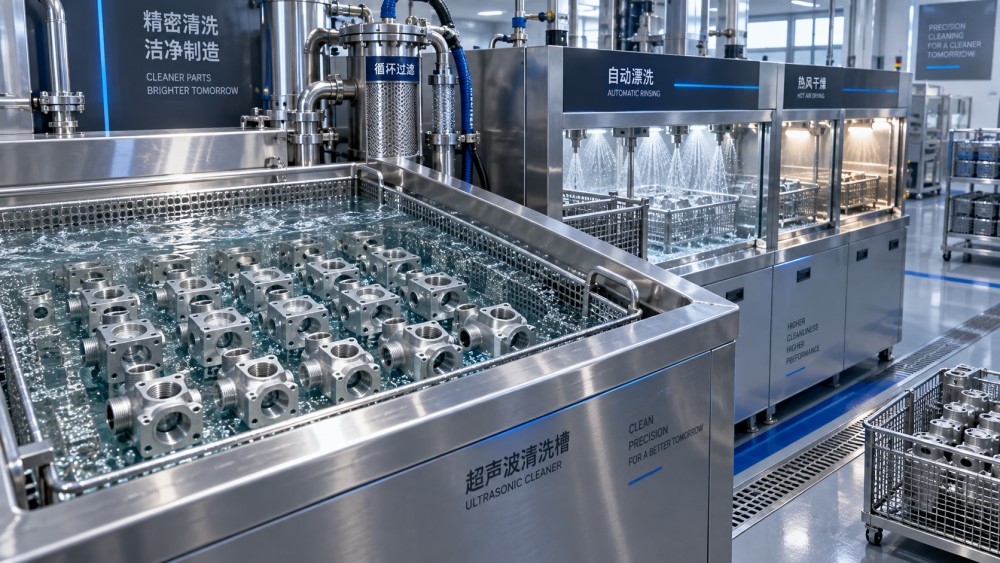
A well-considered line may include pre-cleaning or spray removal for heavy soils, ultrasonic washing, one or more rinse stages, controlled drying, and protected discharge. The exact sequence should follow the part and contamination profile. Heavy swarf and tramp oil may justify removing bulk contamination before the ultrasonic stage; otherwise, the ultrasonic bath becomes a costly first filter rather than a precision cleaning step.
Drying deserves special scrutiny for parts with deep features. Residual liquid can retain dissolved contamination and leave deposits when it evaporates. Vacuum drying, hot air, filtered air, or other approaches may be appropriate depending on geometry, material, water quality, and downstream sensitivity. The objective is not merely a dry-looking component but a component that does not carry residues into assembly, coating, marking, or packaging.
A Practical Evaluation Framework
When reviewing an ultrasonic cleaning proposal, start with the part rather than the machine. Define the materials, surface finishes, internal geometry, and allowable handling method. Then identify the incoming contamination by source: machining fluid, stamping lubricant, polishing compound, mold release, abrasive dust, oxidation, or assembly debris. If the origin is uncertain, it is worth investigating before committing to a cleaning chemistry or frequency.
The next step is to define what “clean” means at the actual decision point. Visual inspection may be enough for one non-critical component and entirely inadequate for another. Depending on the application, relevant checks may include particle extraction analysis, gravimetric residue measurement, surface-energy-related checks, corrosion observation after washing, microscopy, or a downstream functional test. The method should be repeatable and aligned with the failure mode being prevented.
During trials, test production-representative loading, not a few carefully spaced samples. Include difficult orientations and expected worst-case soils. Observe whether the process remains effective after the bath has accumulated a realistic contamination load. It is also sensible to examine the parts after storage if they are prone to flash rusting, water spotting, or recontamination from packaging materials.
For organizations comparing industrial auxiliary systems across cleaning, vacuum, marking, batching, and surface-treatment operations, the recurring principle is the same: process-support equipment is rarely secondary when it controls a final quality risk. A laser mark may be permanent, but it can be compromised by an unclean surface. A coating line may be well designed, but adhesion can fail because the pre-cleaning stage was evaluated only by appearance. Precision cleaning sits within that broader chain of traceability, surface condition, and manufacturing consistency.
The Right Question Is Whether Cavitation Is Controlled
The ultrasonic cavitation effect is powerful because it delivers cleaning energy where brushes and spray patterns cannot reliably reach. But it is not a universal cure for every residue or every geometry. Good results come from matching frequency, chemistry, temperature, loading, rinsing, filtration, and validation to a defined cleanliness requirement.
For technical evaluators, the most useful evidence is not a dramatic demonstration in a clean tank. It is a stable process that cleans representative parts at realistic throughput, protects the material surface, and proves cleanliness using a method that reflects the actual downstream risk. That is the point at which cavitation becomes a controlled manufacturing tool rather than an impressive laboratory effect.