
Yes, cavitation parts washing can remove oil from blind holes, deep threads, cross-drilled passages, and recessed features more effectively than spray-only or manual cleaning. But success depends on whether the cleaning liquid can enter the feature, exchange with the trapped contamination, and carry the released oil away. Ultrasonic cavitation improves the cleaning action inside confined geometry; it does not eliminate the need for suitable detergent chemistry, part positioning, rinsing, and verification.
For an operator facing oil residue in a blind hole, the useful question is not simply whether an ultrasonic tank is powerful enough. It is whether the complete process can break the oil film, displace contaminated liquid from the bottom of the hole, and leave no residue that will interfere with assembly, bonding, coating, sealing, or inspection.
Why blind holes are difficult to clean
A blind hole has one opening and a closed end. Once cutting fluid, rust preventive oil, honing oil, grease, or machining fines enter the cavity, the geometry works against cleaning. Spray impact weakens with depth. Brushes often cannot reach the bottom. Air blowing may remove loose liquid but can leave an oil film on the wall and at the hole base. Even immersion cleaning can fail when an air pocket prevents the solution from fully wetting the surface.
Oil removal becomes harder when the bore is narrow relative to its depth, when the opening faces upward, or when several intersecting passages trap liquid. Threads introduce another problem: contaminants sit behind the thread flank, where direct liquid movement is limited. A part may look clean externally while still carrying oil in a feature that later affects torque control, adhesive curing, leak performance, or corrosion resistance.
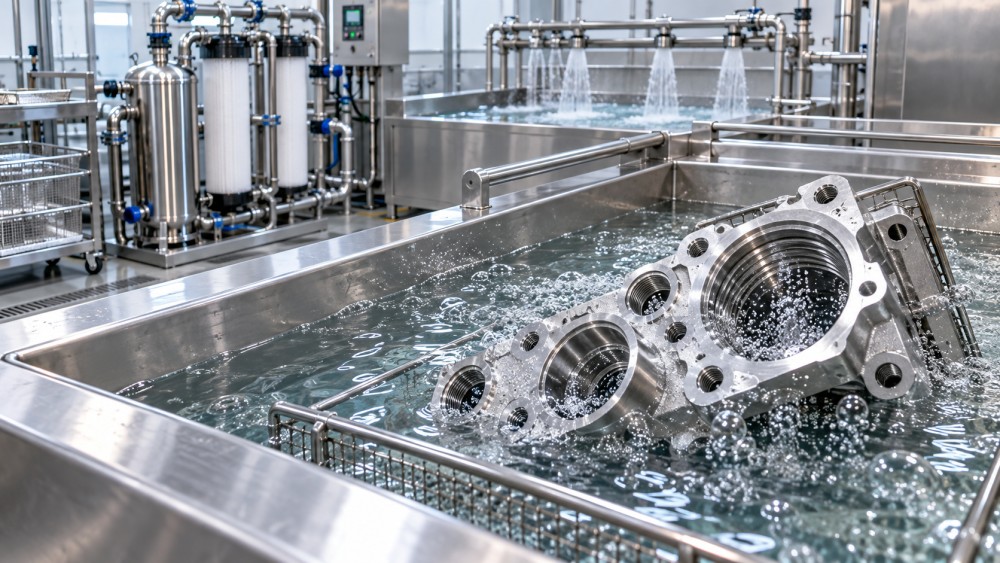
Ultrasonic cleaning addresses part of this problem by generating cavitation bubbles in the liquid. These microscopic bubbles form and collapse rapidly, producing localized agitation at wetted surfaces. That agitation helps disrupt oil films and dislodge contaminants from areas that are inaccessible to mechanical contact.
Cavitation reaches blind holes only when the liquid reaches them first
Cavitation parts washing is often described as a way to clean complex internal geometry. That description is broadly accurate, but it can lead to an unrealistic expectation: that ultrasound will somehow clean through an air lock or remove contamination from a cavity that the solution cannot properly enter.
Before cavitation can act on the bottom of a blind hole, the cleaning bath must wet the hole and displace air. If the part is loaded with the opening facing upward, air can remain trapped at the closed end. The ultrasonic field may agitate the liquid around the part while leaving a dry or partially wetted pocket inside the feature. In that condition, cleaning time can be extended substantially without solving the underlying access problem.
Part orientation is therefore an operating parameter, not a minor loading detail. Blind openings should usually be arranged so that air can escape and liquid can enter freely. Depending on the geometry, this may mean angling the part, orienting the opening downward or sideways, rotating the basket during the cycle, or using an immersion-and-drain sequence that improves solution exchange.
Features with very small openings or extreme depth-to-diameter ratios may need additional circulation or flushing. An ultrasonic tank can loosen oil in the bore, but a stagnant contaminated solution remains inside unless it can be displaced. Where residue requirements are demanding, a process that combines ultrasonic immersion with directed internal flushing, agitation, or multiple rinse stages is often more dependable than immersion alone.
The cleaning chemistry determines whether oil can be carried out
Ultrasonic energy assists removal; it is not a substitute for a compatible cleaning agent. Oil has to be emulsified, dispersed, saponified, or otherwise separated from the component surface so that it can leave the blind hole with the bath liquid. The correct chemistry depends on the oil type, the base material, downstream requirements, and the permitted process controls.
Water-based alkaline cleaners are commonly used for many ferrous and non-ferrous machined parts because they can break down machining oils and provide good detergency. Their concentration, temperature range, and material compatibility need to be controlled. An overly aggressive alkaline formulation may darken, etch, or stain sensitive metals. Aluminum alloys, zinc-containing materials, copper alloys, and parts with mixed-metal assemblies require particular attention.
For heavy oils or tacky corrosion inhibitors, a mild detergent concentration may remove surface residue while leaving an oily film deep in a bore. Raising the cleaner concentration without checking the supplier's operating range can create different problems, including foam, residue, accelerated chemical consumption, or difficult rinsing. The better approach is to match the chemistry to the contaminant and then confirm performance on representative parts.
Bath condition also matters. A fresh solution may clean blind holes effectively, while an overloaded bath can redeposit oil or reduce the ability of the chemistry to lift contamination. If the same process suddenly leaves residue at the bottom of holes, operators should inspect bath contamination, oil separation performance, filtration, concentration, and temperature before assuming the ultrasonic system has failed.
Frequency, power, and temperature need to fit the part
Lower ultrasonic frequencies generally produce more energetic cavitation and can be useful for robust machined components carrying tenacious oil or particulate contamination. Higher frequencies tend to provide gentler, more uniform cleaning and may be preferred for delicate surfaces, fine features, or parts where surface finish must be protected. There is no universal frequency that guarantees clean blind holes.
For many industrial parts, the practical choice is driven by the balance between cleaning force and part sensitivity. A hardened steel hydraulic component may tolerate a more aggressive process than a thin-walled precision part, polished component, coated item, or assembly containing soft metals. Blind holes also complicate the decision because the cleaning field inside a cavity can differ from the field around the outside surface.
Temperature influences both detergent performance and oil viscosity. Warming an aqueous cleaning bath often improves the ability of the solution to wet surfaces and release oils. However, temperature that is too low may leave viscous residue in narrow passages, while excessive temperature can increase evaporation, alter foam behavior, accelerate chemical degradation, or create handling concerns. The cleaning specification should define a working range rather than rely on an operator's visual estimate.
Cycle time should be treated in the same way. A longer ultrasonic cycle may help when parts are heavily soiled, but it cannot reliably correct poor wetting, trapped air, unsuitable chemistry, or inadequate rinsing. Excessive exposure can also be undesirable for some materials and finishes. The target is the shortest validated cycle that achieves the required cleanliness consistently.
Blind-hole cleaning is a process sequence, not one tank
A single ultrasonic wash tank can be sufficient for relatively light oil and noncritical applications. Where internal cleanliness affects function or downstream processing, the result usually depends on the full sequence:
- Pre-drain or pre-rinse to reduce free oil and loose chips before the main wash.
- Ultrasonic cleaning with the correct bath chemistry, temperature, loading pattern, and part orientation.
- Rinsing that actively exchanges liquid in blind holes rather than only washing the outside surface.
- Final rinse quality suited to the downstream process, especially before coating, bonding, precision assembly, or leak-sensitive service.
- Drying that removes retained rinse water without driving dissolved residue back onto the internal surface.
The rinse stage is frequently underestimated. After ultrasonic cleaning, the blind hole may contain a mixture of cleaning solution, loosened oil, and suspended particles. If that liquid is not displaced, the component can dry with residue at the bottom of the cavity. An apparently clean part can then fail a later process for reasons incorrectly attributed to the wash stage.
Drying direction also matters. Compressed air or hot air should have a path to move retained liquid out of the geometry. A blind hole loaded in the wrong position may hold rinse water until it evaporates. For parts with stringent cleanliness demands, vacuum-assisted drying or controlled draining can be useful where ordinary air drying leaves evidence of retained liquid.
How to tell whether the process is actually working
External appearance is a weak acceptance criterion for blind-hole cleaning. Oil residue may be invisible, particularly after a component has dried. Operators need a verification method that reflects the reason the part must be clean.
For some applications, a simple internal wipe or extraction check may reveal whether free oil remains. For threaded or larger holes, a clean swab can provide a practical comparative check during process setup. For smaller features, a controlled rinse extraction followed by analysis may be more meaningful than visual inspection. Assembly performance, coating adhesion, leak testing, particle inspection, or gravimetric residue checks may also be appropriate depending on the component's function.
The test should focus on the most difficult geometry, not the easiest visible surface. A validation part with the deepest hole, narrowest passage, most complex cross drilling, or heaviest expected contamination provides a more useful process challenge than a standard exterior sample.
Common operating mistakes
One common mistake is loading parts too densely. Closely packed components can shield each other from ultrasonic energy and restrict liquid movement around openings. Fixtures should hold the component securely while allowing wash and rinse liquid to enter and drain from internal features. A fixture that improves handling but blocks the blind holes can undermine the cleaning process.
Another is operating an ultrasonic bath without adequate degassing. Freshly made aqueous solutions contain dissolved gases that can dampen cavitation performance until they are released. If a process is evaluated immediately after filling the tank, the observed result may not represent normal operating conditions.
Operators should also avoid treating ultrasonic power settings as a direct cleanliness setting. More power can increase cleaning intensity, but it can also increase noise, heating, component movement, and the risk of damaging sensitive parts. A stable process comes from controlling the bath, load, orientation, wash duration, rinse performance, and drying method together.
Finally, do not assume that a clean blind hole will remain clean after washing. Dirty baskets, oil floating on the bath, poor transfer practices, contaminated drying equipment, or handling with unsuitable gloves can reintroduce contamination before the part reaches its next operation.
When ultrasonic cleaning alone may not be enough
Cavitation parts washing is well suited to many blind-hole oil removal tasks, particularly for machined metal components with accessible openings and compatible aqueous chemistry. It becomes less certain when the bore is exceptionally narrow, the cavity contains a trapped air volume, the oil has cured or carbonized, or the component includes materials that limit chemistry, temperature, or ultrasonic intensity.
Parts with internal passages that must meet strict functional cleanliness requirements may need a dedicated internal-flush process, pressure-assisted circulation, or a cleaning line designed around the component's flow path. The same is true when chips, abrasive debris, or polishing compound accompany the oil. Ultrasound may release the contamination, but the system still needs filtration and rinse capacity to prevent it from remaining in or returning to the part.
The practical conclusion is straightforward: ultrasonic cavitation can be highly effective for oil in blind holes, provided the process is built around liquid access and contaminant removal rather than ultrasonic exposure alone. Start with the hardest internal feature, orient the part to avoid air locks, use chemistry that can release the actual oil, and verify cleanliness where the residue would cause failure. That approach turns cavitation from a promising cleaning mechanism into a controlled production process.