
On July 1, 2026, a revised Appendix G to 21 CFR Part 113 took effect in the United States, raising calibration requirements for Cleanroom Ultrasonic equipment used in pre-cleaning for pharmaceutical and medical device applications. The change is worth close attention because it does not stay at the level of equipment specification alone; it reaches into import compliance, OEM labeling arrangements, audit readiness, documentation retention, and delivery planning for companies tied to the U.S. market.
What the revised rule now requires
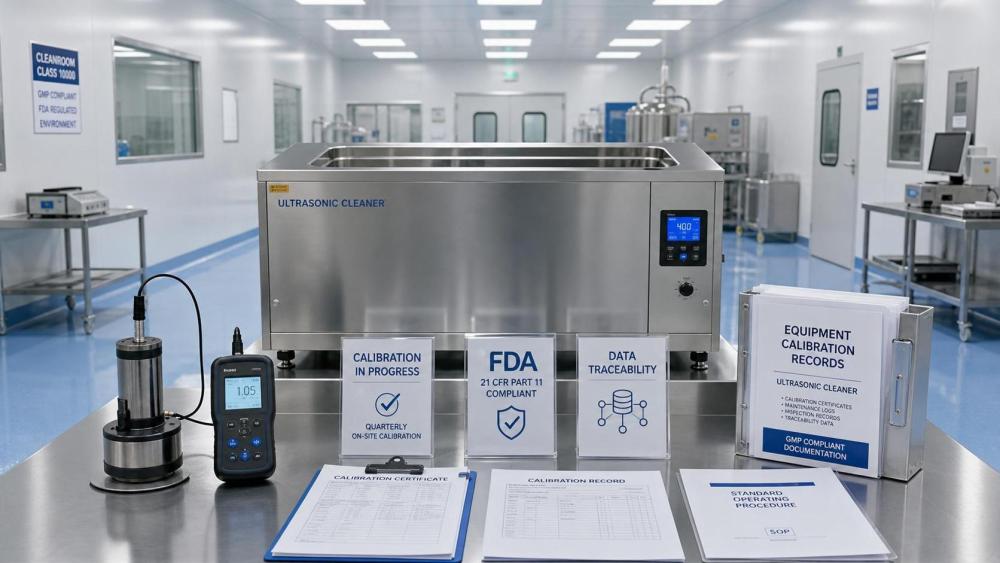
According to the information provided, the U.S. FDA has revised Appendix G to 21 CFR Part 113 with effect from July 1, 2026. Under the revised requirement, all Cleanroom Ultrasonic equipment used for pharmaceutical or medical device pre-cleaning must undergo on-site calibration every quarter by an ISO/IEC 17025 accredited laboratory.
The required calibration items are frequency stability, cavitation intensity distribution, and cleanliness decay rate. The rule also requires traceable raw data to be retained.
The new requirement applies to importers registered in the United States as well as OEM private-label parties. Equipment that does not meet the requirement may be refused entry into the U.S. or may lose eligibility for GMP audit participation.
Where the pressure is likely to appear first
Imported equipment and private-label supply arrangements
From an industry perspective, importers and OEM private-label participants are likely to face the earliest direct exposure because the rule expressly applies to them. The immediate business impact is not limited to technical acceptance of the equipment itself; it also extends to whether supporting calibration records and traceable raw data can be presented in a form that satisfies import and audit-related checks.
What deserves closer attention is the documentary side of delivery. Quarterly on-site calibration by an ISO/IEC 17025 accredited laboratory introduces a recurring compliance condition, which means equipment placement, turnover, and shipment timing may need to align more closely with calibration status and record availability.
Procurement and qualification decisions for regulated users
Purchasers serving pharmaceutical and medical device pre-cleaning environments may need to look beyond nominal equipment performance and focus more closely on whether the installed or supplied unit can support the required quarterly on-site calibration cycle. Analysis shows that supplier qualification, technical review, and acceptance documentation may all be affected where procurement teams must verify both calibration coverage and raw-data traceability.
This can also influence handover and commissioning discussions. If the equipment is intended for U.S.-linked regulated use, buyers may need to pay closer attention to how calibration responsibilities are allocated between seller, laboratory, importer, and end user.
Testing and compliance support functions
Testing service providers and compliance support teams may also see practical impact because the rule names ISO/IEC 17025 accredited laboratories as the required calibration body. Observably, this places greater weight on accredited field-capable calibration support and on document packages that can withstand inspection or audit review.
For supply chain service providers and after-sales support teams, the operational issue is less about abstract regulation and more about coordination: scheduling site access, avoiding gaps between quarterly cycles, and keeping traceable raw data linked to the relevant equipment and compliance file.
What companies should review now
Check whether current document sets match the new compliance threshold
Companies involved in U.S.-registered imports or OEM labeling should review whether existing equipment files include the type of calibration evidence now required. The key point is not only the presence of a certificate, but also whether traceable raw data is retained in a manner that can be produced when requested.
Revisit supplier and laboratory qualification pathways
Analysis shows that qualification work may need to cover two layers at once: the equipment supplier and the ISO/IEC 17025 accredited laboratory performing the on-site calibration. Where contracts or purchase terms are silent on recurring field calibration support, that gap may become commercially important.
Assess timing risk in delivery and audit preparation
Because the rule introduces a quarterly on-site requirement, companies should pay closer attention to timing across shipment, installation, use, and audit preparation. It is more appropriate to understand this as a compliance scheduling issue as much as a technical one, especially for businesses supporting regulated imports or GMP-facing operations.
Monitor how the requirement is reflected in commercial documents
What deserves closer attention is whether the new rule begins to appear more explicitly in purchase specifications, qualification checklists, import files, service agreements, and audit preparation documents. The input provided does not include detailed enforcement mechanics, so this remains a practical area for continued monitoring rather than a confirmed uniform market outcome.
Why this reads as an execution signal
Analysis shows that this development is more than a general policy statement because the requirement is already tied to an effective date, defined calibration frequency, named technical items, a specified laboratory qualification basis, and stated consequences for non-compliant equipment. That gives it the character of an execution signal rather than a purely directional policy discussion.
At the same time, it would be premature to treat all implementation details as settled. Observably, the industry still needs to watch how the requirement is interpreted in day-to-day compliance review, how documentation expectations are applied in practice, and how market participants adjust their procurement and service arrangements.
How the market is likely to read this change
The most balanced reading is that the revised FDA requirement marks a concrete tightening of compliance expectations around Cleanroom Ultrasonic equipment used in pharmaceutical and medical device pre-cleaning for the U.S. market. The immediate significance lies in calibration cadence, accredited on-site verification, and traceable raw-data retention, all of which can affect import handling, supplier qualification, and audit readiness.
Current conditions make it more appropriate to understand this as a rule that has already moved into the implementation stage, while the finer points of execution still merit observation. For companies exposed to U.S.-registered imports or OEM arrangements, the practical issue is not whether the rule matters, but where it first enters contracts, records, site procedures, and delivery planning.
Basis of this article and points still to verify
This article is based on the user-provided news title, event date, and event summary. For developments of this type, relevant source categories typically include official regulatory releases, notices from supervisory authorities, customs or trade administration information, industry association updates, standards-related documents, and reporting by established industry media.
A specific official source link was not provided in the input, so the exact official publication path still needs to be verified on an ongoing basis. Further observation is also needed on implementing details, certification and compliance interpretation, changes in tender or procurement documentation, industry feedback, and how affected companies carry the requirement into actual execution.