
Why does the industrial cleaning validation process matter so much?
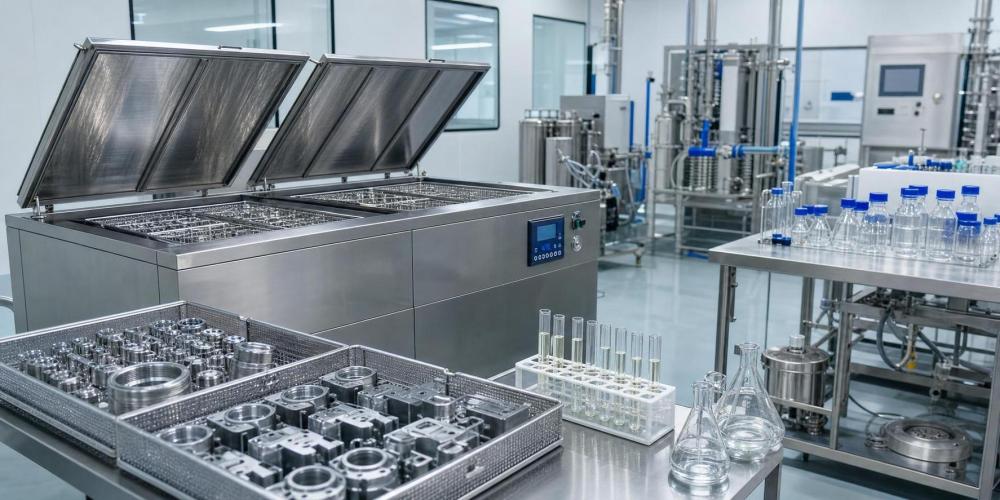
The industrial cleaning validation process is where cleaning performance stops being an assumption and becomes documented evidence.
That matters in precision manufacturing, where tiny residues can trigger coating defects, weak bonding, false weight readings, vacuum instability, or traceability failures later in production.
In practice, validation is not only about passing an audit. It protects yield, repeatability, and supplier credibility across sectors such as electronics, medical components, automotive parts, batteries, chemicals, and food processing equipment.
This is especially relevant for auxiliary systems. Ultrasonic cleaning, vacuum support, surface treatment, coding, and batching may sit outside the core machine, yet they strongly influence final quality.
A useful way to read the industrial cleaning validation process is this: can the line remove the right contamination, from the real part geometry, with stable results, under normal operating conditions?
If the answer is unclear, the risk is usually hidden rather than obvious. Parts may look clean, while ionic residue, oil film, particles, or detergent carryover remain.
What exactly should be validated, and when is visual cleanliness not enough?
Visual inspection is only the starting point. The industrial cleaning validation process should prove that cleaning removes residues which can affect function, adhesion, sterility, corrosion behavior, or downstream process control.
The target residue depends on the application. One line may focus on machining oil. Another may need to control particles, flux, polishing compound, carbon, salts, or detergent residue.
That is why validation begins with a contamination map, not with a test report. Teams need to identify:
- which soils are expected before cleaning
- which product surfaces are most difficult to clean
- which downstream process is most sensitive
- which failure mode creates the highest business risk
For example, a part entering electrostatic coating may fail because of oil or silicone traces. A vacuum component may fail because particles remain trapped in blind holes.
A laser-marked component may still have readable codes, but poor cleaning before marking can reduce contrast consistency and long-term identification reliability.
So the industrial cleaning validation process must connect cleanliness to functional risk, not just appearance.
How does a reliable industrial cleaning validation process usually run?
Most failures happen because validation starts too late or uses idealized lab conditions that do not match production.
A practical industrial cleaning validation process usually follows five linked steps.
1. Define the cleaning objective
State what must be removed, where it is located, and why the limit matters. This prevents broad but weak claims such as “clean enough for assembly.”
2. Set the worst-case boundary
Choose the hardest part family, the highest soil load, the longest holding time before cleaning, and the most difficult surface geometry.
3. Select the right test method
Common methods include gravimetric analysis, non-volatile residue testing, particle count, conductivity, TOC, swab recovery, rinse sampling, and surface energy checks.
4. Run repeated trials under production conditions
Water quality, bath age, load size, ultrasonic power distribution, drying performance, and operator handling all need to match actual operation.
5. Document control limits and reaction plans
Validation is incomplete if there is no response plan for bath contamination, failed samples, equipment drift, or recipe changes.
Where GIAS-style industry analysis becomes useful is in comparing auxiliary process dependencies. Cleaning often interacts with rinsing, drying, vacuum degassing, coating adhesion, and part identification quality.
What are realistic acceptance limits, and how should they be judged?
There is no universal acceptance limit that fits every industrial cleaning validation process. Limits should be tied to use, risk, material, and downstream sensitivity.
In real projects, limits are usually built from one or more sources:
- regulatory or customer specifications
- industry standards and internal quality rules
- functional testing results
- historical defect data and process capability
The key is to avoid arbitrary numbers. A very tight limit looks impressive, but it may create cost and delay without improving actual product performance.
The table below shows how acceptance logic is often judged in practice.
A strong industrial cleaning validation process also states when revalidation is required, especially after detergent changes, new materials, fixture redesign, or throughput increases.
Why do cleaning validation failures keep coming back?
Repeated failure rarely comes from one bad sample. More often, the industrial cleaning validation process missed a hidden variable.
The most common failure points include:
- test coupons that do not represent the real part
- insufficient worst-case definition
- poor rinse water control
- aging bath chemistry with no action limit
- ultrasonic dead zones or overloaded baskets
- handling contamination after cleaning
- sampling methods with weak recovery rates
Another common issue is treating validation as a one-time approval. In production, contamination profiles shift with supplier lots, machining fluids, storage time, and line balancing changes.
In advanced manufacturing, that shift can affect more than cleanliness. It can change coating appearance, weld integrity, batch consistency, vacuum behavior, or code readability across the line.
That is why failure analysis should trace both upstream and downstream signals, not only the cleaning machine itself.
How can implementation be planned without slowing the project down?
A workable industrial cleaning validation process does not need endless study, but it does need disciplined scope.
A practical rollout usually starts with a short decision list:
- identify the critical-to-clean surfaces
- rank contamination by functional risk
- agree on sampling and recovery method
- set alert limits before failure limits
- define who approves process changes
- link validation records to supplier and equipment changes
Cycle time depends on part complexity, soil type, analytical method, and the amount of line variation that must be covered. Simple programs may close in weeks. Complex ones take longer.
The better approach is to phase the work. Validate the highest-risk family first, then expand with shared rules for similar parts and similar cleaning chemistry.
When evaluating equipment or suppliers, review evidence from real process-support conditions. Cleaning, rinsing, drying, vacuum compatibility, and surface preparation should be judged as one system.
That broader view is often where specialized industrial intelligence becomes useful, because auxiliary process details are easy to overlook until a quality escape appears.
What should be done next if the current validation looks weak?
Start by checking whether the current industrial cleaning validation process reflects actual production conditions, not ideal trial settings.
Then review three points together: the contamination risk, the acceptance limit logic, and the line controls that keep results stable between tests.
If any one of those is missing, the program may pass on paper but fail in operation.
The most useful next step is usually a structured gap review. Compare the dirtiest real parts, the current test method, the limit basis, and the response plan for drift.
From there, refine the industrial cleaning validation process around measurable risk. That gives a clearer basis for equipment decisions, supplier comparison, and long-term process control.
In other words, better validation is not extra paperwork. It is a way to make cleaning performance visible before it turns into scrap, delay, or compliance trouble.