
On July 4, 2026, the U.S. Food and Drug Administration issued a technical update under 21 CFR Part 820 that brings validation requirements for cleanroom ultrasonic cleaning tanks used in environments at or above ISO Class 5 into a stricter compliance path. For manufacturers exporting pre-cleaning equipment for medical devices, pharmaceutical packaging components, and implants to the United States, this is not just a technical adjustment: it directly affects equipment qualification, export readiness, third-party verification status, and the risk of customs disruption after the new requirement takes effect on October 1, 2026.
What the FDA update explicitly changes
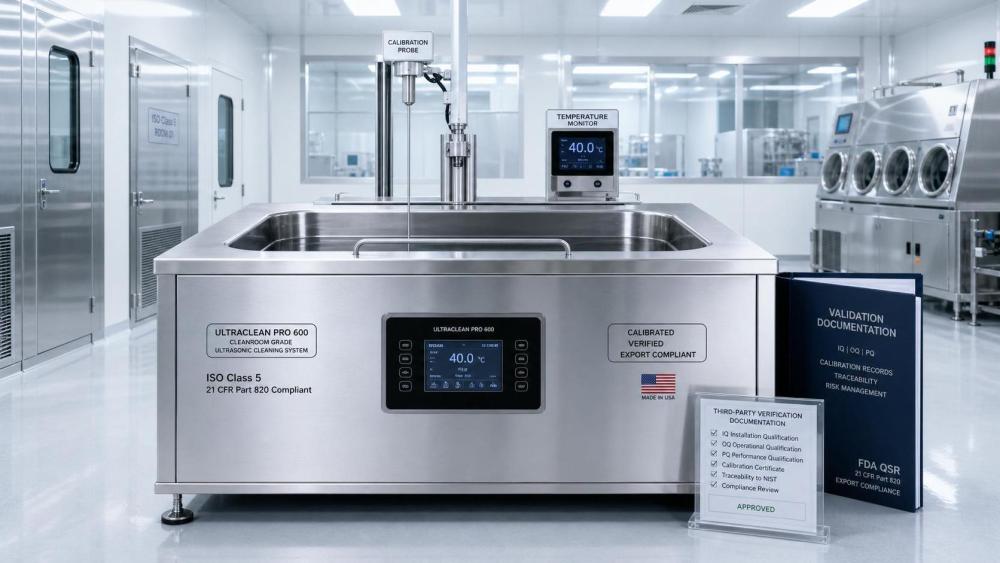
According to the provided event summary, the FDA released the Quality System Regulation (QSR) Technical Update Notice on July 4, 2026. The notice states that periodic power density calibration, cavitation uniformity verification, and temperature stability testing for cleanroom-grade ultrasonic cleaning tanks used in applications at or above ISO Class 5 are to be included within the mandatory validation requirements under 21 CFR Part 820.70.
The stated scope covers manufacturers that export pre-cleaning equipment for medical devices, pharmaceutical packaging components, and implants to the U.S. market. The implementation date provided is October 1, 2026. The summary also states that equipment without third-party verification may be refused entry or placed under import alert.
Where the pressure will appear across the supply chain
Export equipment makers face a narrower compliance margin
From an industry perspective, manufacturers shipping this category of equipment to the United States are the first group likely to feel the change. The immediate pressure point is not only product performance, but whether calibration and validation records align with the FDA's now-explicit requirement under Part 820.70. In practice, this shifts attention toward documentation readiness, third-party verification arrangements, and whether existing delivered or pending units can support U.S. import-facing compliance expectations.
Procurement and project teams may need to revisit technical specifications
For buyers and sourcing teams involved in medical device, pharmaceutical packaging, or implant-related cleaning processes, the update may affect how equipment is specified and accepted. Analysis shows that procurement documents, technical bid requirements, and supplier qualification reviews may need closer scrutiny where cleanroom ultrasonic systems are intended for ISO Class 5 or higher applications. What deserves closer attention is whether vendors can provide evidence tied to the three named validation items rather than relying on broader performance claims.
Testing and certification-related service providers may become a key checkpoint
The event summary specifically mentions the risk tied to the absence of third-party verification. That means verification bodies, calibration service providers, and related testing institutions may become more central in transaction flow, delivery planning, and compliance review. For companies moving equipment into the U.S. market, the commercial issue is not limited to testing itself; it also extends to whether the resulting reports and technical records are usable in export, customs, and quality system review contexts.
Delivery, import, and after-sales handling may carry higher execution risk
Observably, the change also reaches logistics and post-delivery stages. If equipment is not supported by the required verification status, the stated consequences include refusal of entry or import alert exposure. That creates potential knock-on effects for shipment timing, acceptance milestones, and service commitments tied to U.S.-bound orders. Exporters, distributors, and downstream service teams therefore need to pay closer attention to the compliance condition of each shipment before dispatch.
What companies should review before the rule takes effect
Check whether affected product lines fall within the stated application scope
Companies should first review whether any ultrasonic cleaning tanks they manufacture, source, or export are intended for cleanroom applications at or above ISO Class 5 and whether they are positioned as pre-cleaning equipment for medical devices, pharmaceutical packaging components, or implants. This is a practical scoping exercise, because the compliance burden begins with whether a product is actually inside the rule boundary described in the summary.
Prepare technical files around the three named validation items
Analysis shows that the most immediate documentation focus should be on periodic power density calibration, cavitation uniformity verification, and temperature stability testing. Even where companies already perform internal checks, the update raises the importance of how those activities are evidenced, organized, and connected to quality system validation records. For ongoing sales and deliveries, technical files, test reports, and equipment qualification materials may need review for consistency with the stated requirement.
Review third-party verification timing against shipment and installation schedules
Because the summary states that equipment without third-party verification may be denied entry or placed under import alert, companies should pay close attention to the sequencing between verification work and export execution. What deserves closer attention is not only whether verification is obtained, but whether it is available early enough to support customs, customer acceptance, and contractual delivery timing after October 1, 2026.
Track how the requirement appears in commercial and compliance documents
It is more appropriate to understand this as a rule change that may flow into multiple document layers rather than a standalone testing issue. Companies should therefore monitor how the requirement is reflected in supplier qualification forms, tender specifications, purchase orders, quality agreements, shipment files, and traceability records. Since the provided information does not include detailed enforcement mechanics, these points should be treated as areas for monitoring rather than assumed final practice.
Why this reads as an execution signal, not only a technical note
As an editorial observation, this update is better understood as a concrete compliance signal tied to market access rather than a routine restatement of quality expectations. The reason is that the provided summary links specific validation items to a mandatory path under 21 CFR Part 820.70, sets an effective date, identifies the affected exporter group, and points to import consequences where third-party verification is missing.
At the same time, observation also suggests that some practical questions remain open because the input does not provide detailed implementation language beyond the core requirement and consequence framework. For that reason, the market should continue watching for how certification interpretation, document expectations, procurement language, and enforcement practice develop around the rule.
How this update is best understood now
At this stage, the development is best read as an already-defined compliance change with near-term operational implications for U.S.-bound cleanroom ultrasonic cleaning equipment in the specified sectors. It does not yet justify broad conclusions beyond the provided facts, but it clearly raises the importance of validation evidence, third-party verification, and shipment readiness. A neutral reading is that the rule has moved beyond general quality signaling and into an execution-sensitive phase that companies should prepare for before the October 1, 2026 start date.
Basis of this article and what still needs verification
This article is based on the user-provided title, event date, and event summary. For developments of this kind, relevant source types commonly include official regulatory notices, releases from supervisory agencies, customs or trade-administration information, industry association updates, standard-setting documents, and reporting by authoritative trade media. No specific official source link was provided in the input, so the exact official link remains to be verified. Further monitoring is still needed for detailed implementation language, certification interpretation, tender document changes, industry feedback, and how companies execute against the new requirement in practice.