
Why is micron-level cleaning for medical devices getting so much attention?
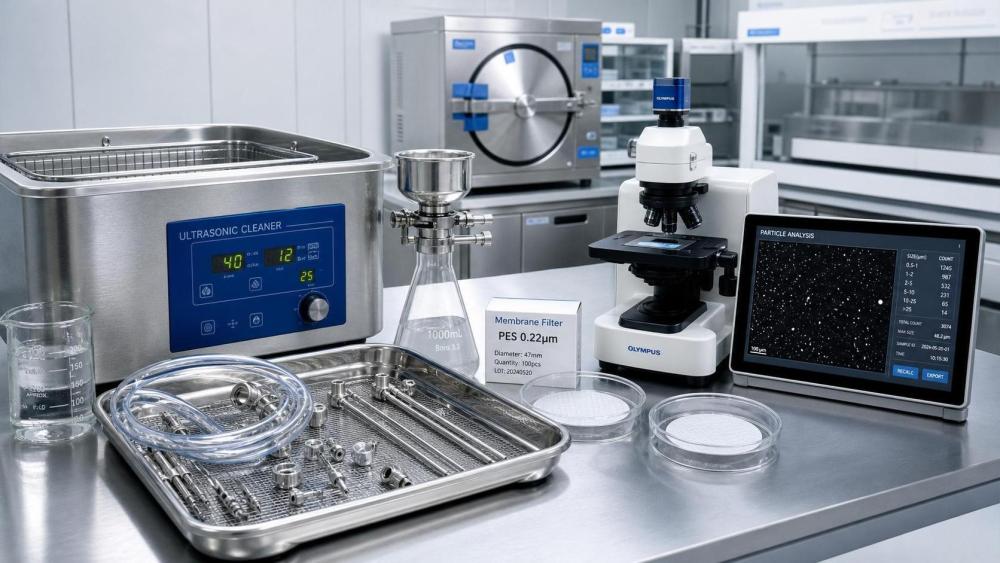
Micron-level cleaning for medical devices has moved from a quality preference to a compliance expectation. Tiny particles and invisible residues can affect safety, function, and product release decisions.
That shift matters because modern devices often include narrow lumens, textured surfaces, bonded assemblies, and precision polymers. These features trap contamination more easily than older, simpler components.
In practice, the question is rarely whether cleaning is needed. The real question is how to prove that particle and residue limits are consistently achieved.
This is where micron-level cleaning for medical devices connects with broader industrial process control. Cleaning systems, vacuum handling, traceability marking, and controlled surface treatment all influence final cleanliness.
Platforms such as GIAS often frame this well. They show that auxiliary systems may sit outside the spotlight, yet they strongly affect compliance, yield, and long-term manufacturing reliability.
For medical applications, the stakes are especially high. If a particle remains on an implantable part or ionic residue stays on a reusable instrument, the risk extends beyond aesthetics or scrap cost.
What does “clean enough” actually mean in a medical device environment?
Cleanliness is not a vague visual standard. It usually means meeting defined limits for particles, non-volatile residue, process chemicals, bioburden, or specific extractable contaminants.
A part can look spotless and still fail a cleanliness review. Residues from machining fluids, detergents, mold release agents, packaging dust, or human handling are often missed by visual inspection alone.
Micron-level cleaning for medical devices therefore depends on measurable criteria. Those criteria should be linked to product risk, intended use, material compatibility, and the next manufacturing step.
A catheter component, for example, may demand strict particulate control because loose matter could enter a fluid path. A surgical instrument may require stronger residue control because sterilization effectiveness can be affected.
The more reliable approach is to define cleanliness in a structured way before production scaling begins. That usually includes limit values, sampling rules, extraction methods, and pass-fail criteria.
A practical way to frame the limits
Different products require different evidence. The table below helps separate the most common questions that arise during micron-level cleaning for medical devices.
The important point is consistency. A limit is only useful when the test method can detect real variation in the process.
Which cleaning methods are usually chosen, and why do some fail validation?
There is no single best process for micron-level cleaning for medical devices. Method selection depends on part geometry, contaminant type, material sensitivity, and throughput targets.
Ultrasonic cleaning is widely used for precision metal and polymer components because it reaches complex features and removes fine debris effectively. It is especially relevant when particles sit in drilled holes, grooves, or mesh structures.
Aqueous cleaning works well when residues are water-soluble or when detergent chemistry can be validated without harming the substrate. Solvent-based processes may still be needed for oils or stubborn organic films.
Some failures come from the cleaning stage itself. More often, failure appears because rinsing, drying, fixture design, or handling control is weaker than expected.
A common example is this: the wash removes contamination, but the final rinse leaves dissolved solids behind. Another is clean parts contacting shedding trays or poorly controlled gloves.
In advanced manufacturing, auxiliary systems matter here. Vacuum drying, controlled transport, filtered air, and surface-compatible baskets can determine whether micron-level cleaning for medical devices remains stable after the wash tank.
When comparing process routes, focus on these points
- Can the method remove both particles and chemical residue, or only one of them?
- Does the chemistry interact with adhesives, coatings, polymers, or laser-marked surfaces?
- Is the final rinse quality monitored well enough to support release data?
- Can the drying step prevent water spots, recontamination, or trapped moisture?
- Will the process remain repeatable at production scale rather than only in pilot runs?
How do particle limits and residue limits get verified without creating false confidence?
Verification should challenge the process, not simply confirm ideal conditions. That means sampling worst-case geometries, maximum soil load, and realistic holding times between manufacturing and cleaning.
Micron-level cleaning for medical devices becomes credible when extraction methods are justified. If rinsing is too gentle, contaminants remain hidden and the data looks better than reality.
It also helps to separate three questions. Was contamination removed? Was contamination measured properly? Did the test environment introduce new contamination during analysis?
This is why many teams rely on blank controls, recovery studies, and repeatability checks. Without them, a pass result may reflect a weak method rather than a clean product.
Traceability supports the whole picture. Permanent coding, batch records, and equipment status logs help link a cleanliness outcome to a specific process condition, detergent lot, or maintenance event.
That broader discipline aligns with the GIAS view of manufacturing support systems. Cleaning precision, identification, vacuum stability, and process consistency are connected, not separate topics.
What should a useful validation package include?
- Documented contaminant profile from machining, molding, assembly, and packaging
- Defined acceptance criteria for particles and residues
- Justified extraction and analytical methods
- Worst-case product family selection
- Evidence for rinse quality, drying effectiveness, and equipment maintenance control
- Revalidation triggers after chemistry, tooling, material, or layout changes
Where do the biggest risks usually hide after a cleaning line is already installed?
The largest risks are often upstream or downstream. A stable washer cannot compensate for dirty incoming parts, unstable coolant carryover, or uncontrolled packaging materials.
Another weak point is delayed cleaning. If residue dries, oxidizes, or bonds to the surface, removal becomes harder and process windows shrink quickly.
Water quality is also underestimated. Micron-level cleaning for medical devices can fail because the rinse loop, filters, or tank turnover rate no longer match contamination load.
Then there is human handling. Clean parts placed on fiber-shedding wipes or touched during manual inspection can lose cleanliness in seconds.
The table below is useful for troubleshooting recurring failures that seem random at first.
How should implementation be judged when cost, speed, and compliance all matter?
The cheapest cleaning setup is rarely the lowest-cost option over time. Rework, delayed release, failed audits, and field risk can easily outweigh lower equipment or chemistry expense.
A better comparison looks at total process capability. That includes cycle time, water and chemistry control, maintenance demands, analytical burden, and changeover stability across product families.
Micron-level cleaning for medical devices should also be judged by how well it integrates with adjacent systems. Marking for traceability, vacuum drying, clean packaging transfer, and controlled storage all influence the final result.
In real programs, the faster route is often the one with clearer validation logic from the beginning. Teams lose time when they install a process first and define acceptance science later.
If the next step is process selection or improvement, start with a narrow checklist:
- List critical contaminants by source, not by guesswork.
- Match limits to product risk and functional surfaces.
- Confirm whether current testing can recover hidden contamination.
- Check post-clean handling before changing the washer.
- Build traceable process data that survives audits and transfers.
Micron-level cleaning for medical devices is ultimately a control strategy, not just a machine setting. When limits, methods, and supporting systems are aligned, cleaner devices and more defensible compliance outcomes usually follow.