
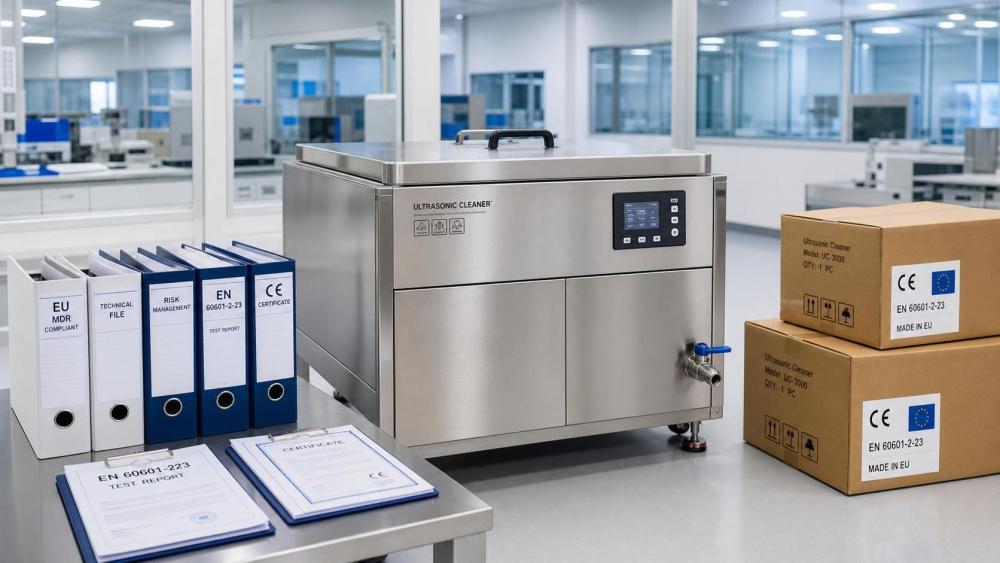
On July 1, 2026, a new EU market-access requirement takes effect for cleanroom ultrasonic cleaning equipment exported to the European market. Under Regulation (EU) 2026/1189, equipment used in scenarios such as medical device pre-processing and pre-cleaning before microelectronic packaging must comply with the EN 60601-2-23 safety standard for medical electrical equipment, and general industrial standards are no longer accepted as a substitute. For exporters, buyers, compliance teams, and delivery planners, this is not just a technical standard update; it directly affects certification paths, customs clearance, and shipment readiness.
What the new requirement clearly changes
The confirmed change is that the European Commission has formally issued Regulation (EU) 2026/1189, with effect from July 1, 2026. From that date, all cleanroom-grade ultrasonic cleaning equipment exported to the EU must meet EN 60601-2-23 if it falls within the described application scenarios, including medical device pre-processing and cleaning before microelectronic packaging. The previous practice of relying on general industrial standards as an alternative is no longer accepted. The summary provided also makes clear that products without the required certification may be detained by customs or refused customs clearance.
Where the pressure is likely to appear first
Export transactions face a narrower access path
From an industry perspective, exporters of cleanroom ultrasonic equipment are the first group directly affected because the rule changes the compliance basis for entry into the EU market. The immediate impact is likely to appear in pre-shipment review, document preparation, and customer acceptance conditions. What deserves closer attention is whether existing export models, especially those previously aligned with general industrial standards, can still move forward without additional certification work.
Procurement and project delivery may need earlier compliance checks
Buyers, project contractors, and sourcing teams may also be affected because equipment selection can no longer be separated from the EN 60601-2-23 requirement when the intended destination is the EU. In practice, this may influence supplier qualification review, bid specification alignment, and delivery scheduling. Observably, procurement teams will need to pay closer attention to whether certification status, technical files, and related supporting documents are ready before placing or confirming orders.
Certification and testing service providers may see a shift in demand
Analysis shows that certification-related firms and testing service providers may face a change in client demand, as exporters reassess products that were previously prepared under broader industrial compliance assumptions. The key business impact is likely to center on standard interpretation, test planning, and documentation support. Even so, the input does not provide detailed execution arrangements, so this should be understood as a practical area to monitor rather than a confirmed market outcome.
Supply chain and after-sales teams may need stronger traceability
Supply chain service providers and after-sales teams may also need to adjust because customs detention or refusal of clearance can interrupt delivery commitments and downstream installation plans. What deserves closer attention is the consistency between shipped configuration, declared application scenario, and certification documentation. Where equipment is tied to regulated end-use environments, document control and product traceability may become more important in cross-border fulfillment.
What companies should review now
Check whether current product classification and certification assumptions still hold
Analysis shows that companies should first review whether their cleanroom ultrasonic equipment exported to the EU falls within the affected application scenarios described in the provided summary. This matters because the rule no longer allows general industrial standards to stand in for the specified medical electrical safety standard.
Reassess technical documents and trade paperwork together
What deserves closer attention is the alignment between certification materials and export documents. Technical files, test reports, product descriptions, and customs-related documentation may need to present a consistent compliance basis. The input does not provide a detailed list of required documents, so this remains an area for careful verification rather than a settled checklist.
Build more time into procurement and delivery planning
Observably, companies involved in EU-bound shipments may need to review delivery schedules, customer commitments, and procurement timing with certification progress in mind. Where orders are already in negotiation or production planning, the practical question is whether compliance readiness matches the planned shipping window after July 1, 2026.
Watch for follow-up wording and execution practice
It is more appropriate to understand this as a rule change with immediate market-access implications, while also recognizing that companies still need to watch how certification interpretation and trade execution are applied in practice. Follow-up attention should remain on official wording, implementation signals, and any changes reflected in buyer specifications or tender documents.
Why this matters beyond a single standard update
Observably, this development is more than a routine standards revision because it changes the accepted compliance route for a defined category of exported equipment. Analysis shows that the most important signal is not simply that EN 60601-2-23 is named, but that the EU is no longer accepting a broader industrial-standard pathway for the affected products. That makes this closer to an execution-level market-entry condition than a distant policy discussion, although detailed enforcement practice still needs continued observation.
How this update is best understood for now
At this stage, the event is best understood as a confirmed compliance threshold for EU-bound cleanroom ultrasonic cleaning equipment rather than a general policy trend. The practical significance lies in certification readiness, document alignment, and shipment risk after July 1, 2026. A cautious reading is appropriate: the rule change is already defined in the provided summary, while its detailed implementation across procurement, customs handling, and market feedback still requires ongoing attention.
Basis of this article and what still needs verification
This article is generated based on the user-provided news title, event date, and event summary. For events of this kind, commonly relevant source types include official notices, regulatory publications, customs or trade authority information, industry association updates, standard-setting documents, and reporting by established media. No specific official source link was provided in the input, so the exact official link remains to be further verified. Follow-up observation is still needed on detailed implementation language, certification application practice, changes in tender or procurement documents, industry feedback, and how companies carry out compliance in actual export operations.