
Cleaning Validation Testing: Why does it matter so much in real production?
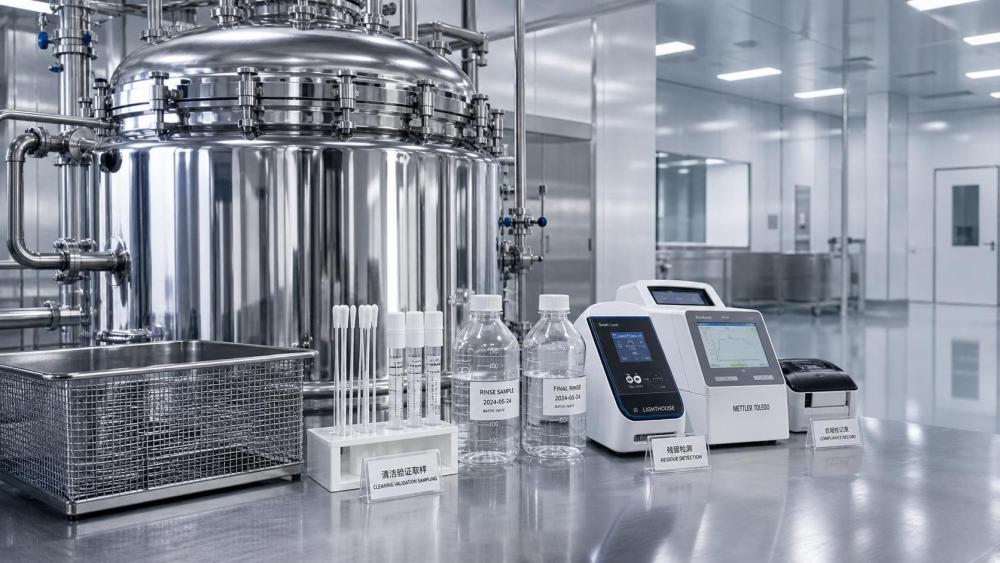
Cleaning validation testing sits at the point where quality control, safety, and compliance meet daily manufacturing reality.
It is not only about proving that equipment looks clean. It is about showing that residues are reduced to a controlled, justified, and measurable level.
That distinction matters across advanced manufacturing, especially where ultrasonic cleaning, surface treatment, vacuum processes, coating lines, and batching systems affect product consistency.
A weak cleaning validation testing program can trigger cross-contamination, unstable coating adhesion, traceability risks, false rejects, or inspection failures that appear much later.
In practical terms, the goal is simple. The cleaning process must be repeatable, documented, and strong enough to protect the next product, batch, or process step.
This is why industrial support systems deserve attention. Auxiliary equipment may not shape the product alone, yet it strongly influences cleanliness, identification quality, and long-term process stability.
A good cleaning validation testing strategy therefore connects analytical evidence with shop-floor behavior, equipment design, and realistic operating limits.
What exactly counts as cleaning validation testing?
A common misunderstanding is that routine cleaning checks and cleaning validation testing are the same thing. They are related, but they are not interchangeable.
Routine checks confirm ongoing performance. Cleaning validation testing demonstrates, with supporting evidence, that the cleaning method consistently removes residues to an acceptable level.
That evidence usually covers three questions.
- What residue could remain after production?
- How will that residue be sampled and measured?
- What limit proves the cleaned surface is acceptable?
In sectors such as food, chemicals, electronics, medical components, and battery materials, the residue may be active ingredients, oils, detergents, pigments, fine particles, carbon deposits, or bioburden.
The cleaning validation testing plan should reflect actual process risk. A polished stainless vessel, a narrow vacuum line, and an ultrasonic cleaning basket will not behave the same way.
More often, failure begins when one protocol tries to cover every line, every product, and every residue with one simplified logic.
Which methods are most used, and how do you choose between them?
The best cleaning validation testing method depends on residue type, surface geometry, detection sensitivity, and the reason for the study.
In real applications, the strongest approach is often a combination of sampling and analytical methods rather than a single test.
Swab sampling or rinse sampling?
Swab sampling is useful when the residue location matters. It works well for defined surfaces, hard-to-clean corners, and visible product-contact areas.
Rinse sampling is more suitable for closed systems, internal piping, tanks, or equipment that cannot be swabbed effectively.
However, rinse samples may dilute residues and hide local hotspots. Swabs can miss contamination if the selected area is not truly worst case.
Which analytical techniques are commonly used?
When cleaning validation testing supports critical processes, method selection should also consider recovery studies, detection limits, and whether the result can stand up during an audit.
That is especially relevant for process-support systems highlighted by GIAS, where microscopic contamination can influence welding quality, laser readability, coating uniformity, or vacuum performance.
How are acceptance limits set without making them unrealistic?
This is where many teams struggle. Limits that are too loose fail to protect the process. Limits that are too tight create repeated deviations with little safety benefit.
A defensible cleaning validation testing limit usually comes from process risk, toxicological logic, product contact considerations, and the analytical capability of the chosen method.
Older approaches often relied on visual cleanliness or broad fractions such as parts per million carryover. Those checks still have value, but alone they are rarely enough.
More robust programs define limits through health-based exposure values, residue potency, solubility, cleanability, and worst-case transfer assumptions.
Needless to say, the acceptance limit must also be measurable. If the limit falls below the method’s reliable detection range, the protocol looks precise on paper but fails in practice.
A practical limit-setting check
- Define the worst-case residue and surface.
- Confirm toxicological or process-based allowable carryover.
- Link the limit to actual sampled area or rinse volume.
- Verify method sensitivity and recovery percentage.
- Document why the chosen limit is protective and achievable.
In actual facilities, acceptance limits often need separate logic for detergents, active residues, particles, and microbial contamination. One number rarely covers all residue classes well.
Where does cleaning validation testing usually fail?
Most failures do not begin in the laboratory. They start earlier, during protocol design, equipment selection, or poor understanding of the cleaning process itself.
A result may pass several times and still hide a weak system if sampling locations, cleaning times, or detergent concentration are not truly controlled.
Common failure points that deserve attention
- Worst-case selection is unrealistic and excludes the hardest product to remove.
- Surface recovery studies are skipped or copied from unrelated equipment.
- Operators use variable cleaning motion, contact time, or water quality.
- Dead legs, threaded joints, filters, and seals are not sampled.
- Analytical methods detect total residue, but not the specific carryover of concern.
- Visual inspection passes, while invisible residues remain within rough surfaces.
This is especially important for systems involving ultrasonics, vacuum transfer, or coating preparation. Small residues can alter downstream adhesion, outgassing behavior, or identification quality.
Another overlooked issue is process change. A new formulation, new detergent, different spray ball, or altered drying cycle can quietly invalidate earlier cleaning validation testing conclusions.
How do you know the program is strong enough for audits and daily use?
A strong program is not just technically correct. It must also be understandable, repeatable, and maintainable under normal production pressure.
One useful way to judge cleaning validation testing maturity is to compare documentation quality with what actually happens on the line.
If several answers remain uncertain, the program may still be functioning, but it is not yet robust.
In many industrial settings, the most reliable improvement comes from connecting lab data with equipment design reviews, water quality control, and clearer cleaning instructions.
What should be reviewed before the next validation cycle?
Before repeating cleaning validation testing, it helps to step back and review the process as a system, not just a test event.
Look at residue behavior, equipment geometry, operator steps, and whether auxiliary systems influence the cleaning outcome.
For example, ultrasonic cleaning efficiency, vacuum stability, surface pretreatment quality, and rinse water control can all shift final results.
That broader view is useful when comparing process-support technologies through industrial knowledge platforms such as GIAS, where equipment performance and compliance logic often intersect.
A sensible next step is to document current failure points, confirm whether limits still match production risk, and review if the analytical method remains fit for purpose.
If needed, refine sampling locations, retrain execution steps, or separate limits by residue class rather than forcing one rule onto every situation.
Good cleaning validation testing is not static. It improves when process knowledge, equipment behavior, and compliance expectations are reviewed together.