
Why does ultrasonic cavitation technology cleaning matter in precision manufacturing?
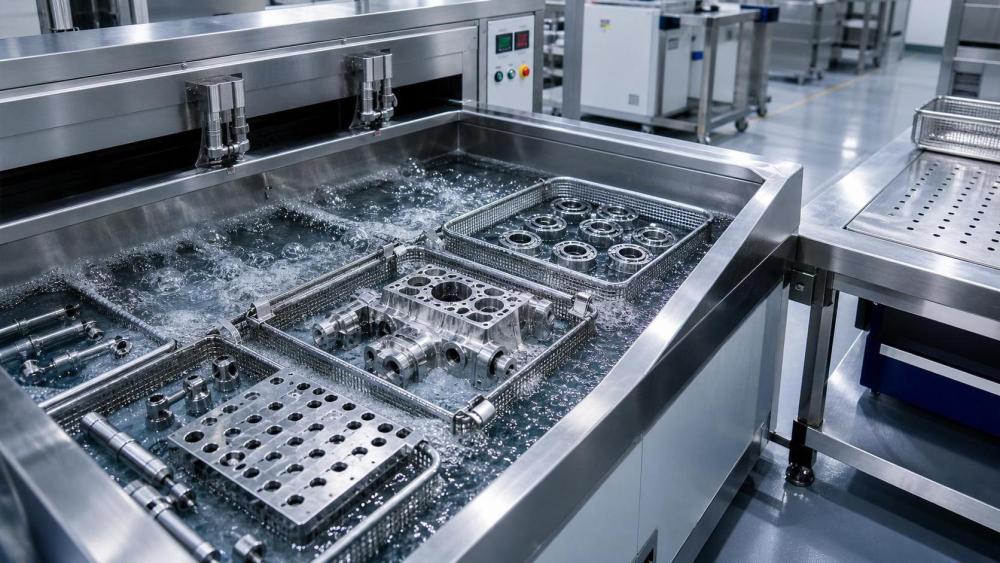
Ultrasonic cavitation technology cleaning matters because tiny contamination often creates outsized production problems.
A part may look clean to the eye, yet still hold oils, polishing paste, oxides, carbon dust, or microscopic metal fines.
Those residues can affect coating adhesion, weld quality, sealing performance, electrical contact, and traceability accuracy.
That is why industrial auxiliary systems receive so much attention on platforms such as GIAS.
They sit behind the main process, but they strongly influence final product consistency.
In simple terms, ultrasonic cavitation technology cleaning uses high-frequency sound waves in liquid.
These sound waves create microscopic bubbles that rapidly form and collapse near the part surface.
That collapse releases localized energy strong enough to dislodge fine contaminants from grooves, holes, and irregular shapes.
Unlike hand wiping or simple spray washing, the process reaches areas that are difficult to clean evenly.
For anyone comparing process-support technologies, this explains why ultrasonic systems are often chosen for precision cleaning tasks.
How does ultrasonic cavitation technology cleaning actually work?
The basic principle sounds simple, but the cleaning result depends on several interacting factors.
First, a generator sends electrical energy to transducers attached to the tank.
Those transducers convert electrical energy into high-frequency mechanical vibration inside the cleaning liquid.
As pressure rapidly rises and falls, countless microscopic bubbles appear and collapse.
That bubble action is the cavitation effect behind ultrasonic cavitation technology cleaning.
The liquid chemistry also matters.
Water alone may remove loose dust, but oils, waxes, oxides, and processing compounds often need a suitable detergent.
Temperature, frequency, power density, basket loading, and cleaning time also shape the final result.
Lower frequencies usually create more aggressive cavitation.
Higher frequencies tend to support finer, gentler cleaning on delicate surfaces.
In actual use, the process usually includes washing, rinsing, and drying rather than one tank alone.
That broader view is important because cleaning quality is rarely judged only at the wash stage.
Residue after rinsing or spotting after drying can still undermine downstream performance.
A quick way to read the process window
The table below gives a practical reference when evaluating ultrasonic cavitation technology cleaning.
Which parts benefit most from ultrasonic cavitation technology cleaning?
The best candidates usually share one feature.
They have complex geometry or cleanliness requirements that basic washing cannot handle reliably.
This includes precision machined components, medical device parts, molds, dies, nozzles, filters, valves, bearings, and small assemblies.
It is also common in electronics, automotive, aerospace, battery production, optics, and metal finishing support processes.
Parts with blind holes, threads, micro-channels, slots, and intricate internal passages often clean especially well.
These features tend to trap contamination that manual methods miss or spread around.
Another strong use case is pre-treatment before coating, marking, bonding, or assembly.
A surface may seem acceptable, yet poor pre-cleaning can still lead to coating defects or weak joint integrity.
In that sense, ultrasonic cavitation technology cleaning supports not only cleanliness, but process stability across adjacent operations.
- Metal parts after machining, stamping, grinding, or polishing
- Plastic components before welding or precision assembly
- Glass, ceramic, and optical parts with particle-sensitive surfaces
- Reusable tools and fixtures carrying carbonized or oxidized residues
- Small parts that need consistent cleaning in batch production
The technology is less ideal when parts are extremely soft, poorly supported, or damaged by the chosen chemistry.
That is why material compatibility always deserves a trial before scaling up.
Is it better than spray washing, soaking, or manual cleaning?
The better question is not whether it replaces everything.
It is whether ultrasonic cavitation technology cleaning solves contamination problems that other methods leave behind.
Manual cleaning can work for visible soil on simple surfaces.
Its weakness is repeatability, especially when hidden features are involved.
Spray washing often performs well for larger parts and line integration.
Still, spray impact may not fully reach deep recesses or microscopic surface textures.
Soaking can soften contamination, but it does not automatically create the same physical scrubbing effect as cavitation.
A practical comparison usually looks like this.
In many factories, the most effective answer is a combined process rather than a single method.
That aligns with the broader logic of industrial auxiliary systems covered by GIAS.
Cleaning, marking, weighing, vacuum control, and surface treatment usually work best as connected process decisions.
What should be checked before choosing an ultrasonic cleaning setup?
A common mistake is choosing by tank size alone.
A more reliable approach starts with contamination type, material sensitivity, throughput, and cleanliness target.
If the main residue is cutting oil, the chemistry decision may be straightforward.
If the issue involves oxide films, carbonized residues, or mixed contaminants, testing becomes more important.
It also helps to confirm what happens after cleaning.
A part headed for coating, laser marking, vacuum packaging, or adhesive bonding may require a tighter cleanliness window.
That downstream context often changes equipment selection more than people expect.
- Define the contamination, not just the part name
- Check material compatibility with chemistry and temperature
- Decide whether batch or inline flow suits production rhythm
- Confirm rinsing quality and drying requirements early
- Set a measurable cleanliness standard before comparing suppliers
Needle-like burrs, trapped air pockets, and overloaded baskets can reduce cleaning performance even with good equipment.
So can unrealistic cycle-time expectations.
When ultrasonic cavitation technology cleaning is evaluated with these details in mind, decisions become much more practical.
What are the most common misunderstandings and maintenance concerns?
One misunderstanding is that stronger cavitation always means better cleaning.
In reality, too much intensity can be unnecessary for delicate parts or fine finishes.
Another misconception is that ultrasonic cleaning eliminates the need for chemistry control.
It does not.
The liquid condition, contamination load, filtration, and rinse management all affect repeatability.
There is also the maintenance side.
Transducers, generators, heaters, baskets, and tanks need regular inspection.
A well-run system usually includes scheduled solution replacement, degassing checks, and performance verification.
If cleaning quality drifts, the cause is not always the machine itself.
It may be a change in incoming contamination, part mix, fixture arrangement, or water quality.
That broader diagnosis is essential in advanced manufacturing, where process-support systems interact closely.
Ultrasonic cavitation technology cleaning works best when treated as a controlled process, not a stand-alone tank.
So how should ultrasonic cavitation technology cleaning be evaluated next?
The clearest starting point is to map the part, the contamination, and the next process step together.
That reveals whether the real issue is visible dirt, microscopic residue, trapped particles, or surface preparation quality.
From there, compare frequency range, chemistry compatibility, rinsing quality, drying method, and validation standards.
This is where a research-driven platform such as GIAS becomes useful.
It places ultrasonic cleaning beside related auxiliary technologies that also shape product quality and manufacturing consistency.
If the goal is better process control, ultrasonic cavitation technology cleaning should be judged by downstream results, not by cleaning action alone.
A sensible next step is to define a small test matrix.
Include part material, contamination type, target cleanliness, cycle time, and acceptable maintenance limits.
That makes comparisons more meaningful and reduces the risk of choosing a process that looks good on paper but struggles in production.