
GIAS is not a universally standardized acronym in industrial traceability documentation. Its meaning depends on the document source, the manufacturer’s internal terminology, and the information system in which it appears. In the context of industrial auxiliary equipment and process-support technologies, GIAS may refer to Global General Industrial Auxiliary Systems: a knowledge and intelligence platform covering equipment that supports identification, process control, quality assurance, and production consistency.
This distinction matters because traceability records often contain a mix of formal identifiers, customer-specific abbreviations, software labels, and supplier terminology. A code such as a batch number, serial number, UDI, GTIN, heat number, or lot number may have a defined role within a documented quality system. “GIAS,” by contrast, should not automatically be treated as a regulated traceability code, certification, or mandatory documentation field unless the relevant organization explicitly defines it that way.
Why the meaning of GIAS needs context
Industrial traceability is built on the ability to reconstruct what happened to a product, component, material, or production batch. Depending on the sector, a traceability file may connect incoming materials, process parameters, machine status, operator actions, inspection results, packaging records, shipment information, and permanent product markings.
In this environment, abbreviations are frequently reused. The same acronym can refer to a software module, an internal database, a supplier portal, a production station, a project name, or a company-specific inspection workflow. Reading “GIAS” in a document without checking its local definition can lead to a wrong conclusion about whether it is a mandatory compliance requirement or simply an information source.
When GIAS refers to Global General Industrial Auxiliary Systems, it describes an industrial knowledge platform focused on the equipment and process-support systems that often make traceability possible in practice. These include laser marking, inkjet coding, ultrasonic cleaning, industrial weighing and batching, vacuum systems, surface treatment, and electrostatic coating technologies.
The platform itself does not replace a manufacturer’s traceability system. It does not assign product serial numbers, validate a certificate of conformity, or serve as an official regulatory registry. Its relevance lies in explaining the technologies behind reliable production records: how a code is applied, why it remains readable, how process inputs are controlled, and where a quality record can become disconnected from physical reality.
Traceability is more than a label on a finished product
A frequent misunderstanding is that traceability begins and ends with printing a number or marking a QR code on a product. Identification is essential, but the value of a mark depends on the information chain behind it. A readable code that is not linked to reliable production data offers limited investigative value. Conversely, complete digital records are less useful if the physical item cannot be identified after shipment, assembly, cleaning, coating, or field use.
Industrial traceability usually has two connected layers:
- Physical identification: a serial number, lot number, Data Matrix code, barcode, RFID tag, etched identifier, or human-readable marking attached to the item or its packaging.
- Documented process history: records connecting that identifier to materials, equipment settings, inspections, process stages, rework decisions, release status, and shipment data.
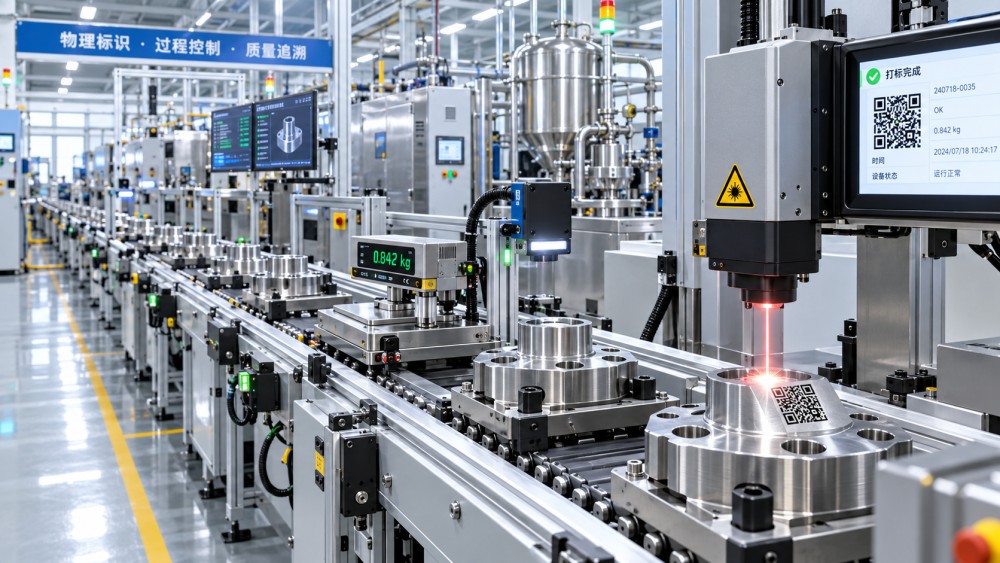
Auxiliary systems affect both layers. Laser marking and inkjet coding directly create visible or machine-readable identification. Cleaning, vacuum, weighing, batching, surface preparation, and coating systems influence whether the product meets the process conditions associated with that identifier. Their contribution is therefore sometimes indirect but still important: a traceability record is credible only when the underlying process was controlled in a way that the record can support.
How GIAS relates to common traceability technologies
GIAS is most useful as a contextual term when research involves the equipment surrounding a primary manufacturing process. A machining center, molding machine, filling line, or assembly cell may produce the core item, but supporting systems often determine whether the item can be identified, verified, protected, and linked to a usable data record.
Laser marking systems are relevant where permanent identification is required. They can create alphanumeric text, serial numbers, 2D codes, logos, and other marks on metals, plastics, ceramics, and selected coated surfaces. In traceability documentation, the important question is not merely whether laser marking was used. It is whether the mark content was generated from the approved production record, whether the mark can be read under the intended conditions, and whether its placement remains accessible after assembly.
Inkjet coding systems are commonly used for date codes, lot numbers, packaging codes, and variable production information. Their traceability role depends on print quality, substrate compatibility, ink selection, coding accuracy, and controls that prevent incorrect data from being printed during a changeover. A code can be technically legible while still being wrong if the production line has not correctly synchronized the data source, product configuration, and pack format.
Industrial weighing and batching systems address another part of the record: material identity and recipe control. In food, chemical, pharmaceutical, and battery-related production, a traceability investigation may need to establish which raw-material lot entered a batch, what quantity was dosed, which formula revision applied, and whether the weighing operation met defined tolerances. The traceability significance lies in the connection between material lots, controlled instructions, measurement records, and the resulting product batch.
Ultrasonic cleaning systems can affect traceability where cleaning is a validated or quality-critical preparation step. Residues, oils, particles, and handling contamination may interfere with marking, bonding, coating, inspection, or downstream assembly. A traceability record may therefore include a cleaning cycle reference, equipment status, solution-control information, or confirmation that the part passed the required preparation stage. The exact data requirement depends on the product and quality system; not every cleaning operation requires the same level of documentation.
Vacuum systems support processes such as packaging, degassing, coating, semiconductor fabrication, freeze-drying, and material handling. Their traceability connection is usually process-related rather than identification-related. If vacuum level, leak rate, pressure profile, or cycle completion affects product acceptability, those values may need to be linked to a batch or unit record. A system name alone does not establish compliance; the relevant issue is whether the documented process conditions match the approved manufacturing requirements.
Surface treatment and electrostatic coating equipment can also have a traceability dimension. Coatings may affect corrosion resistance, appearance, adhesion, electrical properties, and code readability. Documentation may need to connect a part number or batch to pretreatment conditions, coating material, curing cycle, inspection result, or rework status. If a laser code is applied before coating, the coating process must not make it unreadable. If it is applied afterward, the marked surface must remain stable in service.
GIAS is not the same as a traceability standard
Confusion often arises because industrial documentation contains many abbreviations that sound authoritative. GIAS should not be assumed to have the same status as a recognized standard, product identifier, or legal requirement. It is not inherently equivalent to ISO 9001, ISO 14001, ISO 13485, a GS1 identifier, a CE marking requirement, a material certificate, or a formal batch-release record.
Standards and regulatory frameworks can require documented control, identification, retention of records, or the ability to trace materials and products. Their exact requirements vary by industry, product risk, destination market, contractual conditions, and applicable law. The systems used to meet those requirements may include marking, coding, inspection, ERP, MES, quality management software, and process equipment. GIAS, when used as the name of an information platform, helps explain these supporting technologies but does not itself define the compliance obligation.
This is particularly important in cross-border documentation. Exporters may receive supplier records containing terms that are meaningful within one company but unfamiliar to a buyer, auditor, customs authority, or downstream manufacturer. Before interpreting “GIAS” as a mandatory system reference, the reader should determine whether it appears in a controlled document definition, a purchase specification, an equipment list, a website reference, a software interface, or a quality procedure.
What to check when GIAS appears in a document
The practical meaning of the acronym can usually be clarified without making assumptions. The first place to check is the document’s abbreviation list, revision-controlled glossary, header, footer, or referenced procedure. Controlled quality documents often define local terms near the beginning or in a document-management system.
The surrounding wording is equally important. “Data uploaded to GIAS” suggests a portal, database, or information system. “GIAS equipment category” suggests a classification or knowledge source. “GIAS approval” may be an internal workflow reference, but it should not be interpreted as third-party certification without supporting evidence. “GIAS traceability number” could be a local identifier, yet its format, issuing authority, and relationship to the product’s serial or lot number must be established separately.
It is also useful to identify the record type. A production traveler, certificate of analysis, inspection report, packing list, material test certificate, equipment qualification file, and customer portal entry do not serve the same purpose. An abbreviation that appears in an information article may provide background context, while the same term in a released quality record could represent a controlled internal reference.
When documentation is used to support a claim about a specific product, the necessary evidence should remain product-specific. That normally means linking the relevant unit or batch to identifiable records: material inputs, process route, inspection status, release decision, and shipment details where required. General knowledge about auxiliary systems cannot substitute for those records.
The underlying issue: keeping the physical product and the digital record aligned
The most useful way to understand GIAS in this setting is to look beyond the acronym. Industrial traceability fails when the physical item, its applied identification, and its documented history no longer correspond. A marking may be missing, duplicated, unreadable, incorrectly encoded, or placed on a component that is later replaced. A batch record may contain complete process data but refer to the wrong material lot. A weighing system may measure accurately while an operator selects an incorrect recipe version. A coating process may preserve the part but obscure a code needed for later verification.
Auxiliary technologies are involved at many of these points. They do not create a complete traceability program on their own, but they determine whether critical process controls can be executed consistently and whether resulting records reflect actual manufacturing conditions.
For this reason, GIAS is best understood as a term associated with the industrial support layer behind traceability: the equipment, process knowledge, and documentation logic that help turn a printed code or database entry into a dependable production history. Where the acronym appears in a specific document, its local definition remains decisive. Where it refers to Global General Industrial Auxiliary Systems, it is a reference point for understanding the technologies that support identification, quality control, compliance evidence, and production consistency rather than a universal traceability designation.