
Freeze drying technology pharmaceutical production depends on has become a strategic process rather than a niche preservation method. In drug manufacturing, lyophilization protects heat-sensitive ingredients, supports longer shelf life, and helps maintain dosage stability during storage and transport.
That matters even more as biologics, injectable therapies, and complex formulations move through global supply chains. In practical terms, freeze drying is not only about drying a product. It is about controlling water removal, vacuum stability, contamination risk, and batch consistency.
For a platform like GIAS, this topic sits naturally within the wider world of industrial auxiliary systems. Vacuum pumps, weighing accuracy, traceability tools, and clean process support all influence whether a freeze-dried pharmaceutical product performs as intended.
Why freeze drying remains important in pharmaceutical manufacturing
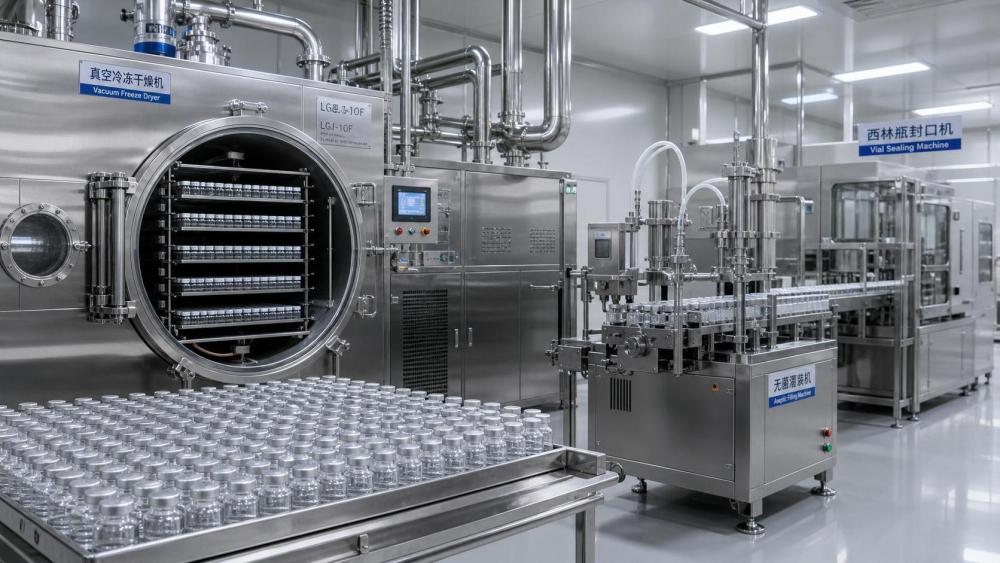
The core idea is simple. Water is removed from a frozen product by sublimation under low pressure. Ice turns directly into vapor, avoiding the liquid phase that can damage fragile drug structures.
This makes freeze drying technology pharmaceutical producers use especially valuable for proteins, vaccines, peptides, antibiotics, and sterile injectables. Many of these products degrade quickly when exposed to heat or excess moisture.
The process also supports logistics. A properly lyophilized product can become easier to store, lighter to transport, and more stable across international distribution channels. Reconstitution before use then restores the intended dosage form.
In today’s market, this is tied to more than shelf life. It also affects regulatory confidence, waste reduction, production planning, and the ability to supply sensitive therapies across regions with different cold-chain capabilities.
The process steps that define lyophilization performance
Although equipment design varies, the process follows a disciplined sequence. Each step shapes cake structure, residual moisture, reconstitution time, and final batch acceptability.
Formulation and filling
Performance begins before freezing. Formulation chemistry determines collapse temperature, glass transition behavior, and how the dried cake will appear after the cycle ends.
Accurate filling matters just as much. If vial volumes vary, heat transfer and drying rates vary too. This is where weighing and batching systems become part of freeze drying technology pharmaceutical operations, not a separate issue.
Freezing
The product is cooled until the water solidifies. Freezing rate changes crystal size. Large ice crystals can improve vapor flow during drying, while uncontrolled freezing may create structural inconsistency across the shelf.
Some processes use annealing to improve crystal uniformity. That extra hold step can strengthen cycle robustness, especially for formulations prone to variability.
Primary drying
This is the longest and most energy-intensive phase. Chamber pressure is reduced, shelf heat is applied carefully, and frozen water sublimes from the product matrix.
The main limit is temperature control. If product temperature rises above its collapse threshold, the structure can deform. That can affect appearance, moisture retention, and reconstitution performance.
Secondary drying
After visible ice is removed, bound moisture remains. Secondary drying raises product temperature in a controlled way to reduce residual water to the target level.
This step is often underestimated. Residual moisture that is too high may reduce stability. Too low may affect product structure or increase processing cost without practical gain.
Stoppering and sealing
Once drying is complete, sterile stoppering under controlled conditions protects the product from moisture uptake. Traceability then becomes essential through coding, labeling, and batch documentation.
Where the real limits appear
Freeze drying is effective, but it is not unlimited. The practical limits usually come from formulation sensitivity, cycle duration, equipment capacity, and the economics of high-quality vacuum control.
A common misconception is that any liquid drug can be lyophilized successfully. In reality, some formulations become unstable during freezing. Others resist efficient sublimation or suffer from poor cake structure after drying.
Another limit is time. A production cycle may run for many hours or even several days. That constrains throughput, raises utility demand, and increases exposure to deviation risk.
Vacuum performance is another boundary condition. Freeze drying technology pharmaceutical plants use depends on reliable chamber pressure, condenser efficiency, and pump stability. Weak vacuum control can extend cycles or compromise endpoint accuracy.
There is also a scale-up challenge. A cycle that works in development does not always translate smoothly to commercial shelves. Heat transfer, load density, and edge-vial effects become more difficult at larger scale.
Auxiliary systems behind a stable freeze-drying line
Lyophilization chambers get most of the attention, yet surrounding systems often determine whether the process stays under control. This is where the broader GIAS perspective becomes useful.
Vacuum pumps and vacuum systems are the most obvious example. Their job is not only to create low pressure. They must hold it consistently, respond to moisture load, and support clean, repeatable operation over long cycles.
Industrial weighing and batching matter earlier in the chain. Precise formulation and fill volume control reduce vial-to-vial variability, which directly improves drying uniformity.
Cleaning quality also matters. Components exposed to sterile product paths need validated cleanliness. In some production environments, precision cleaning systems support the contamination-control strategy behind reliable freeze drying technology pharmaceutical manufacturing.
After drying, coding and marking systems support traceability. Batch identity, anti-counterfeiting measures, and export readiness all depend on durable and accurate product identification.
How to judge process suitability in real projects
A useful assessment starts with the product, not the machine. If the formulation loses activity with heat, moisture, or liquid-phase stress, lyophilization may offer clear value. If the product is already stable in liquid form, the cost case may be weaker.
The next question is whether process limits are understood early. That means knowing critical temperatures, target residual moisture, expected cycle duration, and acceptable appearance standards.
- Check whether formulation data includes collapse or glass transition behavior.
- Review vacuum system capability under full production moisture load.
- Compare lab-scale cycle assumptions with commercial shelf conditions.
- Confirm cleaning, stoppering, and traceability controls around the process.
- Treat cycle optimization as a cross-functional process issue, not only an equipment setting.
This broader view helps explain why freeze drying technology pharmaceutical decision-making often extends beyond the lyophilizer vendor. Supporting systems influence cost, compliance, and repeatability across the entire operation.
What deserves closer attention next
The strongest evaluations usually move from general interest to parameter-based comparison. Instead of asking whether freeze drying is beneficial in theory, it is more useful to compare process windows, vacuum architecture, batch scale, and product sensitivity.
That approach fits the logic of advanced manufacturing intelligence. In the same way that coating quality depends on surface preparation, freeze drying performance depends on supporting process control that is easy to overlook.
For anyone reviewing freeze drying technology pharmaceutical options, the next step is to map the product’s stability profile against equipment capability and auxiliary system reliability. From there, it becomes easier to compare suppliers, define validation priorities, and build a more realistic production strategy.