
Choosing industrial vacuum level control for packaging applications is less about chasing the deepest vacuum and more about matching control stability to the product, film, and line rhythm. In practical production, vacuum performance influences seal appearance, pack protection, shelf life, and rework rates. That is why industrial vacuum level control packaging has become a critical topic across food, medical, electronics, chemical, and precision component operations.
Why vacuum level control matters on a packaging line
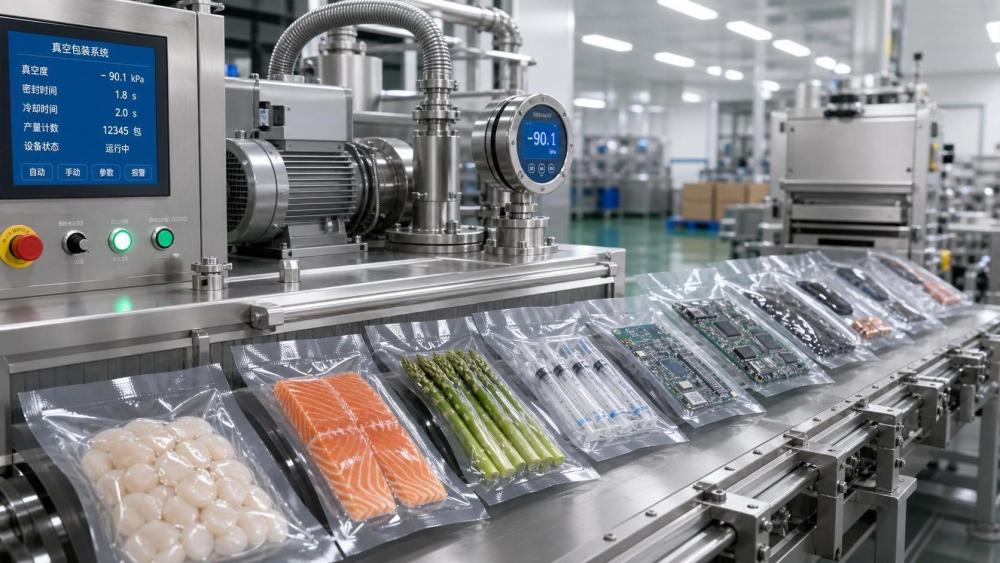
Vacuum packaging is not only a chamber function. It is a process-control issue tied to pump performance, sensor accuracy, response speed, and repeatability.
When vacuum levels drift, the first signs often appear in subtle ways. Seal deformation, trapped air pockets, inconsistent product positioning, and longer cycle times usually show up before major failure.
In high-throughput plants, those small shifts affect waste, downtime, traceability, and customer confidence. For this reason, industrial vacuum level control packaging should be evaluated as part of the broader auxiliary system, not as an isolated machine setting.
This is also consistent with the way GIAS approaches industrial support technologies. Final product quality often depends on stable auxiliary control, whether the process involves coding, weighing, cleaning, coating, or vacuum management.
What “vacuum level control” really means
At a basic level, vacuum level control is the ability to reach a target vacuum, hold it within a useful tolerance, and repeat that performance over many cycles.
That sounds simple, but packaging environments make it more complex. Product moisture, dust, film permeability, chamber volume, and line speed all influence the result.
A strong system does three things well. It evacuates efficiently, measures accurately, and reacts consistently when conditions change.
Core control elements
- Vacuum pump capacity matched to chamber size and cycle demand
- Sensors or transducers with reliable reading stability
- Control logic that adjusts for leaks, load variation, and product changes
- Valves and seals that prevent pressure drift during the hold stage
- Interfaces that allow practical setpoint adjustment and alarm review
In other words, industrial vacuum level control packaging is a combination of hardware, calibration, and operational discipline.
The industry is paying closer attention for good reasons
Packaging standards are rising across sectors. Products now travel farther, face stricter compliance checks, and carry more traceability expectations than before.
That creates pressure to maintain consistent pack quality, especially where oxygen exposure, contamination risk, or moisture sensitivity matter.
Several trends explain why vacuum control gets more scrutiny today.
- Faster packaging lines leave less room for manual correction
- Thinner films and sustainable materials can be less forgiving
- Export packaging often needs better consistency during transport
- Digital quality systems require measurable, repeatable process data
- Downtime costs have become more visible in total line economics
This makes industrial vacuum level control packaging a quality issue as much as a utility issue. A vacuum setting is no longer just an operator preference. It is part of process assurance.
How application type changes the right control approach
Not every package needs the same vacuum strategy. The right choice depends on what is being packed, how fragile it is, and how the package behaves under pressure change.
A delicate product may need softer evacuation control. A high-speed line may need faster closed-loop correction. A dusty environment may need stronger protection for sensors and pumps.
That is why industrial vacuum level control packaging decisions should start with the application, not the catalog headline.
Key selection points that make a real difference
In actual use, a few technical details shape daily performance more than broad specifications do. These are usually the areas worth reviewing first.
Setpoint accuracy and repeatability
A system should reach the intended vacuum reliably across shifts, product batches, and ambient changes. One accurate cycle is not enough. Repeatability is the true benchmark.
Response time under production load
Control performance at low throughput may look acceptable, then become unstable at full speed. It is important to check evacuation time, hold time, and recovery time under realistic line conditions.
Sensor durability and calibration needs
Packaging areas can expose components to washdown, fine particles, oil mist, or temperature shifts. Sensors should stay readable and easy to calibrate without frequent interruption.
Control interface and alarm visibility
A good interface shortens adjustment time. Clear alarms help identify whether a problem comes from leakage, pump wear, valve sticking, or an incorrect recipe setting.
Compatibility with broader line systems
Vacuum control should fit with sealing, coding, weighing, inspection, and traceability systems. This matters when quality data must move across the line without manual gaps.
That integrated view is increasingly important in advanced manufacturing, where auxiliary systems must support one another instead of operating as disconnected islands.
Common problems that signal a mismatch
Vacuum issues are often misread as film defects or sealing problems. Sometimes the root cause is actually poor control logic or unstable vacuum delivery.
- Inconsistent pack shape across the same batch
- Frequent recipe changes to compensate for drift
- Longer cycle times without a product change
- Rising seal rejects after pump maintenance intervals
- Product damage from over-aggressive evacuation
- Unexpected air return during the hold stage
If these patterns appear, industrial vacuum level control packaging should be reviewed at the system level. Looking only at the final seal may miss the real source of variation.
A practical way to evaluate options before commitment
A useful evaluation process does not need to be complicated, but it should be disciplined. It helps to compare options using actual packaging material, real product load, and normal production speed.
Build a short evaluation checklist
- Define target vacuum range by product sensitivity and shelf-life goal
- Test repeatability over multiple cycles, not only single samples
- Review alarm history and ease of troubleshooting
- Confirm maintenance access for filters, seals, and sensors
- Check whether control data can support quality records
- Compare energy use at real operating load
This method keeps the selection grounded in production reality. It also reduces the risk of choosing a system that performs well in demonstration but poorly in daily use.
Where to focus next
The best industrial vacuum level control packaging choice usually comes from a clear process map. Start by identifying the product risk, packaging material behavior, target cycle time, and acceptable variation range.
Then compare control solutions based on measurable stability, not only nominal pump capacity. Pay attention to sensing, response speed, maintenance burden, and how well the vacuum system supports traceability and line consistency.
For operations reviewing broader auxiliary technologies, it also helps to see vacuum control in the same decision framework as coding, weighing, surface treatment, and other process-support systems. That wider perspective often leads to better long-term reliability.
A well-judged vacuum control setup protects more than the package. It supports product quality, process confidence, and the ability to run a stable line with fewer corrections.