A strong cleaning validation protocol sits between routine sanitation and proven process control. It shows that equipment cleaning is not only performed, but verified, repeatable, and suitable for products that demand traceability, safety, and stable quality.
That matters across advanced manufacturing. In sectors supported by ultrasonic cleaning, vacuum systems, surface treatment, precision batching, and coded traceability, microscopic residue can become a visible production problem very quickly.
A useful protocol connects science, operations, and documentation. It defines what must be removed, how cleanliness is measured, where samples are taken, and what evidence will stand up during internal review or external audit.
Why cleaning validation draws so much attention
Cleaning used to be treated as a maintenance task. In many facilities, it is now managed as a controlled process because contamination risks have become more complex and more expensive.
Residual oils, detergents, actives, pigments, particles, or bioburden can affect downstream coating, welding, filling, marking, packaging, and storage performance. Even low-level carryover may distort test results or create complaints later.
This is especially relevant where auxiliary systems influence final quality. Ultrasonic cleaning units, transfer vessels, batching lines, vacuum chambers, and surface preparation equipment all rely on consistent cleanliness to protect process integrity.
Within the broader GIAS industry context, the issue is not just sanitation. It is about how invisible process variables affect product yield, corrosion resistance, identification quality, formulation accuracy, and regulatory confidence.
What a cleaning validation protocol actually covers
A cleaning validation protocol is the approved plan used before validation work begins. It sets the scope, rationale, methods, acceptance limits, sampling points, responsibilities, and required records.
It is different from a cleaning procedure. The procedure explains how operators clean equipment. The protocol explains how the organization will prove that the cleaning procedure is effective.
Usually, the protocol identifies worst-case conditions. These may include hard-to-clean geometries, longest hold times, least soluble residues, strongest colorants, highest toxicity materials, or product families with the highest carryover risk.
It also defines equipment boundaries. That includes product-contact surfaces, transfer lines, dead legs, filters, nozzles, tank lids, gaskets, sample ports, and any area where residue may remain after standard cleaning.
Core elements usually included
- Equipment description, product grouping, and cleaning method
- Rationale for worst-case product or residue selection
- Sampling locations, techniques, and timing
- Analytical methods and detection limits
- Acceptance criteria for residue, detergent, and microbial risk where relevant
- Deviation handling, revalidation triggers, and final approval requirements
Acceptance criteria should be justified, not copied
Acceptance criteria are often the most reviewed part of a cleaning validation protocol. Limits should reflect risk, toxicology, product contact, equipment design, and the sensitivity of the analytical method.
In practice, many sites use a combination of approaches rather than a single limit. That helps prevent a technically valid number from becoming operationally misleading.
A practical limit should be achievable, measurable, and defensible. If the acceptance value cannot be reliably detected or routinely met, the protocol may look complete but fail in actual operation.
More importantly, criteria should link back to process understanding. A line handling adhesives, fine powders, coating chemicals, or precision cleaning fluids may need a very different justification from a simple utility system.
Sampling strategy shapes the credibility of the result
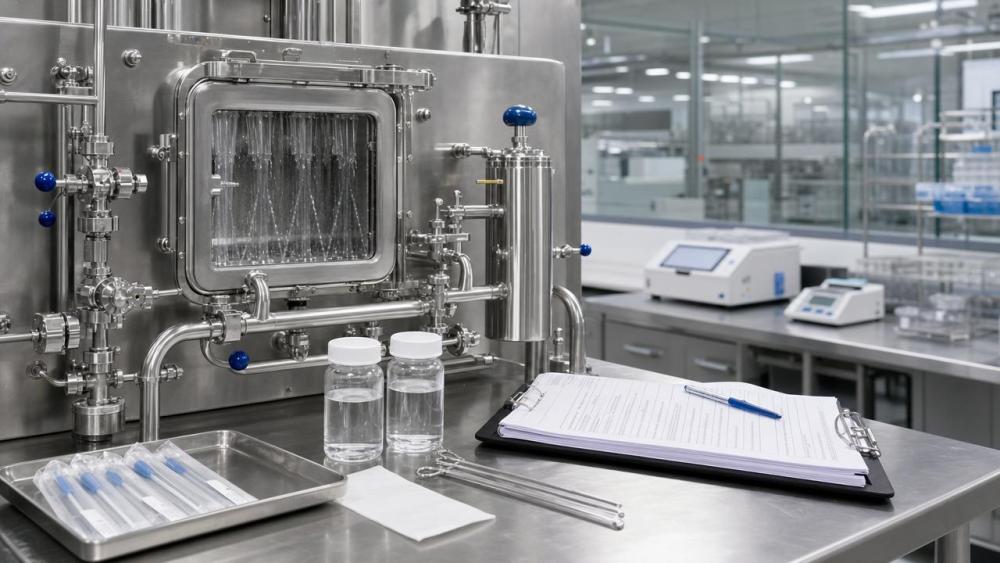
A cleaning validation protocol is only as strong as its sampling plan. Good sampling does not mean collecting the most samples. It means collecting the right samples from the right places.
Swab sampling is widely used for defined surfaces. It helps assess direct residue on equipment walls, corners, blades, seals, and transfer parts. It is especially useful for identifying local cleaning failures.
Rinse sampling is often selected for systems with inaccessible surfaces, long pipework, or complex internals. It can represent broader system contact, but may dilute residue and hide localized contamination.
Many facilities use both methods. That combination is often stronger than relying on one technique, particularly in equipment trains that include tanks, hoses, pumps, valves, and vacuum-assisted sections.
Sampling points that usually deserve attention
- Dead ends, joints, threaded fittings, and shadowed areas
- Locations farthest from spray or flow impact
- Elbows, filters, nozzles, and drain points
- Surfaces exposed to dried residue after hold time
- Parts removed and cleaned manually between batches
Recovery studies matter here. If a swab recovers only part of the residue from stainless steel, glass, polymer, or coated surfaces, the reported result must reflect that limitation.
Timing matters too. Samples collected immediately after cleaning may not reveal the same risk as samples taken after equipment sits idle, dries, or is reassembled.
Documentation is where many protocols succeed or fail
An effective cleaning validation protocol does more than generate test data. It creates a traceable decision path that explains why the study was designed in a certain way and how conclusions were reached.
Auditors usually look for consistency between the protocol, cleaning SOPs, batch history, equipment logs, analytical records, deviations, and final report conclusions. Small mismatches can create major credibility issues.
This is where process-support systems become relevant. Identification methods such as laser marking or inkjet coding can improve part traceability, while weighing and batching records can help confirm what residue challenge was actually present.
For complex industrial lines, vacuum system logs, ultrasonic cleaning parameters, detergent concentrations, and surface treatment records may all support the validation story. Cleanliness evidence rarely stands alone.
Documentation points worth checking before approval
- Clear link between risk assessment and worst-case selection
- Documented rationale for sample locations and sample size
- Verified analytical method suitability and recovery factor use
- Defined handling of outliers, failures, and repeat samples
- Predefined triggers for periodic review or revalidation
Where the protocol creates business value
A good cleaning validation protocol reduces more than audit pressure. It helps stabilize production by making cleaning performance predictable across shifts, sites, product changes, and maintenance events.
That is valuable in high-mix environments. Product families may differ in solubility, viscosity, toxicity, color intensity, or particle profile, yet they may share tanks, feeders, vessels, pumps, or finishing equipment.
In precision industries, cleaning also affects downstream performance. Residue can weaken coatings, interfere with weld quality, compromise vacuum behavior, alter weighing accuracy, or reduce the readability of permanent product identification.
Seen this way, validation is not isolated paperwork. It is part of broader process reliability, especially where auxiliary equipment determines whether the final product meets appearance, function, and compliance expectations.
How to evaluate the next step
If a protocol is being created or revised, start by mapping real contamination pathways rather than copying an older template. Residue source, equipment geometry, cleaning chemistry, and hold time usually reveal the true weak points.
Then review whether acceptance criteria still match current materials, process speeds, and analytical capability. A mature cleaning validation protocol should evolve with formulation changes, new equipment, and updated risk knowledge.
It also helps to compare the protocol against the supporting systems around it. Traceability tools, parameter logging, vacuum stability, ultrasonic performance, and controlled batching data often strengthen the reliability of cleaning evidence.
Where gaps appear, the next move is usually practical: tighten sample location logic, improve recovery studies, confirm worst-case assumptions, and align records across the full process chain. That approach turns the protocol into a working control tool, not just a signed document.