
Can ultrasonic welding replace adhesive bonding for plastic packaging? Yes, when the joint contains compatible thermoplastics, the equipment can reach and support the sealing area, and the finished package passes its required performance tests. It is not a direct replacement for every adhesive joint, especially those joining dissimilar materials, laminating barrier structures, or accommodating large gaps.
On a packaging line, adhesive application can become a bottleneck through dispensing variation, curing time, squeeze-out, or contaminated bonding surfaces. Switching to ultrasonic welding may remove those operations, but it introduces different demands: precise joint geometry, controlled material thickness, stable tooling contact, and a suitable welding window. The practical question is whether the proposed weld can maintain package integrity at production speed without damaging the contents or changing how the package opens.
Start with the joint, not the adhesive dispenser
Ultrasonic welding applies high-frequency mechanical vibration while the parts are held under pressure. Local heating at the interface softens or melts thermoplastic material; continued pressure during cooling forms the joint. No adhesive curing is required, although the process still needs a defined welding and hold sequence.
That mechanism makes an important distinction: replacing an assembly bond is different from replacing the adhesive inside a packaging laminate. A welded closure might eliminate glue used to attach two plastic components. It does not automatically remove adhesives that hold a multilayer film together or provide structural connections elsewhere in the package.
Separate these joint types before requesting trials. Otherwise, a successful demonstration on a molded plastic sample may be mistaken for proof that the entire packaging structure can become adhesive-free.
Identify the materials actually meeting at the interface
A label such as “plastic packaging” is insufficient for process selection. Obtain the resin grades for rigid components and the complete layer structure for films. Include coatings, printing, recycled content, fillers, and additives that could affect vibration transmission or melting behavior.
For rigid assemblies, using the same thermoplastic on both sides often provides a better starting point, but identical polymer names do not guarantee a reliable weld. Grade differences, moisture, pigments, reinforcement, and molding conditions can change the result. Dissimilar thermoplastics require specific compatibility assessment rather than an assumption that both will melt together.
Flexible packaging needs a different interpretation. A laminate may contain several materials yet remain weldable at its opposing thermoplastic sealant layers. The barrier and structural layers must survive the operation without pinholes, delamination, or unacceptable distortion. A weldable inner layer does not prove that the complete laminate tolerates the proposed settings.
- Confirm the contact surfaces: identify the material exposed on each side of the intended seal.
- Record production variability: include thickness tolerances, resin changes, printing coverage, and expected material lots.
- Check conditioning requirements: determine whether moisture or storage conditions affect the materials.
- Use production-representative samples: test actual films or molded components, not merely convenient substitutes.
Adhesives can join materials that cannot form a dependable fusion bond. Where dissimilar substrates are essential to the package design, retaining adhesive bonding may be more practical than redesigning the entire structure around ultrasonic welding.
Make the package geometry work with the tooling
A sound material pairing can still fail when the joint is poorly supported. The sonotrode, also called a horn, introduces vibration; the opposing anvil or fixture supports the package. Their contact geometry must direct energy into the intended interface rather than flexing the package or marking adjacent surfaces.
Rigid parts may need a molded energy director or another engineered joint feature to concentrate heating. Replacing a broad adhesive overlap with an ultrasonic weld often requires a component redesign. Existing gaps, warpage, or uneven flanges that adhesive previously accommodated can prevent consistent contact.
Flexible films generally use tooling designed for the film stack and seal pattern rather than a molded energy director. Wrinkles, folded layers, thickness transitions, and intersections with existing seals deserve particular attention. These locations can create uneven pressure or become damage sites even when a straight, flat seal performs well.
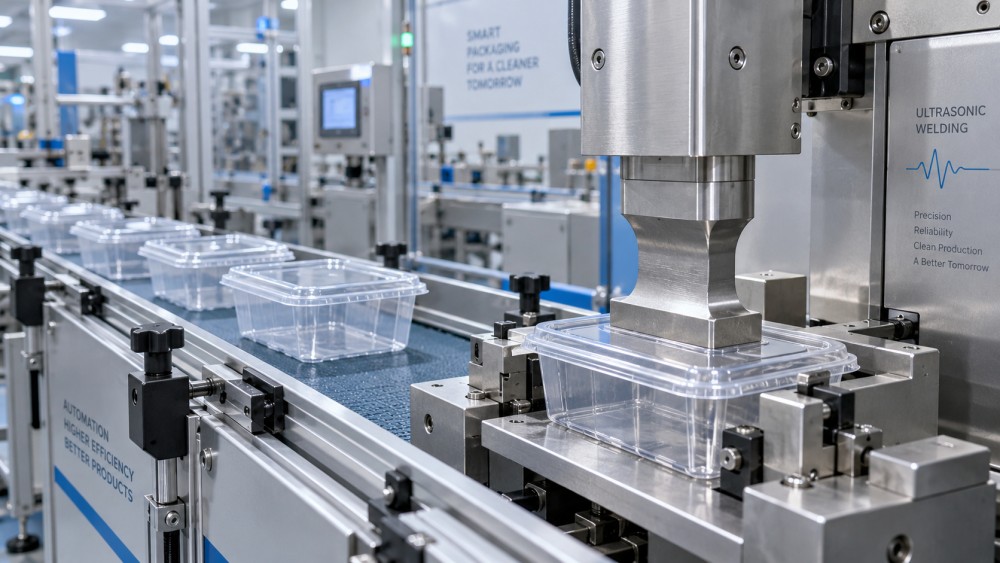
Check tooling access with the package in its production position. A joint that is easy to weld as an empty laboratory sample may be difficult to support after filling. Product location, headspace, conveying accuracy, and nearby closures can restrict where the horn and anvil fit.
Also define the intended opening behavior. A permanent weld is not automatically suitable for a peel-open lid or easy-open pouch. Where consumers must separate the seal predictably, opening force and failure mode belong in the specification alongside leak resistance.
Run a trial that exposes the failure window
The objective of a trial is not to produce one attractive weld. It is to establish a process window that remains acceptable across realistic variation. Before adjusting equipment, write down the package requirements: mechanical strength, leakage limits, appearance, opening performance, barrier function, and any exposure to temperature, pressure, handling, or aging.
- Measure the existing adhesive process. Record its cycle constraints, rejects, inspection methods, and package performance. This provides a baseline for comparison.
- Select representative samples. Include normal production material plus relevant tolerance extremes, such as film thickness variation or molded-part warpage.
- Develop tooling and initial settings. Match the horn, anvil, fixture, and equipment capability to the joint rather than selecting a machine by nominal power alone.
- Vary the critical parameters systematically. Evaluate amplitude, force, weld duration or energy, and hold conditions. For suitable rigid joints, displacement or collapse control may also be useful.
- Challenge the acceptable settings. Introduce expected alignment variation, production speeds, material lots, and operating conditions to find where defects begin.
- Repeat on the integrated line. Verify feeding, filling, registration, tooling temperature, and rejection functions under sustained operation.
Change parameters in a documented sequence. Increasing vibration input to fix a weak seal can produce film thinning, flash, or component damage before it resolves poor contact. When performance varies sharply between nominally identical samples, inspect fixturing and material variation before simply increasing energy.
Connect visible defects to likely causes
These observations guide investigation; they are not one-to-one diagnoses. Several mechanisms can produce the same defect, so confirm suspected causes through controlled changes and repeat testing.
Prove package performance beyond weld strength
A strong joint can still leak through a narrow channel. Conversely, a seal that passes an initial leak check may fail during distribution or become too difficult to open. Validation should therefore test the package function, not just the strength of an isolated weld specimen.
Select methods appropriate to the package. Depending on its use, evaluation may include peel or tensile testing, burst or creep testing, leak detection, visual inspection, and transport simulation. Barrier-sensitive products may also require assessment of the affected packaging structure after sealing. Use defined test conditions and acceptance criteria so that results from adhesive and welded packages are comparable.
Test after relevant storage and exposure conditions, not only immediately after welding. Product contact, temperature cycling, humidity, sterilization, or other downstream treatment may alter joint performance. Where regulated packaging is involved, determine which qualification records and change-control activities apply to the new joining process.
Removing adhesive does not automatically establish food-contact suitability, medical-package suitability, or recyclability. The complete material structure, manufacturing process, intended use, and applicable requirements still govern those judgments. A welded package containing incompatible layers does not become recyclable merely because one adhesive operation has disappeared.
Contamination also needs realistic testing. Ultrasonic sealing may tolerate some product residue in specific applications, but it should not be treated as universally capable of sealing through powder, oil, or liquid. Define the contamination conditions the line can encounter and establish whether they require prevention, detection, or automatic rejection.
Compare the complete production cost
Ultrasonic welding can remove adhesive purchasing, dispensing maintenance, curing-related work in progress, and some consumable handling. Those savings must be weighed against welding equipment, application-specific tooling, fixtures, guarding, integration, maintenance, and validation.
Use the accepted package as the unit of comparison rather than the machine cycle alone. A short welding cycle may not improve throughput if filling, indexing, unloading, or inspection remains the bottleneck. Likewise, lower consumable spending can be offset by scrap if the incoming packaging materials have a narrow tolerance window.
Request an application trial and a cost breakdown that distinguish standard equipment from custom tooling and integration. Confirm who owns the process-development work, what happens when the resin or film changes, and how replacement tooling will be qualified. Maintenance access and changeover repeatability matter when several package formats share one line.
For a viable project, the business case should include material redesign costs and disruption during conversion. Keeping adhesive bonding on an existing low-volume format while adopting welding for a redesigned, higher-volume package can be a rational outcome; replacement does not need to cover every product simultaneously.
Set the conversion decision before production release
Proceed when trials demonstrate a stable process window, complete-package testing meets defined requirements, and integrated-line operation confirms acceptable yield and throughput. Production controls should then specify approved materials, tooling identification, parameter limits, inspection frequency, and rejection rules. Recorded weld energy or displacement can help detect variation, but a normal machine trace is not proof of a leak-free package.
Retain adhesive bonding when the substrates cannot form a dependable welded interface, the package requires gap filling or flexibility that the proposed joint cannot deliver, or tooling access would force an impractical redesign. Consider a partial conversion when only selected plastic-to-plastic joints are suitable. The release decision should identify exactly which adhesive function has been replaced—and demonstrate that the package still performs that function throughout its intended service life.