
Ultrasonic cleaning can be safe for precision plastic parts, but only when the polymer, cleaning chemistry, part geometry, and operating conditions are compatible. A part that looks clean after treatment may still have absorbed moisture, developed microscopic cracks, lost surface quality, or moved outside its dimensional tolerance. Safety therefore means preserving the part’s specified performance—not simply avoiding visible breakage.
The practical decision is whether a controlled ultrasonic process can remove the required contamination without changing dimensions, appearance, or function. Resin compatibility data provides a starting point, but representative-part testing is essential: molded-in stress, thin sections, coatings, and assembly interfaces can make a finished component behave differently from a material sample.
Identify what could damage the part
Ultrasonic cleaning uses high-frequency sound to generate cavitation in a liquid. The formation and collapse of bubbles produce localized mechanical action that helps detach contamination. This action is useful around accessible recesses and complex surfaces, but it is not equally gentle across all materials and geometries.
For precision plastics, several mechanisms must be separated:
- Mechanical damage: Cavitation can affect vulnerable surfaces, while movement or contact between parts can damage thin edges and delicate features.
- Chemical attack: A detergent or solvent can cause swelling, softening, discoloration, or environmental stress cracking.
- Thermal distortion: Bath heat can change dimensions or release molding stresses, especially in unsupported thin sections.
- Liquid absorption: Moisture or solvent uptake can change dimensions and properties even when no immediate surface damage is visible.
- Interface failure: Coatings, adhesive joints, printed markings, and insert interfaces may respond differently from the base polymer.
These mechanisms can interact. A cleaner that appears harmless during a brief room-temperature soak may become damaging when heated or applied to a stressed component. Ultrasound can also accelerate transport of liquid into accessible gaps. A failure observed after ultrasonic cleaning is therefore not automatically evidence that the acoustic action alone caused it.
Assess the exact material and finished geometry
“Plastic-compatible” is not a sufficient specification. Obtain the resin grade, filler content, relevant additives, and any coating or bonding information. Chemical resistance varies within polymer families, and a filled or modified grade should not be treated as interchangeable with an unfilled version.
Review the drawing alongside the material data. Thin diaphragms, snap-fit arms, microfeatures, sharp corners, and stressed press-fit regions deserve closer evaluation than thick, unstressed surfaces. Blind holes can retain air or cleaning liquid, while sealed cavities may be inaccessible to cleaning altogether.
For an assembled component, compatibility must cover every wetted material. A chemically resistant housing does not establish that its seals, adhesive, optical coating, or identification marks will survive the same process.
Select chemistry before increasing ultrasonic intensity
The cleaner must remove the actual contaminant while remaining compatible with the part. Machining oil, polishing residue, loose particles, and mold-release deposits do not necessarily respond to the same formulation. Increasing acoustic energy to compensate for unsuitable chemistry can reduce the margin between effective cleaning and damage.
A mild aqueous cleaner is a reasonable candidate for screening when the contamination and material allow it, but “water-based” does not mean harmless. Alkalinity, surfactants, solvents within the formulation, and additives all matter. The safety data sheet supports hazard assessment; it does not by itself prove compatibility with a particular resin.
Request compatibility guidance for the actual concentration, temperature, and contact time. The full exposure includes cleaning, transfer delays, rinsing, and any liquid retained before drying. Evidence based on a brief ambient-temperature exposure should not be extended to a heated production cycle without testing.
Use a soak control without ultrasound during initial trials. If it produces swelling, haze, or cracking, the chemistry or temperature already presents a problem. If damage appears only in the ultrasonic trial, investigate acoustic exposure, fixture contact, part movement, and localized heating.
Flammable solvents should not be used in a standard aqueous ultrasonic tank. Any solvent process requires equipment and installation specifically designed for its fire, vapor, and ventilation hazards.
Control the acoustic exposure, not just the power setting
Frequency affects cavitation behavior. Lower-frequency systems, such as those operating around 25–40 kHz, generally produce more mechanically aggressive cavitation than higher-frequency systems under comparable conditions. Higher frequencies can be candidates for delicate components, but frequency alone cannot establish a safe process.
Tank construction, transducer arrangement, bath depth, liquid properties, and loading influence the acoustic field. Two machines operating at the same frequency can expose parts differently. A rated wattage also does not show how much energy reaches a particular surface: electrical input, delivered acoustic energy, and adjustable output are not equivalent measurements.
For initial trials, use the least aggressive controllable exposure that has a realistic chance of removing the contamination. Begin with short intervals and inspect between them. If cleaning is insufficient, check chemistry, wetting, orientation, and air entrapment before simply increasing power or duration.
Temperature requires similar discipline. Heat may improve contaminant removal, but it can also increase chemical attack and change the behavior of stressed plastic. Published melting points, glass-transition temperatures, or heat-deflection values are not approved cleaning temperatures. The relevant limit is the temperature at which the finished part retains its required geometry and function under the actual exposure.
Measure the bath temperature during operation, not only before the cycle. Ultrasonic operation adds heat, so a heater setpoint alone may not prevent temperature drift.
Fixture parts so the trial reflects production
Do not place precision parts directly on the tank floor. Use a suitable basket or fixture that keeps them separated, supported, and accessible to the liquid. Supports should avoid loading delicate features or masking surfaces that must be cleaned.
Orientation is especially important for recesses and narrow passages. An air pocket can prevent cleaning even when the surrounding bath is active. Arrange parts so liquid can enter and displaced air can escape, then confirm that the same orientation permits effective rinsing and drainage.
Evaluate fixture materials as part of the process. A soft liner may prevent scratching but also obstruct liquid flow or attenuate acoustic energy. A densely packed basket can behave differently from a single-part trial.
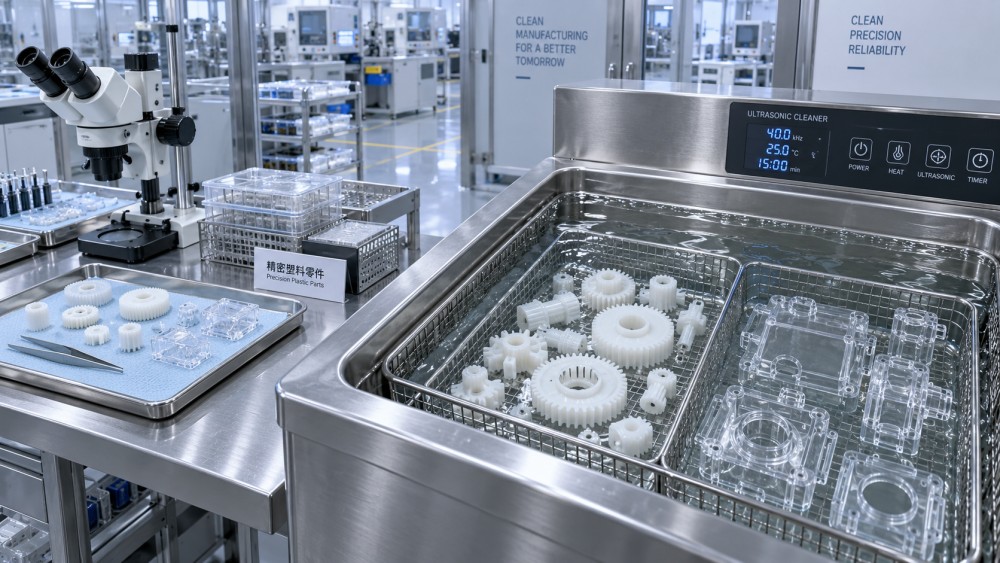
Keep the validated loading pattern consistent: part count, spacing, immersion depth, basket position, and orientation all affect results. Degas a fresh bath according to the equipment instructions before trials so that changing dissolved-gas conditions do not become an uncontrolled variable.
Validate cleanliness and damage together
A useful trial must show both that contamination was removed and that the component remains acceptable. Visual cleanliness alone cannot establish either result for a precision part.
Before testing, define measurable acceptance criteria from the drawing and application. Relevant checks may include:
- Critical dimensions, flatness, roundness, and fit.
- Surface condition under specified magnification.
- Optical transmission, haze, or cosmetic appearance where required.
- Particle or residue limits using a suitable extraction and measurement method.
- Leak tightness, flow, snap-fit behavior, or other functional performance.
- Coating adhesion, marking legibility, and bonded-joint integrity.
Record baseline measurements on representative parts. Include the variations most likely to expose a weakness, such as the thinnest permitted section, stressed assembly regions, different mold cavities, and relevant resin or production lots. A flat resin coupon can help screen chemistry, but it cannot represent molded geometry or residual stress.
Compare an untreated control, a chemistry-only exposure, and an ultrasonic exposure. Keep their thermal and chemical histories as comparable as practical. This makes it easier to distinguish chemical effects from acoustic or handling damage.
During screening, vary one major parameter at a time where practical. Once a promising combination is identified, assess interactions and the proposed operating limits. A process that passes only at one exact setting may be too sensitive for routine production.
Inspect parts after cleaning and again after drying and appropriate conditioning. Absorbed liquid, delayed crazing, and stress relaxation can make immediate measurements misleading. For moisture-sensitive polymers, specify whether dimensions are accepted in a dry or conditioned state and apply that requirement consistently.
Use enough representative parts and repeat runs to assess variation. A successful result on one component demonstrates feasibility, not production capability. Where repeated cleaning or rework is permitted, validate the maximum authorized cumulative exposure.
Include rinsing, drying, and bath condition in the process window
Residual detergent can leave films, affect bonding, or interfere with optical and functional surfaces. Rinse requirements should therefore follow the cleanliness specification rather than an arbitrary number of rinse cycles. Water quality matters, but high-purity water alone does not establish that rinsing is complete.
Drying can create its own failure mode. Excessive heat may distort parts, while inadequate drying leaves liquid in recesses or assemblies. Compressed air can introduce particles or oil unless its quality is controlled. Any oven or vacuum-drying method should be qualified against geometry, absorbed moisture, and assembly requirements.
Bath condition also changes performance. Soil loading can reduce cleaning effectiveness or redeposit contamination, and evaporation or replenishment can alter concentration. Establish usable limits for chemistry, temperature, contamination, and bath replacement, with filtration where appropriate.
The released process should specify equipment, chemistry, concentration, temperature range, exposure time, loading, fixtures, rinsing, drying, and acceptance checks. Supplier demonstrations are most useful when they use representative parts and document these conditions. Equipment conformity documents do not replace part-level validation.
When ultrasonic cleaning should not be the default
Ultrasonic cleaning is a poor candidate when the contaminant requires chemistry that the part cannot tolerate, when liquid cannot be reliably removed from the assembly, or when the exposure needed for cleaning damages delicate features. Unacceptable delayed cracking is also a reason to reject the process, even if the initial inspection passes.
Alternatives may include controlled immersion without ultrasound, spray washing, localized cleaning, or upstream contamination prevention. Each has its own compatibility and geometry constraints; substitution still requires verification.
The decisive question is whether cleanliness and part integrity overlap across a usable operating window. If they do, ultrasonic cleaning can be a controlled process for precision plastic parts. If adequate cleaning requires conditions that approach the damage threshold, a different method offers a more defensible production decision.