
The Interface Determines Whether a Coating Performs or Fails
Surface engineering treatments improve coating adhesion by preparing the substrate to form a stable mechanical and chemical bond with the coating. They remove contaminants, alter surface energy, create controlled roughness, expose reactive material, and sometimes add a conversion layer that is more compatible with the coating chemistry.
For a manufacturer, this matters because many coating failures begin below the visible paint or powder layer. A finished part may initially look acceptable yet later show blistering, peeling, edge corrosion, poor impact resistance, or delamination after humidity, thermal cycling, chemical exposure, or handling. In many such cases, the coating itself is not the primary problem. The interface between coating and substrate was poorly prepared or insufficiently controlled.
Surface treatment should therefore be treated as a defined process stage, not simply as cleaning performed before painting. The appropriate method depends on the substrate, coating type, part geometry, operating environment, production volume, and failure consequences. A pretreatment that works well for powder-coated steel furniture may be inadequate for aluminum electronics housings, galvanized fasteners, polymer components, or parts used in corrosive industrial environments.
Why a Clean-Looking Surface May Still Have Poor Adhesion
Coatings need intimate contact with the substrate. Oils, release agents, fingerprints, machining fluids, dust, oxide films, silicone residues, salts, and polishing compounds can interfere with that contact even when a part appears visually clean. A contaminant layer only a few microns thick can prevent the coating from wetting the surface consistently.
Wetting is especially important with liquid paints, primers, adhesives, and electrocoating processes. If the coating does not spread uniformly across the substrate, it can leave microscopic voids at the interface. Those voids become pathways for moisture, chemicals, or corrosive ions. Once corrosion begins beneath a coating, adhesion loss can travel well beyond the original damaged point.
Powder coatings face a somewhat different version of the same issue. Powder is applied as dry particles and then melted during curing, but contamination still prevents a durable interface from forming. Residual oils can cause craters, fisheyes, poor flow, or local delamination. On complex parts, uneven cleaning can produce a coating system that passes visual inspection but varies substantially in service performance.
Surface engineering addresses these conditions through four related effects:
- Cleaning: removing oils, particulates, salts, oxides, and process residues.
- Surface activation: increasing surface energy or exposing chemically active sites so the coating can wet and bond more effectively.
- Profile control: creating an anchor pattern or controlled roughness that improves mechanical interlocking.
- Interfacial conversion: creating a stable intermediate layer that improves corrosion resistance and coating compatibility.
These effects often work together. A blasted steel surface, for example, may have a useful physical profile but still fail prematurely if abrasive dust, flash rust, oil carryover, or soluble salts remain. Conversely, a thoroughly degreased but extremely smooth substrate may provide too little anchoring for a coating system exposed to impact or repeated thermal stress.
Surface Energy and Chemical Compatibility Matter More Than Many Specifications Suggest
Surface energy is a practical way to describe how readily a liquid coating wets a material. High-energy surfaces generally allow coatings to spread more evenly; low-energy surfaces tend to repel them. Metals that have been freshly cleaned or activated usually provide more favorable wetting than the same metals after exposure to oils, oxidation, or airborne contamination.
This principle is particularly important for plastics, composites, fluoropolymers, and materials containing mold-release additives. Many polymers have inherently low surface energy, so paint may appear to adhere after curing but detach under tape testing, abrasion, humidity, or thermal cycling. Treatment methods such as plasma, corona, flame treatment, chemical etching, or carefully selected primers can alter the outermost surface enough to make coating application viable.
However, activation is not permanent. A plasma-treated polymer or freshly cleaned metal can lose surface activity during storage through recontamination, oxidation, or migration of low-molecular-weight compounds to the surface. The interval between pretreatment and coating application must be managed as part of the process specification. Treating parts in one area and leaving them exposed overnight before coating can erase much of the intended benefit.
The coating formulation also matters. Surface preparation cannot compensate indefinitely for a mismatch between substrate and coating chemistry. A coating system should be assessed as a stack: substrate, pretreatment, primer if used, topcoat, curing profile, and expected service conditions. Adhesion is a property of that entire system, not a property delivered by any one machine or chemical stage.
Roughness Helps, but More Roughness Is Not Automatically Better
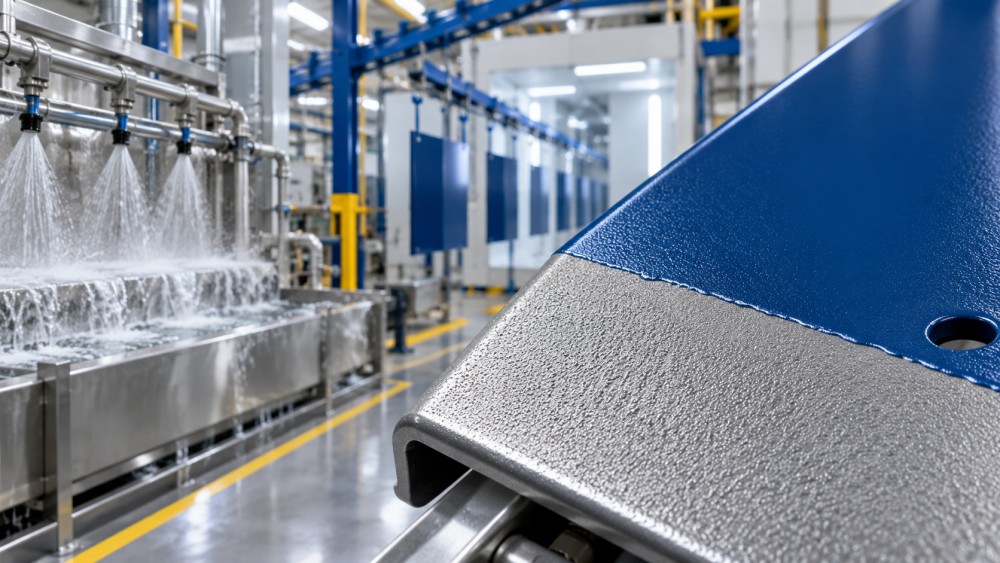
A controlled surface profile gives cured coatings a larger contact area and creates mechanical interlocking. Abrasive blasting, sanding, laser texturing, chemical etching, and certain conversion processes can produce a texture that helps the coating resist shear and peel forces. This is especially useful on steel structures, castings, fabricated equipment, and parts exposed to vibration or impact.
The common mistake is to assume that the roughest surface will provide the strongest coating adhesion. Excessive roughness can create sharp peaks that receive insufficient coating coverage, particularly near edges and corners. It may trap abrasive particles, process chemicals, or air. Deep valleys can become corrosion initiation points if the coating does not fully flow into them. A rough surface can also increase coating consumption and make appearance less uniform.
Profile targets should be matched to coating thickness and coating behavior. Thin films generally cannot bridge a coarse anchor profile reliably. A thick protective coating may tolerate or require a more pronounced profile, while a decorative liquid coating may need a finer and more uniform preparation. Parts with tight dimensional tolerances or sealing surfaces may require masking, selective treatment, or a method that changes chemistry without materially changing dimensions.
Blasting media deserves the same attention as blast pressure and profile. Media selection affects surface cleanliness, embedded residue risk, material removal, and the shape of the resulting texture. Using contaminated or unsuitable media can introduce a new adhesion problem while attempting to solve another. In corrosion-sensitive applications, soluble salt control and post-blast handling may be as important as the blast profile itself.
Choosing the Treatment Method by Substrate and Failure Mode
There is no universal pretreatment route. The right choice begins with the substrate and the reason adhesion is at risk.
For precision components, ultrasonic cleaning can be valuable where conventional spray washing cannot reliably remove residues from blind holes, threads, internal channels, or fine surface features. Its value depends on the cleaning chemistry, bath condition, time, temperature, rinsing, drying, and part loading. Ultrasonic energy does not make an unsuitable detergent effective, and it does not eliminate the need to control drag-out and drying residues.
Conversion coatings are often selected when adhesion and corrosion resistance must be improved together. They modify the metal surface and can provide a more stable base for a subsequent organic coating. Their performance depends on bath control, substrate condition, rinse quality, drying, and compatibility with the coating system. A conversion layer that is too heavy, powdery, uneven, or improperly rinsed can weaken rather than strengthen the interface.
Plasma treatment is often attractive for polymers, electronics-related parts, and selective surface activation because it can alter the outermost surface with limited bulk-material impact. Yet it requires disciplined control of treatment uniformity, fixture design, exposure time, power, gas selection, and time to coating. Complex geometry can create shadowed regions that receive less activation than exposed surfaces.
The Production Window Is Often the Real Adhesion Risk
Surface treatment processes are frequently validated during commissioning and then allowed to drift. Cleaning concentration changes, rinse water becomes loaded with contaminants, spray nozzles clog, bath chemistry ages, abrasive media breaks down, and parts spend longer in queues before coating. Any of these changes can reduce adhesion consistency without causing an obvious immediate visual defect.
Production teams should define the acceptable operating window rather than relying only on a final pass-or-fail adhesion test. Useful controls may include chemical concentration, pH where relevant, conductivity or contamination indicators in rinse stages, temperature, dwell time, spray pressure, bath maintenance intervals, drying conditions, line speed, and maximum elapsed time before coating. The exact controls depend on the selected technology, but the principle is consistent: a pretreatment process must be measurable enough to detect drift before a large batch is affected.
Part handling deserves similar discipline. Bare hands can transfer oils and salts. Inadequate gloves, contaminated racks, silicone-containing maintenance products, and unclean compressed air can all compromise a treated surface. A good process route can be undermined at the handoff between cleaning and coating if ownership of that interface is unclear.
Drying is another overlooked stage. Water remaining in joints, pores, or recessed areas may carry dissolved salts or chemicals onto the surface during heating. Overheating can also change some treated surfaces or accelerate recontamination during long storage. The desired condition is not merely “dry”; it is dry, clean, chemically stable, and ready to coat within the established process window.
How to Verify That Pretreatment Is Working
Adhesion testing should be tied to the expected failure mechanism. A simple cross-hatch or tape test can be useful for screening, but it may not reveal weakness that only appears after humidity, salt exposure, chemical contact, thermal cycling, impact, or outdoor weathering. A coating that survives a room-temperature tape test can still fail quickly when moisture reaches a weak interface.
Verification should include both process checks before coating and performance checks after curing. Before coating, manufacturers may assess cleanliness, water-break behavior on suitable metal surfaces, surface-energy indicators for polymers, profile measurements, conversion-layer condition, and visual uniformity. After coating, appropriate tests may include adhesion, film thickness, cure verification, impact resistance, bend performance, corrosion exposure, or environmental cycling based on the product’s actual service conditions.
When adhesion failures occur, it is important to examine where separation happened. Failure within the coating film, at the coating-to-pretreatment boundary, within the conversion layer, or at the substrate interface points to different corrective actions. Simply increasing coating thickness or changing the topcoat may hide the symptom while leaving the root cause untouched.
A Practical Decision Sequence Before Changing the Coating
When parts show peeling, blistering, or inconsistent adhesion, changing the paint supplier is often the first instinct. It may be justified, but the more efficient sequence is to first identify the actual interface condition.
- Define the substrate precisely, including alloy, plating, prior finishing, heat treatment, and whether material batches vary.
- Identify contaminants introduced by machining, forming, molding, welding, storage, handling, and maintenance activities.
- Map the current process from incoming part to cure, including queues, touch points, rinses, drying, and rework loops.
- Relate the failure location to geometry, such as weld zones, sharp edges, recesses, threaded areas, or hand-contact zones.
- Set the required performance standard according to service exposure, rather than relying solely on appearance after application.
- Test changes as complete coating systems, because pretreatment, primer, topcoat, and cure schedule interact.
This sequence helps distinguish a material-selection issue from a controllable process issue. It also avoids installing a more aggressive treatment that damages dimensions, increases waste, creates unnecessary chemical-management burden, or introduces variability elsewhere in the line.
Surface engineering improves coating adhesion when it produces a clean, stable, compatible, and consistently prepared interface. The most effective treatment is rarely the most elaborate one. It is the one that addresses the substrate’s actual condition, supports the chosen coating chemistry, fits the part geometry, and remains under control from pretreatment through curing.