
A freshly cleaned surface can become contaminated again within minutes. A glove touches a cart handle, then returns to the workbench. A wipe crosses a dirty edge and carries particles back into the clean zone. Nearby maintenance releases debris just as an operator removes a protective cover.
Semiconductor cleanroom cleaning is therefore not simply a matter of removing visible residue. It is a controlled transfer process: particles must leave the surface without moving onto another critical surface or returning through airflow, handling, or equipment activity. For operators, that means paying as much attention to what happens after a wipe passes as to the wiping itself.
The following practices focus on room surfaces, equipment exteriors, and approved support tools. Wafer cleaning, process-chamber cleaning, and other product-contact applications require separate, process-specific procedures.
When particles return, look beyond the surface
A cleanroom classification describes airborne particle concentrations under specified conditions. It does not guarantee that every bench, glove, tool, or equipment panel is sufficiently clean for its intended use. ISO 14644-1 classification is not, by itself, a surface-cleanliness acceptance criterion.
Recontamination usually follows one of three routes: particles settle from the surrounding air, transfer through contact, or are generated locally by movement, friction, and equipment operation. Identifying the route makes corrective action more useful than simply increasing cleaning frequency.
A recurring contamination pattern deserves investigation. Repeated wiping can hide an equipment or handling problem without removing its source.
Set the boundary before opening the wipe package
Before cleaning begins, establish what must remain protected. Confirm the equipment state, isolate hazardous energy where required, and follow site controls for access, chemical use, and maintenance. Cleaning around energized equipment, moving assemblies, hot surfaces, or exposed process materials is not a routine housekeeping decision.
Remove unnecessary items through the approved route. Protect sensitive openings with approved covers, and separate incoming tools from cleaned tools. Do not place packaging, used wipes, or waste containers in a position that requires reaching over a cleaned surface.
Check nearby activities, too. Cleaning a workstation while an adjacent team opens equipment panels may create more contamination than the cleaning removes. Coordinate the work or use an approved isolation arrangement.
Keep clean supplies, the surface being cleaned, and used materials moving in one direction. If the task repeatedly makes you cross back over cleaned areas, reorganize the setup before continuing.
Choose materials for contamination control, not convenience
A low-lint wipe is only the starting point
Wipe selection should reflect the process sensitivity, surface finish, chemical exposure, and site specification. Useful supplier information includes particle and fiber release, extractable residues, ionic contamination, absorbency, edge construction, and compatibility with the intended chemistry.
No single wipe construction is best for every application. A material suitable for a general equipment exterior may be unacceptable near a sensitive process opening. Use the approved grade rather than substituting whatever looks similar in the supply cabinet.
Keep packages closed between uses. Check package integrity, shelf life where specified, and lot identification. Pulling wipes with contaminated gloves can compromise the remaining contents, not just the wipe in your hand.
Cleaning liquid must match both the soil and the surface
Isopropyl alcohol is common in cleanrooms, but it is not a universal particle-removal solution. Some residues need a different approved solvent or aqueous chemistry. Water-sensitive materials, coatings, seals, plastics, and electrical assemblies impose additional restrictions.
Use the specified chemical grade, concentration, and dispensing method. General-purpose cleaning fluids may contain additives or leave residues that are unacceptable in semiconductor environments. Even approved chemistry can cause problems when too much is applied or when loosened contamination is allowed to dry back onto the surface.
Where the procedure permits, pre-wetted wipes or controlled dispensing onto a wipe reduce unnecessary mist and overspray. Never spray toward exposed product, sensitive openings, or electrical components. Observe ventilation, flammability, chemical-exposure, and electrostatic-discharge controls.
A wiping sequence that does not bring particles back
The exact pattern should follow the validated site procedure and surface geometry. The objective is consistent: collect contamination, expose fresh wiping material, and avoid carrying removed soil across an area already cleaned.
- Check gloves before starting. After touching doors, packaging, waste, or unclean tools, change gloves or clean them only as the approved procedure allows. Replace damaged gloves immediately.
- Prepare a controlled wiping face. Fold the wipe as instructed so that clean faces remain available. Avoid bunching it into an irregular ball that makes contact pressure unpredictable.
- Apply the specified amount of liquid. The wipe should collect contamination without dripping into seams, vents, bearings, or electrical connections.
- Use controlled, overlapping strokes. Where suitable, move in one direction rather than scrubbing back and forth. Backtracking with a loaded face can redistribute particles.
- Turn to a fresh face before it becomes overloaded. Replace the wipe at the defined interval, whenever visibly soiled, or when the task creates a transfer risk. Do not wait for heavy discoloration.
- Complete any required rinse or drying step. Use fresh approved materials, not the wipe that removed the original contamination.
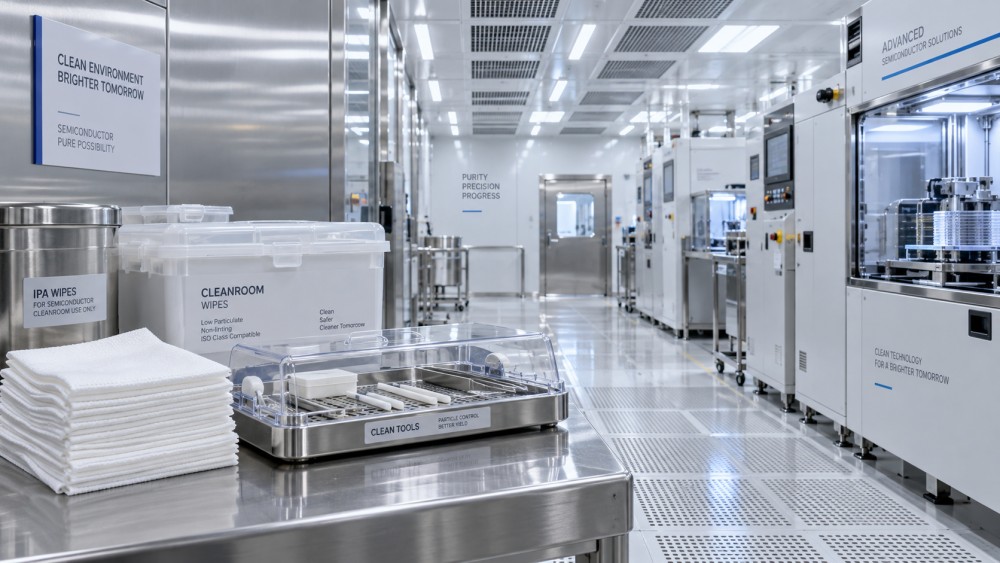
For broad horizontal surfaces, work from the designated cleaner region toward the dirtier region. For room-level cleaning, higher surfaces generally precede lower surfaces so later fallout does not undo completed work. However, airflow direction, equipment geometry, and process risk may require a different validated sequence.
Edges, recesses, fasteners, and undersides deserve deliberate attention. They can retain contamination and release it later during vibration or handling. Use approved detail-cleaning tools where needed; forcing an oversized wipe into a narrow feature can snag fibers or damage the surface.
Do not let tools and auxiliary equipment become the return path
A cleaned bench is only as protected as the next object placed on it. Tool trays, carts, portable instruments, vacuum hoses, and maintenance accessories all need defined cleaning and storage requirements.
Keep cleaned items covered or enclosed as specified. Identify their status so another operator does not have to guess whether a tool is ready for use. If an item leaves the controlled area, follow the transfer procedure before bringing it back; a quick wipe of its most visible face may miss wheels, handles, cable jackets, and undersides.
Auxiliary systems require particular care because their contamination risks are easy to overlook:
- Vacuum cleaning: Use only site-approved equipment suitable for the environment. Filtration performance, exhaust location, hose cleanliness, and maintenance condition all matter. An ordinary vacuum can release particles back into the room.
- Compressed gas: Do not improvise with blow guns. Gas jets can scatter particles into inaccessible areas. Any approved use requires suitable gas quality, delivery hardware, pressure controls, and a defined contamination-management method.
- Ultrasonic cleaning: For compatible removable parts, a qualified ultrasonic process can help reach complex features. Bath condition, chemistry, rinsing, drying, and clean packaging determine whether removed contamination stays removed.
Equipment capability and handling discipline must work together. A precisely cleaned part can lose its cleanliness during an uncontrolled rinse, an unsuitable drying step, or transport in a contaminated container.
Protect the result while the area returns to service
The period immediately after cleaning is a common weak point. Operators are ready to resume production, supplies are being returned, and several people may touch the same work area.
Avoid unnecessary motion above cleaned surfaces. Keep protective covers in place until the approved point of use. Do not place paperwork, unapproved labels, pens, or personal items on the cleaned area. Replace covers and guards using clean handling practices rather than touching their inner surfaces.
Respect the site's defined drying and recovery conditions. A surface that looks dry does not prove that the surrounding area has recovered from particle-generating work. Recovery depends on the disturbance, airflow, equipment layout, and required cleanliness—not on an arbitrary waiting period.
If airflow alarms, pressure abnormalities, damaged filters, or unexpected particle trends appear, escalate them through the site procedure. More wiping cannot compensate for a failed environmental control.
Verify cleaning with the right evidence
Visual inspection is useful for finding streaks, fibers, pooled liquid, and obvious residue. It cannot establish microscopic cleanliness on its own.
Verification should match the contamination risk and the approved acceptance criteria. Airborne particle monitoring can show environmental changes during or after activity. Surface particle assessment provides different information. Where molecular, ionic, or metallic residues matter, separate analytical methods may be necessary.
Do not treat a passing airborne particle result as proof that a critical surface is clean. Likewise, a visually clean surface does not rule out residue that could affect adhesion, electrical performance, or downstream processing.
Useful cleaning records identify the area or equipment, procedure, materials, completion time, operator, abnormalities, and required verification results. This is not paperwork for its own sake. Traceable records help teams distinguish a material-lot issue from a handling change or equipment fault.
When recontamination keeps happening
Stop repeating the same cleaning cycle without asking what changes between cleaning and detection. Compare conditions immediately after cleaning, after tools are returned, and after normal equipment activity begins. Use approved sampling and observation methods so the investigation does not introduce new contamination.
Look for the smallest repeatable event: a cover opening, a cart arriving, a glove touching a control panel, or a mechanism cycling. If contamination appears only after that event, investigate the transfer path or generation source rather than automatically changing the cleaning chemistry.
For daily semiconductor cleanroom cleaning, the most reliable endpoint is not “the operator finished wiping.” It is a controlled handover: the surface meets its defined acceptance requirements, cleaned tools remain protected, waste has been removed, and the next task can begin without reopening the contamination pathway. That is how cleaning becomes lasting process control rather than a temporary reset.