Manufacturing compliance technology now sits close to the center of plant performance. Environmental compliance is no longer handled by paperwork alone, because process variation, traceability gaps, emissions, and surface-treatment risks often begin on the shop floor.
That is why Manufacturing Compliance Technology environmental compliance matters across advanced manufacturing. It connects production control with measurable environmental results, helping operations maintain product quality while meeting tighter rules on waste, chemicals, energy use, and reporting.
Where compliance technology fits in daily manufacturing
Environmental compliance requirements rarely depend on one machine. They are shaped by how materials are cleaned, mixed, marked, coated, transported, sealed, and documented from one step to the next.
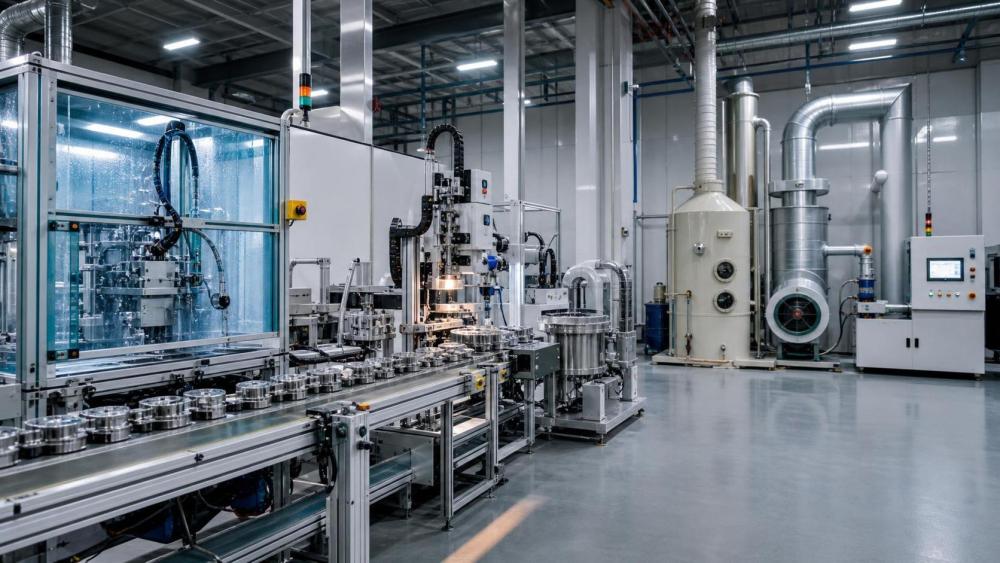
In practice, manufacturing compliance technology includes equipment, sensors, software logic, and verification routines. Together, these tools reduce uncontrolled process changes that can lead to rejects, contamination, excess chemical use, or emission-related violations.
This is especially relevant in auxiliary systems. Ultrasonic cleaning, laser marking, inkjet coding, industrial weighing, batching, vacuum support, surface treatment, and electrostatic coating all influence compliance outcomes, even when they are not the main production asset.
A portal such as GIAS is useful in this context because it organizes these supporting technologies around process quality, traceability, and environmental performance rather than treating them as isolated equipment categories.
Why environmental compliance has become a process issue
Regulatory pressure has expanded beyond end-of-pipe control. Inspectors, customers, and export markets increasingly expect evidence that environmental risk is controlled during production, not only after production finishes.
Several shifts explain the change. Product traceability is tighter. Material declarations are more detailed. Surface finishing chemicals face closer scrutiny. Energy-intensive operations are also being measured more carefully.
At the same time, quality and compliance now overlap. A poorly controlled cleaning stage may increase solvent use. Inaccurate batching may create off-spec material that becomes waste. Weak coding may break traceability during a recall or audit.
From this angle, Manufacturing Compliance Technology environmental compliance is not only about avoiding fines. It is about proving that the factory can run stable, documented, low-loss processes under real operating conditions.
Core technologies that influence environmental performance
The strongest compliance results usually come from process-support systems that control contamination, dosage, identification, pressure, and coating consistency. Their value becomes clear when reviewed against common environmental risks.
What matters is the connection between these systems. Compliance problems often appear between stages, where material condition, labeling, pressure stability, or coating thickness is not fully controlled.
What quality and safety teams should examine first
A useful starting point is to map environmental risk to process points rather than departments. This makes it easier to see whether the issue comes from materials, equipment settings, operator intervention, or poor data capture.
Focus on measurable failure points
- Cleaning stages that leave residues or consume unstable chemical volumes
- Batching steps where dosing drift creates scrap or disposal issues
- Marking systems that fail to keep durable product identity
- Vacuum lines with leakage, poor maintenance, or excessive power demand
- Coating processes with low transfer efficiency or weak thickness control
These points usually carry both quality and environmental consequences. A compliance review becomes more effective when it measures lost material, rework volume, maintenance frequency, and traceability gaps alongside permit-related limits.
Treat data quality as a compliance control
Many sites already own capable equipment, but records are fragmented. Environmental compliance suffers when cleaning validation, recipe control, marking verification, and maintenance logs cannot be connected during an audit.
That is where Manufacturing Compliance Technology environmental compliance becomes more than hardware. It also depends on timestamped process data, calibration history, exception records, and consistent product identification.
Typical scenarios across advanced manufacturing
Different industries face different rules, but the logic is similar. Compliance improves when auxiliary systems prevent variation before it grows into waste, contamination, nonconformance, or reporting failure.
Precision parts and electronics
Micron-level contamination can damage downstream performance. Ultrasonic cleaning and vacuum stability become important because poor cleanliness may trigger scrap, extra solvent use, and repeated processing.
Food, pharmaceuticals, and chemicals
Weighing and batching accuracy is central here. Small dosing errors can create off-spec lots, disposal burdens, and documentation failures, especially where formulation traceability is tied to compliance obligations.
Battery, coating, and treated metal products
Surface treatment and electrostatic coating have direct environmental exposure. Transfer efficiency, pretreatment control, and overspray recovery affect not only finish durability but also chemical consumption and emission management.
How to judge whether a solution really supports compliance
Not every advanced machine improves compliance in a meaningful way. A useful evaluation asks whether the system makes environmental performance more controllable, more visible, and easier to verify.
- Can the system reduce waste at the source rather than only detect it later?
- Does it capture process data that can support audits and internal investigations?
- Are calibration, maintenance, and alarm records easy to review?
- Can the process be repeated across shifts, sites, or export programs?
- Does it improve traceability when a customer complaint or recall appears?
This is one reason industry platforms matter. GIAS helps compare auxiliary technologies through application context, compliance insight, and supplier visibility, which is often more useful than comparing isolated product claims.
A practical route to stronger environmental compliance
A realistic compliance upgrade usually starts small. Begin with one line, one high-risk material flow, or one process where waste, emissions, or traceability failures already show a pattern.
Then link the process risk to supporting technology. That may mean tighter ultrasonic cleaning validation, more stable batching control, better vacuum monitoring, or stronger coating transfer efficiency.
The next step is evidence. Define which records, alarms, inspection points, and maintenance data will prove that the process remains within environmental and quality expectations over time.
Manufacturing Compliance Technology environmental compliance works best when technical decisions are tied to measurable process discipline. That is how environmental performance becomes repeatable rather than reactive.
For the next review cycle, it is worth comparing current auxiliary systems against three questions: where loss begins, where proof is weak, and where process control could prevent both compliance and quality failures.