
Uniform wafer coating sits at the center of many thin-film semiconductor steps, even when it is treated as a supporting process rather than the headline operation.
Film thickness uniformity influences lithography behavior, etch consistency, electrical performance, and defect risk across the wafer surface.
A small thickness shift at the coating stage can become a larger yield problem after baking, exposure, development, deposition, or packaging.
That is why uniform wafer coating matters beyond coating itself. It links directly to process stability, traceability, and equipment evaluation across advanced manufacturing lines.
Why thickness control deserves closer attention
In practical production, film thickness is never shaped by one parameter alone. It is the result of fluid behavior, wafer condition, machine repeatability, and the surrounding environment.
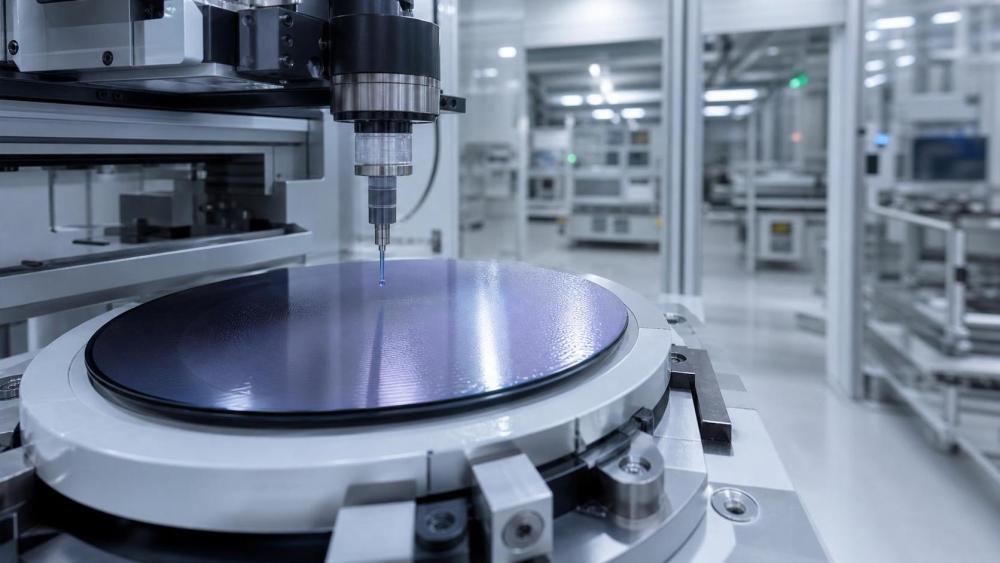
When evaluating uniform wafer coating, the main question is not only whether a target thickness can be reached once.
The more useful question is whether the same thickness profile can be reproduced lot after lot, across shifts, recipes, and wafer types.
This concern fits the wider industrial logic highlighted by GIAS. Auxiliary systems often decide whether a primary process remains stable, clean, and economically repeatable.
In semiconductor workflows, coating tools, vacuum support, cleaning systems, and surface preparation methods all contribute to that result.
What uniform wafer coating really means
Uniform wafer coating usually refers to the controlled deposition of a liquid film that dries or cures into a layer with minimal thickness variation.
The material may be photoresist, dielectric precursor, protective coating, adhesive, or another functional chemistry used in microfabrication.
Thickness uniformity can be described within a wafer, wafer to wafer, and batch to batch.
A process may look acceptable at the center of the wafer while still failing near the edge bead, exclusion zone, or local defect clusters.
So the assessment of uniform wafer coating should include distribution shape, not just an average number.
Common thickness variation patterns
Different patterns often point to different root causes. Recognizing them speeds up process review.
- Center-thick or center-thin profiles, often linked to spin dynamics or solvent evaporation behavior.
- Radial streaks, which may indicate dispense instability, particles, or chuck-related issues.
- Edge buildup, commonly associated with edge bead formation and incomplete removal control.
- Local islands or voids, often tied to contamination, surface energy variation, or microbubbles.
The process factors that most often change film thickness
Several variables shape the final film. They interact, so changing one setting can alter the response of another.
Coating speed and acceleration
In spin-based uniform wafer coating, rotation speed is one of the strongest thickness drivers.
Higher speed usually produces thinner films because centrifugal force spreads material more aggressively.
But the ramp profile matters too. Fast acceleration can cause early flow imbalance, while a slow ramp may leave excess solvent or uneven spreading.
Viscosity and solids content
Material viscosity influences how easily the liquid levels across the wafer before drying.
Higher viscosity often gives thicker films, but it also increases sensitivity to temperature and dispense consistency.
Solids content, solvent ratio, and shelf life can shift viscosity enough to change a previously stable recipe.
Dispense volume and dispense position
Insufficient volume may create dry regions or incomplete radial coverage. Excess volume can worsen edge bead and waste chemistry.
The dispense location also matters. Off-center placement can create asymmetric flow, especially on large wafers or faster ramps.
Wafer surface condition
Cleanliness, roughness, surface energy, and prior treatment strongly affect wetting behavior.
A wafer that carries residual particles, moisture, organics, or cleaning chemicals may reject the coating locally.
This is one reason why ultrasonic cleaning, drying quality, and controlled handling remain relevant to uniform wafer coating performance.
Ambient temperature and humidity
Coating fluids respond quickly to environmental changes. Solvent evaporation rate changes with room temperature, airflow, and humidity level.
Even when the recipe is unchanged, ambient drift can shift thickness and profile shape.
That is why controlled enclosures, stable air handling, and disciplined recipe windows are often more important than headline tool speed.
Equipment precision and mechanical stability
Uniform wafer coating depends on a stable chuck, repeatable rotation, accurate dispense timing, and predictable vacuum holding force.
Small runout, vibration, nozzle drift, or vacuum instability can produce measurable thickness variation.
This is where auxiliary systems become commercially important, because vacuum pumps, filtration, and maintenance discipline affect coating consistency indirectly but clearly.
How supporting systems influence coating results
A coating tool rarely works in isolation. Uniform wafer coating quality often reflects the condition of upstream and adjacent process-support systems.
This broader view matches the way GIAS frames industrial quality. Final performance often depends on process-support stability more than on isolated machine specifications.
Where uniform wafer coating creates business value
Thickness control is not only a technical metric. It affects cost, qualification speed, and confidence in cross-site manufacturing.
Better uniform wafer coating can reduce material overuse, lower scrap, and tighten downstream process windows.
It also improves traceable process learning. When thickness variation is understood, root-cause analysis becomes faster and scale-up becomes less risky.
For exporters and global suppliers, that consistency supports qualification across customers who expect reproducible process data, not just acceptable samples.
Useful checkpoints when comparing coating options
A practical review should move beyond brochure claims and ask how the process behaves under realistic production conditions.
- Check within-wafer uniformity data across center, mid-radius, and edge positions.
- Ask whether results are measured after coating only, or after soft bake and later process steps.
- Review viscosity control, filtration method, and material age management.
- Confirm ambient control limits and whether airflow around the tool is monitored.
- Look at wafer preparation, including cleaning sequence and surface conditioning.
- Assess maintenance history for chuck vacuum, dispense nozzles, and moving components.
- Compare repeatability over time, not only best-case demonstration data.
A simple way to interpret results
If thickness improves only after tight operator intervention, the process may still be fragile.
If uniform wafer coating remains stable through normal lot variation, maintenance cycles, and environmental drift, the process is more credible for production use.
What to examine next
Uniform wafer coating should be evaluated as part of a connected process chain, not as a single coating recipe in isolation.
The next useful step is to map thickness variation against upstream cleaning, material preparation, vacuum stability, and downstream yield data.
That approach usually reveals whether the main limitation comes from chemistry, wafer condition, tool precision, or environmental control.
For teams reviewing suppliers or process upgrades, a clearer decision framework starts with measurable coating profiles, stable auxiliary systems, and repeatable operating windows.
When those elements are aligned, uniform wafer coating becomes less of a troubleshooting topic and more of a dependable foundation for consistent manufacturing results.