
Choose food processing equipment by proving two things under the intended operating conditions: it can meet the required measurement or dosing tolerance, and it can be cleaned and inspected without leaving unacceptable contamination risks. A narrow tolerance on a specification sheet is not enough if vibration, product buildup, washdown, or difficult access changes performance during production.
The trade-off becomes visible when a line handles variable ingredients, frequent recipe changes, or wet cleaning. A highly sensitive weighing system may deliver stable readings in a controlled test but drift when installed beside a mixer. An enclosed dosing unit may protect the product during operation yet retain residue in seals or transfer points. Compare precision industrial equipment for food processing against the actual product, environment, cleaning method, and verification plan—not against an isolated headline figure.
Define the result the equipment must control
Start with the critical process output. Depending on the application, that may be ingredient mass per batch, fill weight per pack, liquid flow, or the proportion of a minor ingredient. Set an acceptance limit for that output using product specifications, process risk, and applicable requirements. Then identify where the measurement occurs: a load cell under a hopper does not necessarily measure the mass that reaches the mixer if material remains in the discharge path.
Separate the tolerance needed for an individual dose from the tolerance needed for the finished batch. A scale can indicate a target mass accurately while the dosing process overshoots because material continues to fall after the feeder stops. Likewise, good average performance across a shift can conceal individual out-of-tolerance fills. Ask for performance at the smallest and largest intended doses, as well as at the planned production rate.
Document the operating window before requesting quotations. Include product form, density or particle variation where relevant, temperature, moisture, expected throughput, changeover frequency, and the available installation space. For powders, describe dusting, bridging, and any tendency to adhere to contact surfaces. For liquids, consider viscosity, foaming, and changes caused by temperature. These properties influence both the measuring method and the cleaning design.
Read accuracy claims in context
Supplier terminology is not always directly comparable. Accuracy describes closeness to a reference value; repeatability describes how consistently a system produces the same result under stated conditions. Resolution is the smallest displayed increment, not proof that the measurement is correct to that increment. A display with more decimal places does not by itself make a dosing system more accurate.
Request the test conditions behind any claim. Check whether the stated tolerance applies to the complete installed system or only to a component, whether it is expressed as an absolute value or a percentage, and whether it covers the full operating range. A percentage of full scale can have a very different practical effect from a percentage of the measured value, particularly for small doses.
Account for the measurement chain rather than the sensor alone. Mounting, junction boxes, electronics, signal filtering, tare procedures, and control logic all affect the usable result. Excessive filtering can make a reading look stable while delaying the signal used to stop a feeder. Ask how the system handles settling time, in-flight material, and compensation after a dose; then verify those functions with the intended material.
Installation can invalidate a good laboratory result
Vibration from nearby machinery, air currents, pipe strain, and thermal expansion can introduce error into a weighing assembly. Rigidly connected pipework may carry load around a vessel’s load cells, so the indicated mass no longer represents the vessel contents. Flexible connections and suitable mounting arrangements may reduce these effects, but their design must also satisfy hygiene and pressure requirements.
Inspect the proposed arrangement with both the equipment supplier and the site’s process team. Identify where the vessel is supported, where services connect, and whether operators can reach calibration points. Check performance with adjacent equipment running, not only with the line isolated.
Inspect hygienic design at the interfaces
Food-contact material selection matters, but a material certificate alone does not demonstrate hygienic design. Surfaces must also be suitable for the product and cleaning chemistry, appropriately finished, and accessible to the selected cleaning method. Stainless steel is widely used, yet grade, weld quality, surface condition, and exposure to chemicals all influence suitability. Ask the supplier to specify the materials and finishes for each relevant contact surface, seal, and gasket.
Follow the product path on drawings and, where possible, on the machine itself. Look closely at welds, joints, fasteners, sensor mounts, hopper outlets, and the transition between equipment supplied by different vendors. Crevices, overlapping surfaces, exposed threads, and poorly drained pockets can retain food or cleaning solution. A smooth external panel does not compensate for an inaccessible internal valve seat.
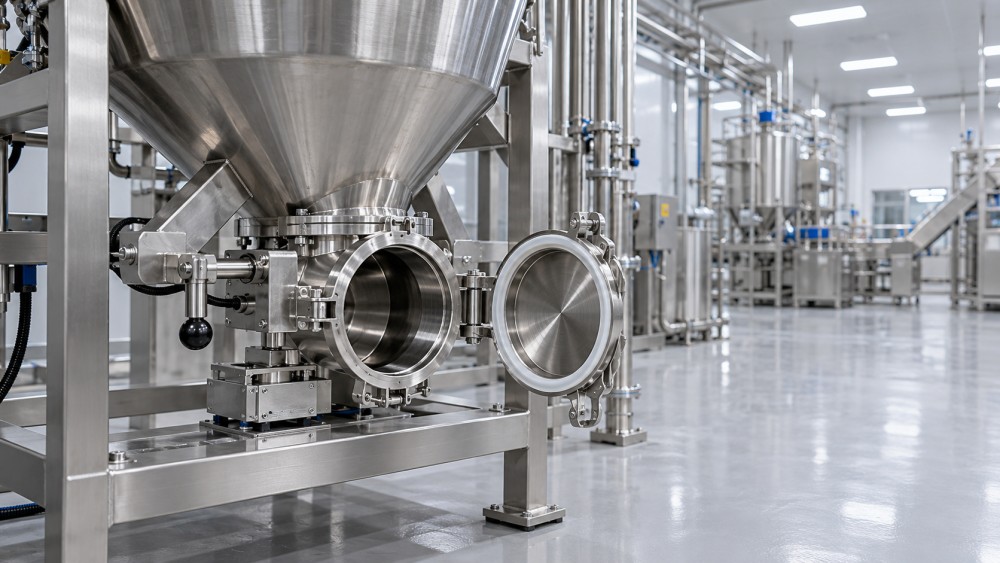
Distinguish equipment intended for cleaning in place from equipment that requires dismantling. For a clean-in-place arrangement, request a description of the flow path, coverage, drainage, and the conditions needed to clean each product-contact area. The site still needs to validate its own cleaning procedure for the product, equipment configuration, and hygiene objective. A supplier’s statement that a machine is “CIP ready” is not evidence that the complete installed system will clean effectively.
For dismantled assemblies, assess the practical sequence. Can seals be removed without damage? Can components be reassembled in the wrong orientation? Are inspection points available after cleaning? Frequent removal of delicate parts may increase downtime and create opportunities for misassembly or seal wear. Consider how the design supports cleaning verification, including visual inspection and, where appropriate, site-defined residue or microbiological checks.
Dry operations need a different assessment. Introducing water into a process designed for dry cleaning can create problems, so do not treat washdown capability as a universal advantage. Examine dust containment, access for dry cleaning, and the risk of residue collecting in non-product zones. Agree on permitted cleaning methods and chemicals before selecting motors, sensors, and enclosures.
Match the equipment type to the duty
The right measurement approach depends on the material and where control is needed. A gravimetric feeder measures mass and can compensate for some variation in bulk density, but it still requires attention to vibration and material flow. A volumetric feeder meters by volume and may be simpler for a consistently behaving material; its delivered mass can change when bulk density changes. Compare both using the actual ingredient and the allowable variation in the finished product.
For batch weighing, a hopper on load cells can measure several ingredients into one vessel, but sequence and retention matter. A minor ingredient added after a large dose may demand a measurement range that the same scale cannot deliver reliably. A separate smaller-scale dosing station may be justified when the required tolerance cannot be demonstrated over the full range. That choice also adds transfer points and cleaning interfaces that need assessment.
For packaged products, an in-line checkweigher measures packs after filling and can identify units outside configured limits. It does not replace control of the filling process or prove that an upstream recipe was correct. Determine whether the system only rejects packs or also sends feedback to the filler, and establish who controls the feedback limits. A reject mechanism needs its own verification: detecting an unsuitable pack is not enough if it can remain in the accepted product stream.
Flow meters and pump-based dosing systems can suit liquids, but the measured quantity and installation conditions must match the objective. A volumetric flow measurement may need density information when the recipe is specified by mass. Entrained air, viscosity changes, straight-run requirements, and cleaning compatibility can affect the choice. Ask for the supplier’s performance evidence at the expected flow range and with a representative product or a justified substitute.
Turn the specification into an acceptance test
Before ordering, agree on a test protocol that connects the supplier’s claims to the site’s acceptance criteria. Include the production configuration, representative materials, measurement references, and a plan for recording individual results. A factory test can expose problems before shipment, but site testing remains important because utilities, mounting, interfaces, and adjacent equipment may differ.
- Verify the reference method. Use suitable reference instruments with traceable calibration and sufficient capability for the tolerance being checked. Record their status and the conditions of the test.
- Test across the intended range. Include the smallest critical dose, a normal operating point, and the upper end of the expected range. Run enough cycles to assess variation under a documented sampling plan.
- Run at the intended rate. Measure individual outputs after the equipment has reached normal operating conditions. Include starts, stops, and changeovers if these are significant to the process.
- Challenge relevant disturbances. Where practical, test with nearby equipment operating and examine the effect of foreseeable product variation. Do not introduce unsafe conditions merely to create a challenge.
- Check cleaning and restart. Carry out the agreed cleaning and reassembly procedure, inspect accessible areas, and repeat relevant performance checks before release to production.
Define in advance what constitutes a pass, how failed results will be investigated, and which changes require a retest. Record both the indicated value and the independently measured output where the process permits. This distinction is especially useful when a controller reports a correct dose but material remains in a chute or continues to discharge after the stop signal.
Plan for calibration, records, and maintenance
Ask how zero, span, and calibration are checked on the installed machine. Access for test weights or another suitable reference should be part of the mechanical design, not an improvised procedure after installation. Establish calibration intervals using risk, equipment behavior, manufacturer guidance, and site requirements; verify performance after interventions that could affect measurement, such as load-cell replacement or mechanical adjustment.
Review the data interface against the controls already in use. Recipe identifiers, setpoints, actual doses, alarms, operator actions, and timestamps may be needed for investigation and traceability. Confirm which values are stored, where they are stored, how records are retrieved, and what happens during a network interruption. Access controls should prevent unauthorized changes without making routine operation dependent on shared credentials.
Finally, compare maintenance demands alongside purchase specifications. Check availability of wear parts, seals, calibration instructions, diagnostic information, and procedures for returning the equipment to hygienic condition after repair. The preferred machine is the one that can demonstrate the required process output, be cleaned using the site’s validated method, and remain verifiable after installation and maintenance.