
FDA does not issue a standalone certificate approving a drug manufacturing process. Manufacturers must establish and maintain evidence that their processes consistently produce drugs meeting predetermined quality requirements. FDA evaluates that evidence through application review, where applicable, and inspections of manufacturing operations and compliance with current good manufacturing practice (CGMP).
For quality control and safety teams, this distinction affects supplier qualification, equipment acceptance, validation planning, and batch release. A claim that a process or machine is “FDA certified” cannot replace evidence that the specific manufacturing operation is controlled for its intended product, site, equipment, and operating conditions.
What FDA approval, registration, and inspections actually establish
Several regulatory activities can be mistaken for process certification. They have different purposes, and none provides a permanent assurance that every future batch will meet specifications.
- Drug application approval: For drugs requiring an approved application, FDA reviews manufacturing and control information as part of its assessment. Approval relates to the application and its conditions; it does not create a transferable certificate for a manufacturing technology.
- Establishment registration and drug listing: These fulfill applicable regulatory obligations. Registration or listing does not mean FDA has approved the establishment, its processes, or its products.
- Manufacturing inspections: FDA examines operations, records, facilities, and quality systems to assess compliance. Inspection findings concern the conditions and evidence evaluated; an inspection does not replace ongoing manufacturer oversight.
- Manufacturer validation: The manufacturer develops, documents, and maintains evidence that its process can consistently deliver the required product quality. This responsibility continues throughout commercial production.
When a supplier presents an “FDA certificate,” the first useful question is what the document actually represents. A registration-related document, an export certificate, and a private consultant’s assessment carry different meanings. None should be accepted as proof that a proposed drug manufacturing process has been validated for the buyer’s application.
Equipment claims require the same scrutiny. A vacuum pump, weighing system, or ultrasonic cleaner may have features that support pharmaceutical use. Its suitability still depends on installation, materials, operating range, cleaning, controls, and interaction with the process. FDA does not routinely certify individual machines as universally suitable for drug manufacturing.
The validation framework: binding requirements and FDA guidance
For finished pharmaceuticals, the central federal CGMP requirements are in 21 CFR Parts 210 and 211. Relevant provisions address equipment design and maintenance, written production procedures, control of manufacturing processes, laboratory controls, and production record review. Section 211.100 requires written production and process control procedures designed to assure drug identity, strength, quality, and purity. Section 211.110 addresses controls that monitor process output and validate the performance of manufacturing processes that may cause variability.
FDA’s Process Validation: General Principles and Practices guidance, issued in January 2011, explains the agency’s lifecycle approach. The guidance describes FDA’s recommendations; the regulations establish binding obligations. A manufacturer should distinguish between the two when writing procedures, assessing gaps, or responding to an inspection observation.
This article focuses on that lifecycle framework for drug manufacturing. Active pharmaceutical ingredients and specialized operations can require additional consideration of applicable guidance and product-specific requirements. A validation strategy should identify its regulatory scope before adopting a standard protocol across different products or facilities.
Stage 1: Process design establishes what must be controlled
Process design defines the commercial manufacturing process using knowledge gained during development and scale-up. The practical objective is to understand which material attributes and process parameters affect product quality, how much variation can be tolerated, and which controls keep the process within an acceptable range.
A useful process design package explains why the operating conditions were selected. It connects product quality attributes to material variability, equipment behavior, sampling, and control limits. A list of machine settings, without a scientific basis, provides limited support when a batch behaves unexpectedly.
Consider a blending operation supplied by an automated weighing system. Confidence in the process depends on more than the scale’s calibration certificate. Minimum ingredient quantities, dispensing tolerances, material transfer losses, ingredient identification, and recipe controls may all affect whether the intended composition reaches the blender.
Stage 2: Process qualification demonstrates commercial capability
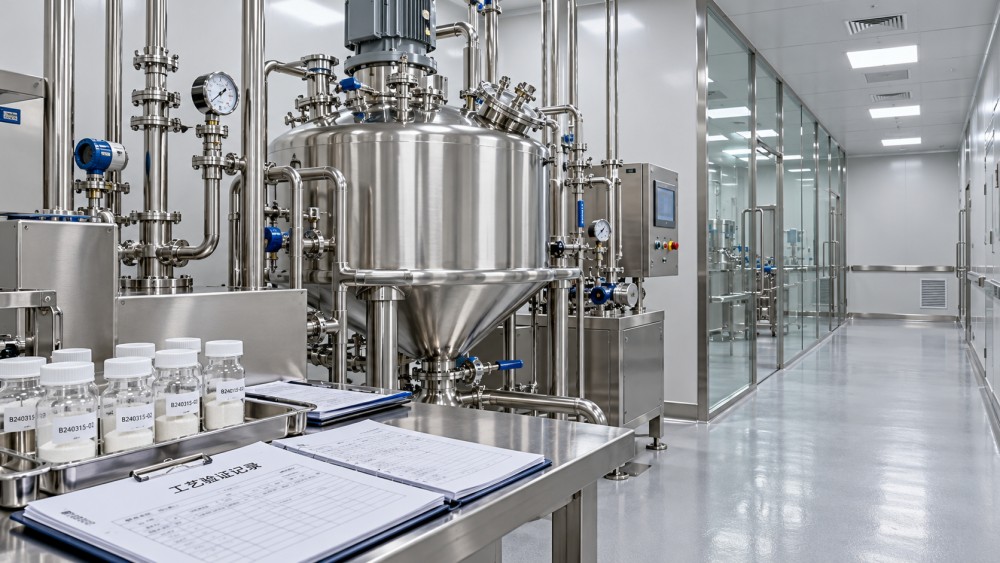
Process qualification includes qualification of the facility, utilities, and equipment, followed by process performance qualification (PPQ). These activities answer related but different questions: whether the manufacturing infrastructure is suitable, and whether the defined process can perform reproducibly under commercial manufacturing conditions.
Installation qualification, operational qualification, and performance qualification—often abbreviated IQ, OQ, and PQ—can support equipment qualification. Completing those documents does not, by itself, establish that the overall drug manufacturing process is validated. Equipment performance must connect to the product and the process it supports.
PPQ should follow an approved protocol with defined operating conditions, sampling plans, tests, acceptance criteria, and responsibilities. Sampling needs enough depth to reveal relevant variation within and between batches. The resulting report should assess deviations and explain whether the combined evidence supports routine commercial manufacture.
Three successful batches are not a universal FDA rule. FDA’s lifecycle guidance does not prescribe a fixed PPQ batch count for every process. The amount of evidence should reflect process understanding, complexity, variability, and relevant experience. A familiar batch count cannot compensate for weak sampling or unexplained results.
FDA’s general expectation is successful completion of PPQ before commercial distribution. Its guidance discusses concurrent release in limited circumstances. Such an approach needs a specific justification and appropriate oversight; a production deadline does not establish that justification.
Stage 3: Continued process verification maintains the evidence
Validation remains active after qualification. Continued process verification uses production data to assess whether the process remains in a state of control and to identify changes before they cause unacceptable product quality.
Monitoring should cover the variables that matter to the process. Depending on the operation, these may include blend uniformity, fill weight, moisture, yield, temperature, pressure, equipment performance, and relevant material attributes. The monitoring plan should define review responsibilities and the actions triggered by an adverse trend.
Passing release specifications does not eliminate the need to investigate process drift. A parameter moving steadily toward an established limit may warrant action before a batch fails. The annual evaluation required under 21 CFR 211.180(e) contributes to product quality oversight, but the timing of process monitoring should reflect risk and the speed at which problems can develop.
How auxiliary systems affect the validation conclusion
Supporting equipment can introduce variability directly into a drug manufacturing process. Its validation significance depends on its effect on product quality, including contamination control, dosing accuracy, and process conditions. Equipment size, purchase price, or location outside the main production room is a poor basis for deciding its importance.
Cleaning systems: demonstrate residue removal under defined conditions
An ultrasonic cleaner’s operating frequency and cycle time describe only part of its performance. Cleaning effectiveness can also depend on component geometry, loading, cleaning solution, temperature, bath condition, rinsing, and the accessibility of contaminated surfaces. A successful cycle for one component family does not automatically establish suitability for another.
Cleaning validation should support the cleaning procedure for its intended use, using justified residue limits, appropriate analytical methods, and a sampling strategy capable of detecting relevant contamination. Where applicable, microbial contamination and endotoxins also need consideration. Grouping equipment or selecting a worst case requires a documented scientific basis.
A visually clean surface can still carry unacceptable residues. Conversely, simply increasing cleaning time does not demonstrate adequate removal. Quality teams need evidence connecting the cleaning conditions, residue characteristics, and measurement method to an acceptable outcome.
Weighing and batching: qualify the complete material addition
A calibrated balance can produce an accurate reading while the overall dispensing operation delivers the wrong quantity or ingredient. Potential causes include unsuitable weighing ranges, vibration, incorrect tare handling, material remaining in transfer containers, and recipe configuration errors.
Qualification should therefore examine the intended weighing range and actual operating environment. For automated batching, relevant challenges may include ingredient identification, recipe access, tolerance alarms, interrupted sequences, and reconciliation of commanded versus delivered quantities. The control strategy should address what happens when an addition falls outside its permitted tolerance.
Electronic records also need appropriate controls. Where 21 CFR Part 11 applies, electronic records and signatures bring additional requirements. The scope should be assessed against the records being maintained and the applicable underlying regulations, rather than inferred from a software vendor’s claim of “Part 11 compliance.”
Vacuum systems: connect equipment performance to product conditions
In operations such as freeze-drying and vacuum drying, pressure behavior can affect drying performance and product quality. A pump achieving its specified ultimate vacuum does not establish that the assembled system maintains the required conditions during a loaded production cycle.
Relevant evidence may include leak performance, instrument accuracy, pressure stability, load effects, and the response to utility interruptions. Depending on system design, contamination risks from pump fluids or backflow may also require controls. Acceptance criteria should reflect the process need rather than simply reproduce a pump datasheet.
What quality teams should be able to demonstrate
A defensible validation package allows a reviewer to trace the reasoning from product requirements to process controls and then to observed performance. Protocol signatures matter, but they cannot resolve missing evidence or unexplained discrepancies.
For an internal assessment or inspection preparation, four questions expose substantial weaknesses quickly:
- Why should this process work consistently? Development knowledge, risk assessments, and studies should explain the selected operating ranges and controls.
- What demonstrates performance at commercial scale? Qualification and PPQ records should represent the intended equipment, materials, procedures, personnel, and operating conditions.
- How are departures evaluated? Deviations, atypical results, failed acceptance criteria, and investigations should be assessed before concluding that qualification succeeded.
- What demonstrates continuing control? Monitoring, maintenance, calibration, change control, and periodic review should show whether the original validation conclusions remain supported.
Data integrity connects all four. Reviewers need reliable original records, traceable calculations, controlled methods, and explanations for excluded or repeated results. A polished final report cannot repair a study whose underlying data are incomplete or selectively presented.
Changes also require an explicit assessment. Replacing a pump with a different design, modifying cleaning chemistry, changing ingredient characteristics, or updating batching software may affect validated conditions. The response can range from documented assessment and targeted qualification to additional process validation, depending on the change and its potential effects. Repeating every study automatically can waste effort; assuming every replacement is equivalent can leave a material gap.
Finished-product testing remains important, but it samples only part of a batch and cannot establish control of every manufacturing step. Validation supplies the broader evidence that the process is capable of consistently producing acceptable output.
When a customer or auditor requests “FDA process certification,” the practical response is to clarify the evidence needed: applicable regulatory status, qualification records, the process validation conclusion, and evidence of continuing control. A useful readiness question is whether the quality team can explain why the process remains reliable after a material, equipment, or operating condition changes—and show the records supporting that judgment.