In food production, a small trace of the wrong powder can compromise product safety, introduce an undeclared allergen, and lead to costly recalls. For quality control and safety managers, prevention starts with understanding how ingredients move through batching and powder handling equipment—not just during normal production, but also during changeovers, cleaning, maintenance, and recovery from a stoppage.
The difficult part is that powder does not always follow the intended process route. It can settle on overhead surfaces, collect behind seals, escape when a bag is opened, or remain in a flexible hose after a product change. A reliable control plan therefore combines equipment design with ingredient segregation, verified cleaning, disciplined recipe management, and records that make affected batches identifiable.
Follow the powder, not just the process diagram
A process flow diagram is a useful starting point, but it rarely shows every place where an ingredient can travel. Map the full route from receiving and storage to bag tipping, conveying, weighing, blending, and discharge. Include shared tools, dust extraction, waste handling, rework, and the movement of people between rooms.
At each transfer point, ask two questions: where can material remain after the batch has passed, and where can dust escape? A weigh hopper may discharge cleanly while powder remains on its lid, in a vent filter, or at a screw feeder inlet. A disconnected transfer hose may be clean internally but contaminated on the outside. These details matter when the next recipe has a different allergen profile.
Consider a line that handles milk powder followed by a dairy-free seasoning. The obvious shared surfaces are the hopper, feeder, and blender. Less obvious routes include the scoop used for minor ingredients, powder deposited on a platform above an open vessel, and dust released when a collection bin is emptied. The assessment should cover the whole production area, not only the equipment listed on the recipe.
Separate ingredients before relying on cleaning
Physical segregation is generally more dependable than asking operators to remove every trace from a complicated shared system. Depending on the hazard and production volume, options range from dedicated rooms and lines to dedicated hoses, scoops, containers, or filter elements. The right boundary depends on the consequences of transfer and the practical ability to verify removal.
Storage and staging deserve the same attention. Keep ingredients identified throughout their movement, including after outer packaging has been removed. Close partially used bags or transfer their contents into suitable, clearly labelled containers. Assign locations that reduce the chance of spills reaching exposed materials, and control access to ingredients awaiting weighing.
Production sequencing can reduce changeover risk: products without a particular allergen may be scheduled before products containing it. But sequencing is not a substitute for a validated cleaning procedure when one is required. Schedule changes, urgent orders, rework, and maintenance can all break the intended sequence. The plan needs a defined response when that happens.
Rework is especially easy to overlook. Its identity should include the original ingredient and allergen profile, not just a generic product name. Define which recipes can receive it, how much may be used, who authorizes the addition, and how the originating lots remain linked to the receiving batch.
Design for access, containment, and inspection
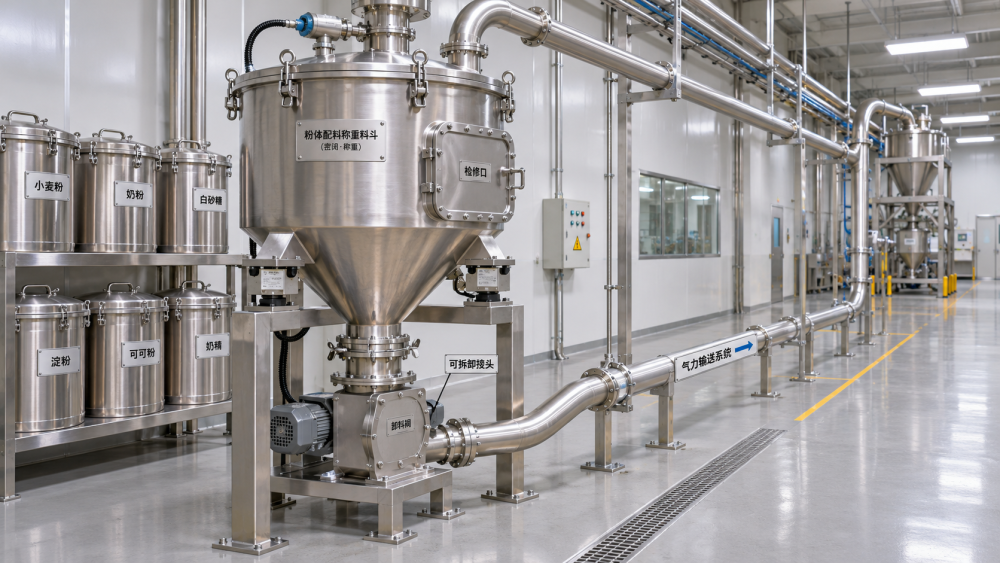
A closed transfer system can reduce exposure to airborne dust, but “closed” does not automatically mean cleanable. During equipment reviews, follow the product path through bends, valves, gaskets, feeder screws, flexible connections, and filter housings. Ask which components must be opened or removed to inspect them and whether operators can do that safely within the available changeover window.
Useful design features may include accessible contact surfaces, joints that can be inspected, minimal powder traps, and components that can be disassembled without damaging seals. Materials and surface finishes should suit the food, cleaning method, and applicable food-contact requirements. A smooth stainless-steel surface is helpful, but it cannot compensate for a concealed cavity that cannot be reached.
Dust control also needs a system-level review. Local extraction at bag tipping or manual dosing points can limit the spread of powder, provided the airflow is appropriate for the task and the collection system is maintained. Check whether shared ductwork, filter changes, or discharge of collected dust could transfer material between areas. Avoid treating a visibly clean floor as proof that airborne deposition is under control.
Food safety must be considered alongside worker safety. Some powders can create combustible dust hazards. Extraction, electrical equipment, housekeeping, and any proposed cleaning method should be evaluated against the materials handled and applicable local requirements. Compressed-air blowdown, for example, can redistribute contamination and may create additional hazards; it should not be adopted casually as a cleaning shortcut.
Choose a cleaning method the process can support
Dry cleaning is often attractive in low-moisture environments because introducing water can create its own food safety problems. Depending on the equipment and hazard assessment, a procedure may involve controlled removal of residual powder, suitable industrial vacuuming, wiping with approved materials, and disassembly of selected parts. The procedure should specify where to start, what to remove, how to protect cleaned components, and how to dispose of recovered material.
Wet cleaning may be appropriate where product residues cannot be removed effectively by dry methods or where the equipment is designed for it. It also introduces questions: Can water reach electrical or inaccessible areas? Can every surface be dried before production resumes? Could moisture remain under a gasket or inside a conveyor? A method that removes an allergen but leaves persistent moisture in a low-moisture process may exchange one hazard for another.
Flush material can help remove residual powder from some systems, but its effectiveness must be established for the equipment, ingredient, and operating conditions. Define the material used, the route it follows, the amount needed for the intended purpose, and how it is identified and disposed of or otherwise handled. A flush cannot be assumed to reach a stagnant pocket simply because material exits the discharge point.
Validation is different from a routine check
Cleaning validation provides evidence that a defined method can consistently achieve its intended result under relevant conditions. Routine verification checks whether the procedure has been completed effectively in day-to-day operation. Both need a documented rationale, but they answer different questions.
Select sampling locations based on the process map and the hardest places to clean, not only the easiest surfaces to reach. Allergen-specific tests may be useful where appropriate to the ingredient and sample; general protein or ATP tests can support hygiene checks but do not necessarily establish the absence of a particular allergen. Visual inspection remains valuable, especially for trapped powder, but a surface that looks clean is not conclusive evidence of allergen removal.
Define acceptance criteria, sampling methods, test limitations, and release authority before the line is cleaned. If a check fails, hold potentially affected product, investigate the source, reclean as necessary, and document the decision before restarting. Reassess the validation when equipment, formulation, cleaning materials, or operating conditions change in a way that could affect the result.
Make weighing and recipe controls part of the safety barrier
Accurate weighing is important, but a scale can deliver the right quantity of the wrong ingredient. Food safety batching systems need controls that connect ingredient identity, recipe authorization, and the physical point of addition. Depending on the process, those controls may include barcode checks, restricted recipe changes, confirmation prompts, and interlocks that prevent an unapproved addition or transfer.
Manual additions require particular care. Provide a defined staging area and identify each preweighed container with its ingredient, lot, quantity, intended batch, and status. Set rules for interrupted work: an open container left beside a scale during a shift change should not become an unidentified addition. If a scan fails or a label is damaged, the operator needs a controlled exception process rather than an informal workaround.
Scale calibration and routine checks should reflect the required weighing range and tolerances of each ingredient. Also consider where powder accumulates around load cells, platforms, and enclosures. Cleaning should not compromise measurement performance, and maintenance should not leave the system ready for use without the appropriate checks and release.
Trace the batch through exceptions, not just normal production
A useful batch record links finished lots to ingredient lots, quantities, equipment used, operators or authorization events, cleaning status, and relevant deviations. It should also capture rework, partial bags, substitutions, and interrupted transfers. Those exceptions are often where traceability becomes difficult.
Test the system with a mock recall or trace exercise. Can the team identify where a suspect ingredient lot went, including material used as rework? Can it identify all ingredients and shared equipment associated with a finished batch? Examine not only whether records exist, but whether they are complete and accessible when production is under pressure.
For regulatory decisions, check the rules and allergen-labelling obligations applicable to the manufacturing site and each destination market. Requirements and recognized allergens differ between jurisdictions. Preventive controls and precautionary labelling decisions should be based on the relevant legal framework and a documented assessment, not on an assumption that one market’s approach applies everywhere.
What to ask before changing equipment or procedures
A proposal to add a conveyor or automate a minor-ingredient station should be assessed against the whole contamination-control plan. Before approving a design or modification, quality, engineering, sanitation, and operations teams should resolve a few practical questions:
- Which ingredients and allergen profiles will share the equipment, and what changeovers are expected?
- Which contact points, dust-control components, and seals require inspection or removal during cleaning?
- Can the intended cleaning method be performed and verified within the production schedule?
- What happens to material and batch records during a stoppage, failed check, or maintenance intervention?
- What evidence will be needed for commissioning, cleaning validation, operator training, and handover?
Global General Industrial Auxiliary Systems (GIAS) covers industrial weighing, batching, and related process-support technologies, providing a useful context for comparing equipment features against these operational questions. The important distinction is between a feature that looks suitable on a specification sheet and a control that can be inspected, maintained, and demonstrated on the production floor.
Start with the highest-consequence transfer routes and the changeovers that are hardest to verify. A detailed walk-through with operators and sanitation staff may reveal a shared hose or inaccessible filter that matters more than a major equipment upgrade. Once those routes are understood, the team can decide where segregation is necessary, where cleaning can be validated, and what evidence is needed before the next batch is released.