
The scale passed its accuracy check before production. After the evening washdown, its zero began to drift. Operators compensated, batches continued, and the problem looked like a minor maintenance issue—until quality control had to determine whether ingredient additions were still within specification.
Choosing industrial weighing systems food processors can rely on means looking beyond the accuracy stated on a datasheet. High-pressure cleaning, chemical exposure, temperature changes, and trapped moisture can affect both measurement reliability and hygiene. For quality control and safety teams, the purchasing decision should connect three questions: Can the system weigh correctly, can it be cleaned effectively, and can it keep doing both under the plant’s actual sanitation routine?
A useful evaluation starts with the cleaning process, not the equipment catalog.
Turn your washdown routine into a purchasing specification
“Suitable for washdown” is too vague to be an acceptance criterion. A scale exposed to occasional low-pressure rinsing faces different conditions from one cleaned daily with hot water, foam detergents, and directed pressure jets.
Before contacting suppliers, document the conditions at the installation point. Include water temperature, pressure, nozzle distance, cleaning frequency, chemical concentrations, contact times, and whether operators spray beneath the platform. Record exposure to condensation, brine, fats, flour, and product residues as well.
Ask sanitation staff what actually happens during cleaning. A written procedure may prohibit direct spraying of an indicator, while its location makes avoiding the spray nearly impossible. Equipment selection should address that mismatch rather than assume perfect operator behavior.
- Open-product areas: Prioritize cleanability, accessible inspection points, and prevention of residue accumulation.
- Raw-product zones: Consider biological hazards, aggressive cleaning, and separation from ready-to-eat operations.
- Allergen changeover areas: Assess whether product-contact and splash-exposed surfaces can be inspected and cleaned effectively.
- Cold or humid rooms: Evaluate condensation and temperature transitions, not only direct water exposure.
This exposure profile gives procurement a defensible basis for comparing proposals. It also helps identify where relocating an indicator or changing the installation layout could reduce risk more effectively than upgrading an enclosure alone.
Read ingress ratings carefully—and at component level
Ingress protection ratings describe tested resistance to solids and water under specified conditions. They do not establish hygienic design, detergent compatibility, or indefinite durability.
IP69 and IP69K refer to designations associated with different standards; do not treat them as interchangeable without reviewing the supporting documentation. Where immersion and pressure washing are both relevant, request evidence for both exposures.
Most importantly, identify what was tested. A protected load cell does not make the entire weighing system equally protected. The indicator, junction box, connectors, cable glands, and accessories may have different ratings. Ask suppliers whether ratings apply to individual components or to the assembled configuration being offered.
Installation matters too. An incorrectly sized cable gland, a loose enclosure cover, or an unsealed unused port can undermine the intended protection. Include sealing checks in installation acceptance and subsequent maintenance.
Inspect the places where water and food can hide
A stainless-steel exterior may look reassuring while concealing poor drainage, inaccessible crevices, or exposed threads beneath the platform. Hygiene assessment should follow the path of food residue and cleaning water through the equipment.
Inspect the underside, feet, hinges, overload stops, cable routes, and junction-box mounting points. Look for overlapping surfaces, unsealed hollow sections, rough welds, and horizontal ledges that retain liquid. Ask whether the platform can be lifted safely and whether cleaners can reach the surfaces underneath without dismantling electrical connections.
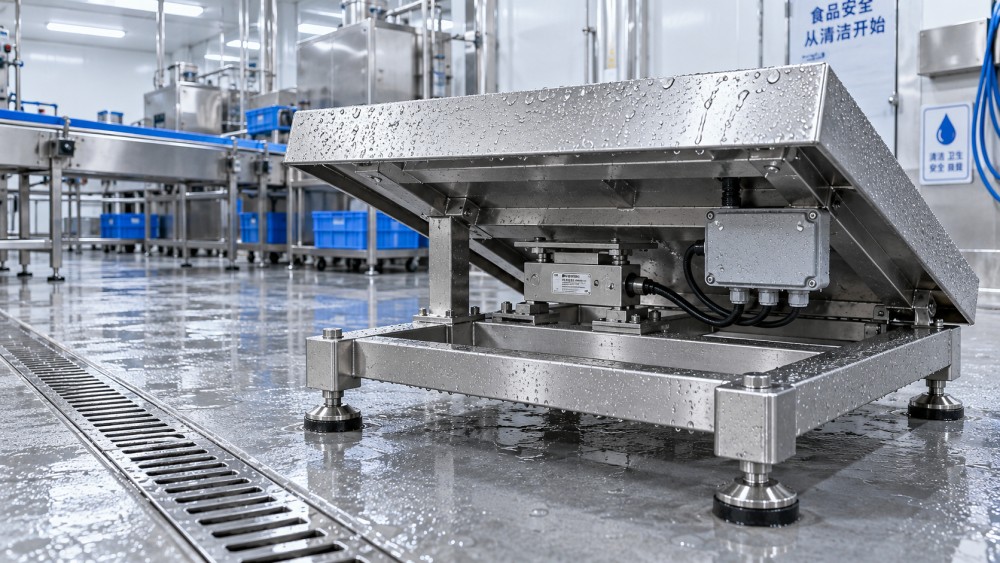
For direct food-contact surfaces, request material documentation and evidence of suitability for the intended use. For splash zones, assess the same practical concerns: corrosion resistance, cleanability, drainage, and compatibility with the site’s sanitation chemistry.
Stainless steel is a starting point, not a complete specification
Grades such as 304 and 316 are common in food-processing equipment. The additional corrosion resistance of 316 can be useful in some chloride-containing environments, but neither grade is immune to poor chemical control, prolonged exposure, or unfavorable surface conditions.
Ask suppliers to evaluate the actual cleaning agents, concentrations, temperatures, and contact times. Include seals, display windows, keypads, adhesives, and cable jackets in that review. These materials may deteriorate before the metal frame shows visible damage.
Surface finish and fabrication also matter. Smooth, accessible welds and drainable geometry generally offer a better cleaning outcome than a nominally superior alloy assembled with residue-trapping details.
Cleanable equipment must also be safe to clean
A removable deck is useful only if employees can handle it safely. Check its weight, lifting assistance, pinch points, and stability when raised. Hinges and supports should allow inspection without creating a new injury hazard or obstructing cleaning access.
For hygienic-design certifications or assessments, verify the specific model, configuration, and scope. A certification covering one product family or component should not be assumed to cover every offered accessory or installation.
Match weighing performance to the food process
Once sanitation suitability is established, evaluate the measurement task. Receiving bulk ingredients, dosing minor additives, verifying package weight, and weighing a mixing vessel require different selection criteria.
Start with the smallest quantity that must be measured reliably and the largest operating load. Include containers, fixtures, and vessel tare weight. Then define the acceptable error for the process—not merely the desired display resolution.
Readability is not accuracy. A display with fine increments does not prove that the system can resolve small ingredient additions reliably on a large platform. Ask for repeatability, linearity, eccentric-loading performance, and uncertainty information appropriate to the intended use.
For ingredient dosing, check performance at the actual addition weights. A scale that performs well near full capacity may be unsuitable for a small additive dose. Separate minor-ingredient weighing may be more defensible than forcing one high-capacity system to cover every recipe requirement.
For tank and hopper weighing, examine piping, flexible connections, agitators, and structural supports. These can introduce forces that bypass or disturb the load cells. Thermal expansion after hot cleaning may also change the mechanical conditions around the vessel.
Dynamic checkweighers need a different assessment: package spacing, belt speed, product stability, vibration, and reject-system performance all affect results. Static calibration alone cannot demonstrate performance during production.
Protect the complete measurement chain
Load cells often receive the most attention because they are central to measurement. Yet moisture entering a junction box or damaged cable can produce equally disruptive symptoms: unstable readings, intermittent faults, or unexplained zero shifts.
Evaluate the load-cell sealing method and the manufacturer’s application guidance. Hermetically sealed designs may be appropriate for demanding wet environments, but the term should be supported by construction details and relevant test information.
Check cable routing for abrasion, pulling, crushing, and exposure to standing water. Connectors should be positioned to reduce direct spray exposure where practical, with suitable strain relief and sealing. Avoid installation details that allow water to collect around entries.
Mechanical protection needs equal attention. Floor scales may experience impacts from bins or handling equipment. Overload stops can protect load cells, but they must be correctly adjusted and accessible for cleaning. Residue lodged against a stop or beneath a platform can create a force path that changes the reading.
Indicator placement is a practical trade-off. Operators need good visibility and ergonomic access, while sanitation teams need fewer exposed surfaces in the wet zone. Remote mounting can reduce exposure, provided the cabling, access, and installation remain suitable.
Make post-cleaning verification part of acceptance
Calibration establishes the relationship between the weighing indication and reference values under defined conditions. Routine verification checks whether performance remains acceptable. Neither should be treated as a substitute for investigating moisture ingress or mechanical problems.
Before approval, agree on a verification plan that reflects process risk. It should identify check weights, test points, tolerances, frequency, records, and the response to a failed check. Use suitable reference weights with documented traceability, and manage their storage and cleanliness.
Where washdown is a significant concern, verify performance before and after representative cleaning. Follow the manufacturer’s specified stabilization conditions and note temperature, drying time, and any abnormal behavior. If readings recover only after prolonged drying, investigate rather than accepting that pattern as normal.
An on-site acceptance trial can include:
- Checking zero and repeatability at representative operating loads.
- Testing off-center loading where applicable.
- Performing the approved sanitation procedure under controlled conditions.
- Inspecting drainage, cleaning access, seals, and vulnerable connection points.
- Repeating measurement checks after the specified stabilization period.
- Running actual production conditions to assess vibration, throughput, and operator handling.
Define failure handling before production begins. For quality teams, a failed verification may require assessment of product made since the last satisfactory check. Traceable weighing records and clear escalation rules make that assessment more manageable.
Compare suppliers on evidence, not washdown language
A strong proposal should connect the offered equipment to your exposure profile and measurement requirements. Ask for rating documentation, cleaning instructions, material specifications, performance data, maintenance requirements, and a clear list of excluded conditions.
If weighing data supports recipe control or traceability, review how the system records units, tare values, ingredient or batch identity, timestamps, and operator actions. Where electronic records are required, consider access controls, change history, connectivity failures, and recovery procedures.
Commercial or regulated weighing may require jurisdiction-specific approval and verification. Food-safety obligations are also application-dependent; an enclosure rating is not evidence that every relevant regulatory requirement has been met.
Finally, compare lifecycle costs: cleaning labor, verification time, replacement seals, service availability, spare load cells, downtime, and potential product holds. A lower purchase price can lose its advantage if routine sanitation repeatedly interrupts production.
GIAS approaches industrial auxiliary equipment as part of the wider process-quality system. For food weighing, that means evaluating measurement, hygiene, installation, and traceability together. The strongest purchasing decision is not the scale with the most impressive headline rating. It is the system whose documented performance matches the process, whose construction supports safe cleaning, and whose reliability can be demonstrated after the washdown crew has finished.