
A defect discovered during a customer inspection can raise an urgent question: which other products were made under the same conditions? Without reliable identification, answering it may mean checking paper logs, searching spreadsheets, or holding an entire shipment while the investigation continues.
A digital traceability serial number gives each identified item a unique reference that can connect it to manufacturing and supply chain records. Depending on how the system is designed, those records may include material lots, production dates, equipment settings, inspection results, and shipment details. The number itself does not contain the full history; it makes that history easier to find and verify.
What Is a Digital Traceability Serial Number?
A serial number is an identifier assigned to one particular item within a defined identification system. It may be printed as readable text, encoded in a machine-readable symbol such as a Data Matrix or QR code, or presented in both forms. When a reader captures the code, software uses the identifier to retrieve or update the relevant records.
Consider two pumps of the same model produced on the same day. Their model number describes what they are, and a shared batch number may identify the production group. Different serial numbers distinguish one pump from the other, allowing a manufacturer to examine each unit’s assembly and test history separately.
The distinction matters because identification can operate at several levels:
- Product or model number: Identifies a product type or configuration.
- Lot or batch number: Identifies a group made or processed under defined conditions.
- Serial number: Identifies an individual item within the relevant system.
These identifiers often work together rather than compete. A serialized assembly can be linked to component serial numbers and material lot numbers, creating a more complete view of how the finished product came together.
From a Mark on a Part to a Usable Production History
A serial number becomes valuable when it is linked to events. Imagine a manufacturer marking a metal housing before assembly. At a later station, an operator scans the housing and the lot number of a seal used inside it. A test station then records the result against the housing’s serial number. Finally, packing records connect that unit to a carton and shipment.
If the seal supplier later reports a potential issue with that lot, the manufacturer can search for housings linked to it. The investigation may still require physical checks and engineering judgment, but the search starts with a defined population rather than every unit made during a broad period.
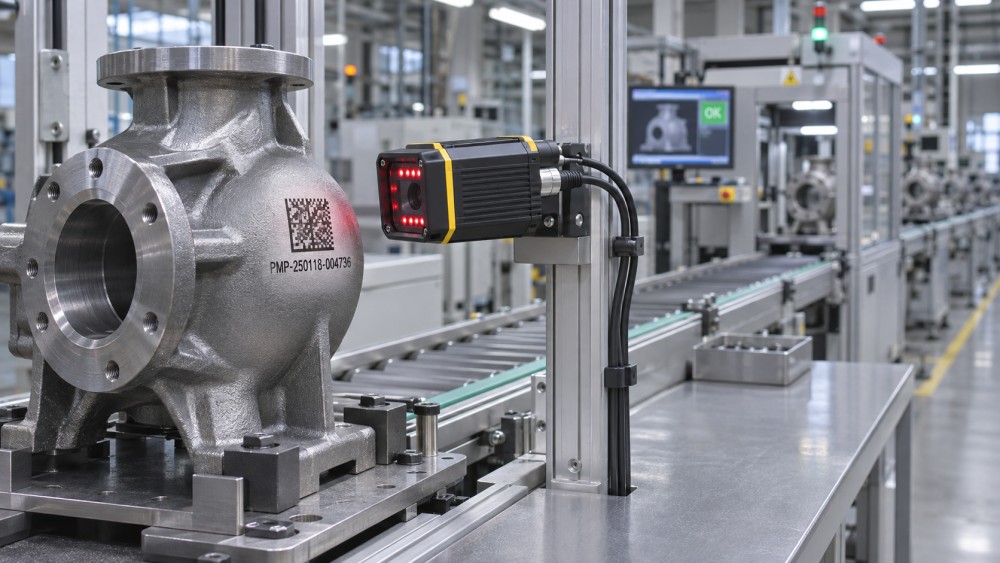
A typical digital traceability path includes four connected activities:
- Assign an identity. Generate a serial number according to rules that prevent duplication within the intended scope.
- Apply and read it. Mark the item or its label, then confirm that the identifier can be captured at the required points.
- Record events and relationships. Associate the identifier with relevant materials, processes, tests, assemblies, and movements.
- Retrieve and interpret the history. Make records searchable for quality investigations, service, audits, or other authorized purposes.
The links between records are as important as the marks themselves. A perfectly readable code cannot reveal which component was installed if the assembly station never recorded that relationship.
What Information Can a Serial Number Connect?
There is no universal record set for every industry. A practical system captures information that supports a specific decision, investigation, or obligation. Depending on the product and process, a serial number may connect to:
- Material and component identifiers, including supplier lots.
- Production order, line, station, and timestamps.
- Equipment or tooling used during critical operations.
- Selected process parameters, such as a recorded weld setting or coating batch.
- Inspection results, test measurements, failures, and rework history.
- Parent-child relationships between components, subassemblies, finished products, and packaging.
- Shipment, service, or return records where those events are captured.
More data is not automatically better. Recording every available machine signal can make systems costly and difficult to manage without improving an investigation. Teams should identify which process characteristics affect quality and which records they would need if a problem occurred.
Traceability across auxiliary processes
Important events do not happen only at the main assembly machine. A precision component may pass through ultrasonic cleaning before welding or coating. A traceability record might identify the cleaning cycle, equipment, or inspection outcome when those details matter to the application.
Similarly, a manufacturer may link a finished unit to a weighing or batching record, a vacuum process cycle, or a surface-treatment lot. The appropriate level of detail depends on the process risk and on whether the equipment and software can reliably capture the information. The aim is not to attach every auxiliary operation to every product, but to preserve the relationships needed to understand product quality.
How Are Serial Numbers Applied to Products?
The right identification method depends on the surface, production environment, expected product life, and the points where the code must be read. A mark that scans immediately after application may behave differently after cleaning, coating, abrasion, or years in service.
Laser marking for direct part identification
Laser marking can place text and machine-readable codes directly on suitable materials, including many metals and certain plastics. It is often considered when a label could detach or when the identifier needs to remain with a component through later operations.
Laser processes and results vary by material and equipment. A mark that is legible on one alloy, coating, or plastic formulation may have insufficient contrast or may affect the surface on another. Trials should consider not only initial readability but also whether the marking process is compatible with functional surfaces and downstream treatments.
Inkjet coding for flexible application
Industrial inkjet systems can apply variable identifiers to products, labels, or packaging, including on moving production lines. Different inkjet technologies and inks suit different surfaces and operating conditions. In some applications, inkjet offers a practical way to add serialized information without directly altering the substrate.
Ink adhesion, drying or curing requirements, and resistance to handling or chemicals deserve attention. If a product undergoes washing or surface treatment, test the selected ink and location under representative conditions rather than assuming the code will remain readable.
Labels and other carriers
A printed label may be appropriate when direct marking is unsuitable or when information needs to be added at packaging. Its usefulness depends on the label material, adhesive, print durability, and exposure during storage and use. Radio-frequency identification can also carry an identifier in some workflows, but it requires compatible tags, readers, and data controls.
No carrier is inherently best for every situation. The choice should reflect where identification must survive and how people or equipment will retrieve it.
Reading the Code Is Only Half the Challenge
A traceability system can fail even when a number is present. The code may be duplicated, linked to the wrong part, obscured after coating, or recorded in a database that another department cannot access.
Code quality and data quality therefore need separate attention. A scanner confirming that a symbol is readable does not necessarily verify that its content is correct or that it meets a specified print-quality grade. Where required, a suitable verification process can assess a code against the applicable symbology or quality standard. Teams should also check that the captured identifier matches the intended item and that the expected production event has been saved.
Common gaps include:
- Duplicate or reused identifiers: Two items may appear to share a history, making records unreliable.
- Missing scans: A component can pass through a station without being associated with its assembly.
- Incorrect parent-child links: A recorded component may not be the one physically installed.
- Unreadable marks: Surface finish, poor contrast, damage, or later processing can prevent capture.
- Disconnected systems: Production, warehouse, and service records may exist but lack a dependable way to connect.
- Uncontrolled corrections: Changes without an audit trail can make it difficult to understand what happened and when.
Exceptions deserve a defined response. If a code cannot be read, can the operator reprint it? Who confirms the item’s identity before relabeling? What happens if a station is offline? These questions are easier to answer before an urgent production issue exposes them.
What Should Manufacturers Consider Before Starting?
For an organization exploring serialization, the first decision is not necessarily which printer or laser to buy. It is what the identifier must make possible. A manufacturer investigating assembly defects may need component-to-product relationships; a service team may need access to configuration and repair records; an exporter may need to satisfy customer or market-specific identification requirements.
From there, several design choices follow:
- Define the item and scope. Decide whether individual components, finished units, cartons, or a combination need serial numbers. Establish where uniqueness must be maintained, including across sites and time.
- Map the critical events. Identify the stations and records needed to answer likely quality or service questions. Include rework and replacement activities, not just the normal production route.
- Test the carrier in context. Assess the actual material, available marking area, line speed, reader position, and exposure to cleaning, coating, handling, or storage.
- Plan system connections. Determine how marking equipment, readers, manufacturing software, and other databases will exchange identifiers and confirm successful transactions.
- Set data rules. Define who can create, correct, view, and retain records, along with how errors and system outages will be handled.
- Check applicable requirements. Customer contracts, industry standards, and regulations may specify identifiers, data carriers, verification, or retention periods. Requirements vary by product and market.
A small pilot can reveal practical issues that are easy to miss on paper. For example, a code placed where a scanner can see it before assembly may be hidden once a cover is installed. Testing the complete route helps teams choose a location and capture strategy that work beyond the marking station.
Does Serialization Guarantee Traceability or Prevent Counterfeiting?
No. A unique identifier is a foundation for traceability, not proof that every record is complete or correct. The strength of the system depends on accurate data capture, reliable relationships between items, controlled changes, and access to records when they are needed.
Serialization can also support authenticity checks, but a visible code can be copied. Anti-counterfeiting measures may require additional controls, such as protected verification processes, monitoring for suspicious identifier use, or other security features appropriate to the product. Those measures serve a different purpose from simply assigning a serial number.
For manufacturers and researchers, the useful question is therefore broader than “Can this part be marked?” It is “Can the right people identify this specific item and trust the history connected to it?” When the physical mark, production workflow, and digital records are designed together, a serial number becomes a practical link between a product and the decisions made throughout its lifecycle.