
A rejected batch, an unreadable traceability code, a coating defect discovered after packaging, or a weighing deviation found during an audit can make a quality system feel expensive very quickly. That is why the question, “How much does a process quality assurance system cost?”, rarely has a useful one-line answer.
For industrial manufacturers, the investment can range from a modest upgrade to inspection controls and digital records to a multi-site program linking sensors, machine data, quality software, traceability, and compliance workflows. The final figure depends on production scale, the consequences of failure, the required level of automation, and how many existing systems must exchange reliable data.
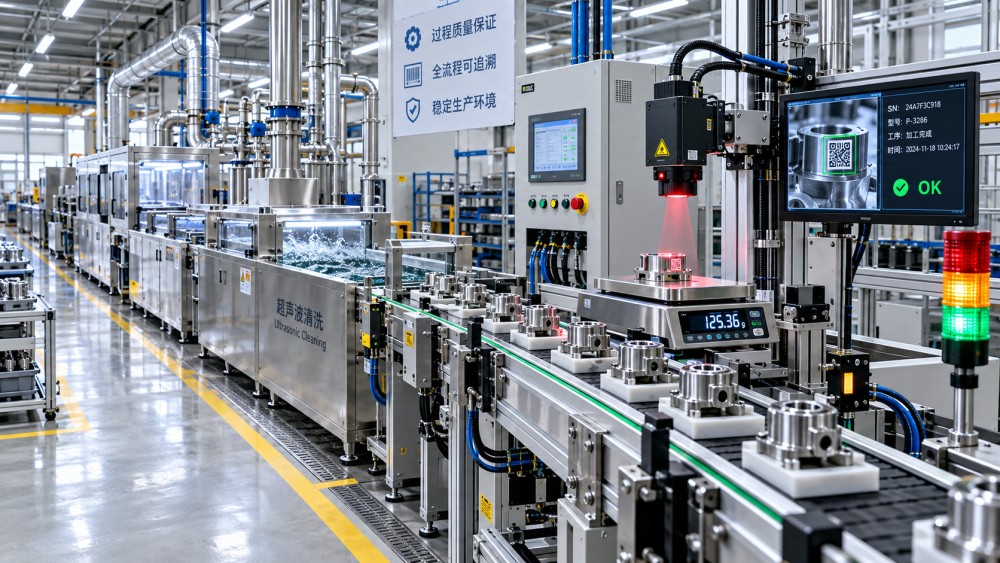
In facilities using ultrasonic cleaning, laser marking, inkjet coding, industrial weighing and batching, vacuum systems, or surface treatment and electrostatic coating equipment, process quality assurance is not a separate administrative layer. It is the framework that proves whether critical conditions were achieved, records what happened, and makes deviations visible before they become customer claims or regulatory problems.
Typical Cost Ranges: A Practical Starting Point
A process quality assurance system may include instruments, inspection stations, software, integration work, validation, training, and ongoing support. Because scope varies so widely, cost is better discussed in bands than as a single market price.
*These are broad planning ranges, not supplier quotations. They can rise substantially when custom automation, cleanroom-compatible equipment, machine vision, regulated validation, cybersecurity requirements, or complex legacy-system integration is involved. They may also exclude recurring software, calibration, maintenance, and internal project costs.
The lower end generally suits a defined problem: for example, monitoring ultrasonic cleaning parameters, recording batch weights, or confirming that codes are present and readable. The upper end becomes relevant when a manufacturer wants a connected quality architecture—one that can associate a product, batch, operator, machine condition, recipe, inspection result, and corrective action across the production journey.
The Most Important Question Is Not “What Does the Software Cost?”
Many buyers begin with a software budget and later discover that software is only one part of the project. A dependable quality assurance system must capture trustworthy information at the point where quality is created or lost. That may require sensors, barcode or vision verification, data-capable controllers, calibrated weighing devices, vacuum gauges, coating thickness measurement, or interfaces to equipment that was never designed to share data.
Consider a manufacturer cleaning precision components before coating or assembly. A digital checklist alone cannot confirm cleaning quality. The system may need to collect ultrasonic frequency, bath temperature, chemical concentration, cycle time, rinse quality, drying conditions, and part identification. If the plant also needs evidence for customer audits, it may require electronic records, controlled user access, exception handling, and secure data retention. The project has moved well beyond a simple form-based application.
The same principle applies to coding and marking. A laser marker can produce a permanent code, but quality assurance may require verification of code content, contrast, placement, legibility, database linkage, and rework controls. In a high-volume environment, an inline vision system and automated reject mechanism may be justified. In a low-volume, high-mix workshop, a guided manual verification process might deliver adequate control at a much lower cost.
Where the Budget Goes
A realistic budget separates capital expenditure from the costs that follow the system into daily operation. The categories below are useful when comparing proposals that initially appear similar.
Measurement, inspection, and process-control hardware
This category can include sensors, PLC upgrades, industrial scales, load cells, cameras, code verifiers, data loggers, vacuum transmitters, temperature probes, thickness gauges, conductivity meters, and test fixtures. Hardware spending depends on the number of quality-critical points and the precision required.
For example, a batching process in food, chemicals, pharmaceuticals, or battery materials may require approved scales, recipe control, material identification, and interlocks that prevent a batch from progressing when tolerance limits are exceeded. The cost is shaped not only by the scale itself, but by hygienic design, hazardous-area suitability, accuracy class, installation conditions, and the number of materials being managed.
Software licenses, platforms, and data storage
Quality management software may support nonconformance management, statistical process control, electronic batch records, audit trails, document control, calibration schedules, dashboards, and corrective and preventive action workflows. Some systems are purchased as perpetual licenses; others use annual or subscription-based pricing.
Cloud platforms can lower upfront infrastructure costs and make multi-site access easier, but recurring fees, user counts, data volume, retention policies, and integration features need close review. An inexpensive license can become costly when every additional production line, operator terminal, or reporting module is priced separately.
Integration and engineering
Integration is often the most underestimated line item. A process QA system may need to communicate with PLCs, SCADA, MES, ERP, laboratory systems, warehouse platforms, or supplier databases. Each interface requires technical mapping: what data is transferred, when it is transferred, who owns it, how errors are handled, and whether a record can be changed after approval.
Older equipment presents a particular challenge. A vacuum oven, coating line, or ultrasonic washer may run reliably for years but lack a modern communication protocol. Adding gateways, sensors, edge devices, or custom middleware may be entirely worthwhile, yet it must be included in the estimate from the beginning.
Validation, documentation, and compliance work
Compliance-sensitive industries may need formal installation, operational, and performance qualification; controlled change management; electronic signature controls; or detailed audit trails. Even where regulations do not prescribe a specific method, export customers frequently require documented evidence that processes are stable and products are traceable.
This work adds cost, but it also avoids a common failure: installing a technically capable system that cannot produce records in a form accepted by customers, auditors, or internal quality teams.
Training and change adoption
Operators should not have to guess why a screen is asking for a check or what to do when a limit is exceeded. Training needs to cover normal use, alarm response, escalation paths, data integrity, and basic troubleshooting. Supervisors need to understand how to interpret trends rather than merely acknowledge alerts.
A system that adds clicks without simplifying decisions tends to create workarounds. Budgeting for clear work instructions, role-based training, and a short period of shop-floor support is often more valuable than adding features that no one uses.
What Drives the Price Up—or Keeps It Sensible?
The largest cost drivers are usually the number of critical control points, the need for automated inspection, integration complexity, traceability depth, and the cost of a missed defect.
A manufacturer of decorative coated components may only need periodic coating thickness checks and batch records. A supplier of safety-related or regulated parts may need continuous process capture, serialized identification, retained images, material genealogy, and controlled release decisions. Both businesses are investing in quality assurance, but they are buying different levels of risk reduction.
Traceability is especially influential. Basic traceability might link a production order to a batch record. More detailed traceability connects incoming materials, machine settings, operator actions, inspection results, rework, packaging, and shipment identifiers. The deeper the traceability chain, the more data sources, labeling practices, and workflow controls must work together.
Automation also changes the economics. Automated code grading, inline weighing feedback, machine vision, and closed-loop batching control can reduce dependence on manual inspection and improve response speed. Yet automation is not automatically the right answer. If production volume is limited or product variants change frequently, a well-designed manual check supported by digital records may provide better value.
Build the System Around Failure Modes, Not Around a Feature List
The most disciplined way to control cost is to identify where quality can fail and what evidence is needed to prevent, detect, or investigate that failure. This approach keeps teams from paying for attractive dashboards while leaving the real process risk untouched.
For ultrasonic cleaning, the relevant questions may involve contaminant carryover, bath chemistry, loading consistency, drying effectiveness, and cleaning validation. For vacuum processes, concern may center on leak rate, pressure stability, pump condition, outgassing, cycle time, or contamination. For electrostatic coating, the critical variables can include grounding, powder flow, humidity, film thickness, curing profile, and surface preparation.
Once failure modes are mapped, classify each control point:
- Prevent: Interlocks, recipe permissions, material verification, and parameter limits stop an error from progressing.
- Detect: Sensors, vision inspection, weighing checks, and sampling reveal deviations.
- Prove: Secure records, batch history, and product identification demonstrate what occurred.
- Improve: Trend analysis identifies recurring drift before it produces significant scrap or returns.
This framework often exposes a more affordable route. Rather than replacing an entire line, a plant may add targeted instrumentation to the few parameters that actually determine yield. Or it may begin with traceability and exception reporting before investing in full closed-loop control.
Hidden Costs That Deserve a Place in the Business Case
Initial purchase price is visible; operational friction is less visible. A complete business case should allow for calibration, preventive maintenance, spare sensors, software renewal, cybersecurity updates, data backups, validation after changes, and periodic review of alarm limits. These are normal costs of maintaining confidence in quality data.
There is also an internal cost. Engineers must define requirements. Operators must participate in testing. Quality teams must approve workflows. IT teams may need to review networks and access controls. Projects move more smoothly when these responsibilities are recognized as planned effort rather than treated as interruptions to normal work.
At the same time, the cost of doing nothing should be measured honestly: scrap, rework, line stoppages, returned goods, customer containment, delayed export shipments, audit findings, lost production data, and the time spent searching for the source of a deviation. In many plants, the financial benefit does not come from eliminating every defect. It comes from finding the cause faster and preventing a small problem from becoming a large one.
A Sensible Buying Path for Industrial Teams
Before requesting quotations, define the quality outcome in plain operational terms. “Improve traceability” is too broad. “Link each finished unit to its laser mark, cleaning cycle, coating batch, and final inspection result” is actionable. Suppliers can price a clear requirement; they can only guess at a vague ambition.
Ask potential providers to distinguish standard functions from custom development. Request an architecture diagram showing where data originates, how it is stored, who can edit it, and what happens if a connection fails. Confirm whether instruments are included, whether calibration certificates are required, and which systems must be integrated.
It is also wise to phase the investment. A pilot on one high-risk line can establish data quality, operator acceptance, and measurable benefits before a wider rollout. The pilot should be meaningful—not merely a dashboard demonstration. Choose a process with recurring defects, customer scrutiny, high rework cost, or difficult traceability.
For companies evaluating industrial auxiliary systems, the quality conversation should extend beyond machine capacity and headline specifications. A cleaning unit, coding system, vacuum pump, weighing platform, or coating line creates value when its critical conditions can be controlled and demonstrated consistently. That is where equipment capability becomes production confidence.
So, How Much Should You Budget?
For a limited, well-defined application, budgeting in the tens of thousands of US dollars may be realistic. For an integrated, multi-process quality assurance solution, a six-figure investment is common once equipment interfaces, inspection technology, software, engineering, and implementation are included. Complex multi-site or highly regulated programs can go far beyond that.
The better decision is not to seek the cheapest system or the most elaborate one. It is to buy the level of control that matches the consequences of failure. When process data is accurate, traceable, and usable by the people on the factory floor, quality assurance becomes more than a cost center. It becomes a practical way to protect yield, compliance, customer trust, and the long-term reliability of industrial production.