
Why weighing and batching for pharmaceuticals changes from one production setting to another
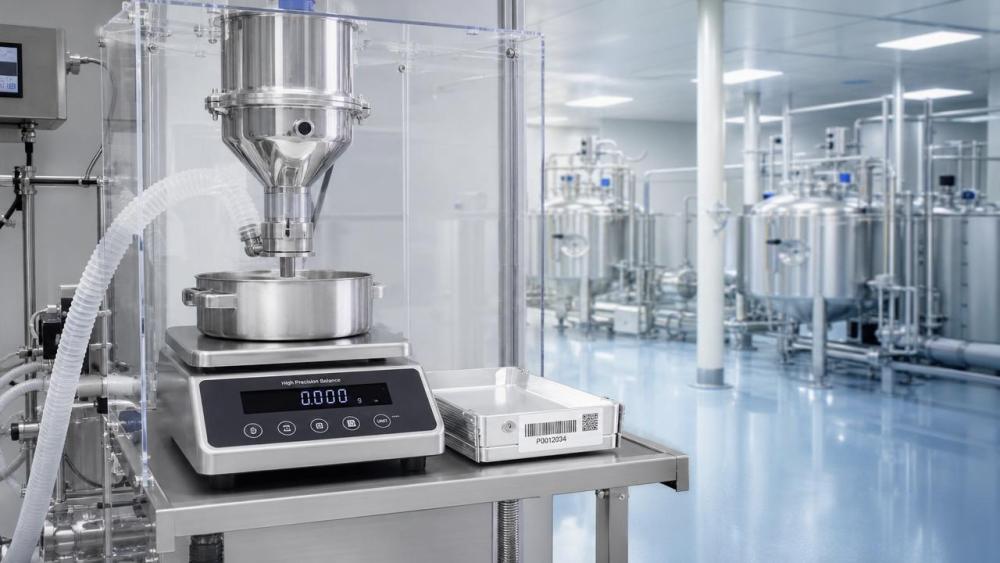
In pharmaceutical manufacturing, tiny dosing errors rarely stay tiny for long.
They can shift assay results, disrupt blend uniformity, delay release, and increase material loss across an entire batch.
That is why weighing and batching for pharmaceuticals is not only a metrology issue.
It is a process-control decision linked to traceability, containment, cleaning discipline, and production stability.
In practice, different production settings create different priorities.
A high-potency line focuses on operator protection and dust containment.
A solid-dose plant may care more about recipe repeatability across many ingredients.
A sterile preparation area often puts stronger pressure on cleaning validation and environmental control.
This is where the broader logic of industrial auxiliary systems becomes clear.
As GIAS often highlights across advanced manufacturing, final quality depends on precise support processes, not only core production equipment.
For pharmaceuticals, weighing and batching for pharmaceuticals sits at that critical support layer.
Actual production conditions usually decide the real accuracy target
The nominal resolution of a scale is only one part of the decision.
More useful questions involve material behavior, batch size, cleaning method, and documentation requirements.
For example, free-flowing excipients behave very differently from cohesive powders.
Low-dose active ingredients create another layer of risk because loss during transfer becomes proportionally larger.
Humidity, vibration, airflow, and operator intervention also change the real-world performance of weighing and batching for pharmaceuticals.
A system that performs well in a controlled pilot room may drift in a busier production area.
That is why site conditions should be reviewed before accuracy claims are accepted at face value.
The better approach is to define acceptable error by process impact.
If a dosing variation can affect potency, dissolution, or compliance records, the weighing strategy needs tighter controls around both equipment and handling.
In oral solid dosage lines, recipe consistency usually matters more than speed alone
Tablet and capsule production often involves multiple powders with different bulk density and flow properties.
Here, weighing and batching for pharmaceuticals supports not just target quantity, but blend predictability from lot to lot.
A common challenge appears during manual or semi-automatic dispensing of minor ingredients.
Small overfills look harmless at the station, yet they create cumulative deviation across repeated batches.
The better control point is not only final weight confirmation.
It is controlled dispensing, transfer recovery, barcode-linked material identity, and clear separation of approved and pending materials.
When formulations change frequently, recipe management becomes even more important.
The risk is less about one dramatic failure and more about gradual inconsistency hidden inside normal production routines.
In this setting, weighing and batching for pharmaceuticals works best when scales, dispensing software, and batch records stay synchronized.
What usually deserves closer attention in this setting
- Minor ingredient tolerances versus total batch size
- Powder retention in containers, chutes, and liners
- Line clearance between product changeovers
- Electronic verification of material identity before addition
- Calibration frequency under actual shift conditions
High-potency compounds bring containment and recovery into the same conversation
In high-potency environments, accuracy cannot be separated from exposure control.
The main question is not simply whether the target mass is reached.
It is whether the material can be weighed, transferred, and recorded without escape, contamination, or avoidable residue.
This changes the design priorities for weighing and batching for pharmaceuticals.
Enclosed dispensing booths, negative pressure control, glove interfaces, and compatible cleaning procedures become part of accuracy management.
A technically accurate scale still underperforms if powder adheres to surfaces or if transfer steps create measurable hold-up.
More advanced operations also review material recovery as a yield indicator.
If repeated campaigns show unexplained loss, the source may be container design, air movement, or cleaning practice rather than formulation itself.
This is one reason auxiliary process analysis matters across industries covered by GIAS.
Small support-system decisions often decide whether compliance and productivity can coexist.
Liquids, syrups, and sterile preparations need different judgment points
Liquid batching introduces another set of variables.
Viscosity, foaming, temperature sensitivity, and line dead volume all influence the true delivered quantity.
In these environments, weighing and batching for pharmaceuticals may need to work alongside flow measurement, tank control, and recipe interlocks.
Sterile or aseptic preparations raise the bar further.
Cleaning validation, material traceability, and sealed transfer paths can become more critical than throughput.
A common mistake is assuming liquid systems are naturally easier because powders are absent.
In reality, residual film, trapped liquid, and temperature-related density changes can distort the batch result.
Where sterile assurance is involved, the weighing method also has to fit sanitization routines and documentation controls.
Different scenarios create different priorities
A direct comparison helps clarify why one configuration does not fit every operation.
Where weighing and batching for pharmaceuticals is often misjudged
One frequent error is buying on specification sheets alone.
Readability, maximum load, and stated accuracy matter, but they do not reveal cleaning effort, data integrity, or material retention risk.
Another weak point is treating similar products as identical applications.
A formulation with fragile active ingredients may require gentler transfer and tighter environmental control than a visually similar batch.
Implementation cost is also commonly underestimated.
The full cost of weighing and batching for pharmaceuticals includes software validation, staff training, calibration discipline, spare parts, and downtime during changeover design.
There is also a traceability blind spot.
If weighing records, labeling, and batch execution systems are disconnected, investigations become slower and deviations harder to resolve.
That disconnect often costs more than the original equipment gap.
A practical way to improve accuracy and reduce material loss
Improvement usually starts with mapping where loss really occurs.
Some lines lose material during dispensing.
Others lose it during transfer, container change, or cleaning.
Once the true loss point is visible, accuracy upgrades become more targeted.
- Review actual environmental conditions around each weighing point
- Separate critical ingredients from routine bulk additions
- Validate transfer containers for residue and discharge behavior
- Link weighing data with batch records and identification systems
- Set maintenance intervals based on drift history, not only calendar dates
- Recheck cleaning steps that may remove product along with residue
In many facilities, the best gains come from combining moderate equipment upgrades with stricter process discipline.
That balance is often more effective than pursuing ultra-high instrument accuracy in isolation.
Before changing the system, confirm the fit between process risk and control method
The most useful next step is not choosing equipment immediately.
It is defining which process conditions truly drive error, loss, or compliance pressure.
For weighing and batching for pharmaceuticals, that usually means reviewing batch size variation, ingredient sensitivity, containment level, cleaning demands, and data traceability.
From there, it becomes easier to compare options in a realistic way.
The strongest decisions usually come from building a simple scenario-based checklist.
Confirm the material behavior, target tolerance, transfer path, operator interaction, and maintenance burden for each application.
That method supports better process control, lower waste, and more reliable compliance over time.
It also reflects a wider industrial truth seen across GIAS topics: support systems shape final quality far more than they first appear.