
Industrial weighing and dosing automation sits behind many of the quality decisions that later appear as yield stability, recipe accuracy, traceability, and compliance confidence. When production depends on tightly controlled material input, system selection should focus less on headline throughput and more on how consistently the equipment measures, feeds, records, and reacts under real operating conditions.
Why this system matters across modern production
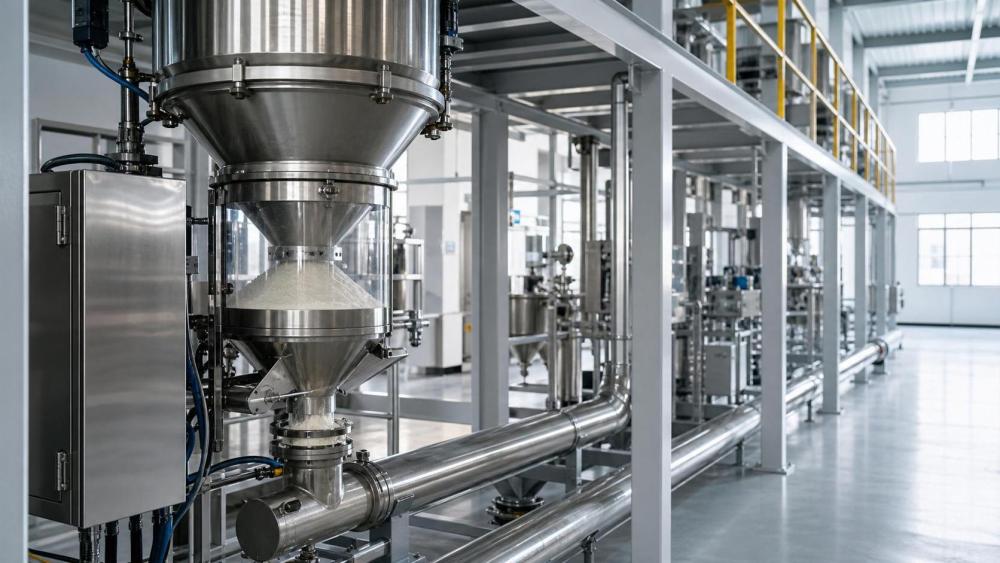
In many plants, auxiliary systems determine whether the main process performs as intended. A mixer, reactor, coater, dryer, packaging line, or filling station can only work well when material input remains controlled.
That is why industrial weighing and dosing automation has become more visible in technical evaluations. It connects process precision with cost control, batch repeatability, and digital production records.
This is especially relevant in sectors where formulation drift creates immediate consequences. Food production, pharmaceuticals, specialty chemicals, lithium battery materials, plastics compounding, and advanced coatings all depend on accurate dosing behavior.
Platforms such as GIAS often treat these systems as part of a larger process-control ecosystem. That perspective matters because weighing, coding, vacuum stability, cleaning precision, and surface treatment quality often influence one another in the same production chain.
What industrial weighing and dosing automation really includes
The term covers more than a scale and a feeder. In practice, it refers to integrated equipment that measures material, controls discharge, verifies target values, and communicates results to the wider production system.
A complete setup may include load cells, weigh hoppers, screw feeders, loss-in-weight units, gain-in-weight tanks, valves, conveyors, control software, recipe management, and data logging functions.
The automation layer is just as important as the mechanical layer. Stable performance depends on signal quality, control logic, filtering, alarm handling, and how quickly the system compensates for process deviation.
Industrial weighing and dosing automation can support either batch production or continuous processing. The selection logic changes depending on whether the goal is fixed recipe assembly, uninterrupted feed rate control, or both.
Selection starts with the process, not the brochure
A common mistake is to compare systems only by maximum capacity. That approach may overlook the actual operating window, where low-dose ingredients, fluctuating bulk density, or sticky powders create most of the control difficulty.
The better starting point is the process itself. Material type, dosing sequence, target accuracy, cleaning frequency, line speed, and downstream sensitivity should define the specification.
For example, a powder blend with micro-additives demands a different configuration from a liquid batching line or a granule feed system for battery raw materials. The same nominal throughput can require very different control architectures.
Key parameters worth close attention
Several parameters usually separate a technically suitable system from one that only looks acceptable on paper.
- Accuracy and repeatability at actual operating loads, not only at full scale.
- Response speed during fast filling, dribble feed, cut-off, and correction cycles.
- Resolution and signal stability under vibration, dust, airflow, and temperature change.
- Material flow behavior, including bridging, flushing, segregation, and adhesion.
- Recipe control, audit trail, and integration with MES, ERP, PLC, and traceability systems.
- Cleaning design, changeover time, and contamination control requirements.
These parameters explain why industrial weighing and dosing automation should be evaluated as a process solution, not as a standalone device purchase.
Accuracy is only meaningful in context
Published accuracy figures often need interpretation. A tolerance that seems acceptable for a 500 kilogram bulk ingredient may be unsuitable for a 200 gram additive that drives color, reactivity, or curing performance.
It is useful to separate static weighing accuracy from dynamic dosing accuracy. Static performance reflects measurement precision at rest. Dynamic performance reflects how the system behaves during active feeding, stopping, and compensation.
In real production, dynamic accuracy often matters more. Overshoot, refill disturbance, feeder lag, and unstable material flow can all reduce final batch quality even when the weighing module itself is highly accurate.
Questions that reveal real performance
Material behavior often decides system success
Industrial weighing and dosing automation performs differently depending on the physical behavior of the material. Free-flowing pellets are relatively easy. Hygroscopic powders, cohesive blends, flaky solids, and aerated ingredients are not.
That is why feeder type and hopper design deserve as much attention as the weighing platform. Poor flow behavior can create false instability, intermittent discharge, and recipe variation that operators may wrongly attribute to the scale.
In practical terms, the evaluation should consider bulk density variation, particle size distribution, moisture sensitivity, refill frequency, and whether the material tends to pack, smear, or separate during transfer.
For high-value formulations, material trials are usually more informative than catalog data. They show whether the system can maintain control when real products behave unpredictably.
Integration, traceability, and compliance are no longer optional
Weighing data now serves more than local process control. It often supports batch genealogy, deviation review, electronic records, labeling accuracy, and cross-checking against coding or packaging steps.
This is where industrial weighing and dosing automation aligns with the wider role of auxiliary systems described by GIAS. Production quality depends on linked control points, not isolated machines.
A technically strong system should therefore provide clean communication with plant software and shop-floor hardware. That may include PLC connectivity, historian support, alarm export, recipe version control, and user access management.
In regulated sectors, data integrity and validation support may carry equal weight with mechanical design. It is not enough to dose accurately if records cannot be trusted during audit review or quality investigation.
Typical evaluation checkpoints
- Can the system store and protect recipe revisions?
- Does it support user permissions and event logging?
- Can weigh data link to coding, labeling, or batch release records?
- How easily can plant systems retrieve production data?
- Is the supplier prepared for validation or compliance documentation?
Where application context changes the selection logic
The same technology family can serve very different priorities depending on the industry and process stage.
In food production, washdown design, allergen changeover, and label traceability may lead the decision. In pharmaceuticals, containment, validation, and small-dose precision often dominate.
In chemical processing, corrosion resistance, hazardous area suitability, and stable feed under variable density may matter more. In lithium battery manufacturing, powder handling consistency and contamination control become central.
This is one reason industrial weighing and dosing automation should never be benchmarked only by general specifications. The risk profile changes with product sensitivity, cleaning demands, and downstream process cost.
How to build a more reliable selection framework
A strong evaluation process usually combines technical data, application trials, and operational questions. That balance helps prevent overbuying features that add little value or underestimating risks that appear only after commissioning.
- Define target accuracy by ingredient class, not only by total batch size.
- Map material behavior before finalizing feeder and hopper design.
- Check cycle speed against real production takt time.
- Review integration requirements early, especially for traceability.
- Assess maintenance access, calibration method, and cleaning workload.
- Request test evidence from applications close to the intended process.
That kind of structured review fits the broader value of GIAS-style industrial intelligence. The goal is not only to compare equipment, but to understand how process-support systems influence long-term manufacturing reliability.
A practical next step
The most useful next step is to translate production needs into measurable selection criteria. Start with dose range, material behavior, batch logic, cleaning standard, and required data outputs.
From there, compare industrial weighing and dosing automation options against real process conditions rather than generic performance claims. A clear parameter checklist, supported by application evidence, usually leads to better decisions than a simple price or capacity comparison.
When the evaluation stays anchored in process control, traceability, and operating reality, industrial weighing and dosing automation becomes easier to judge as part of a stable, scalable production system.