
Sizing a food additive dosing system starts with a simple question: what must the line deliver every minute without drifting from the recipe? In food production, that answer affects taste, label compliance, sanitation performance, and the practical output a plant can sustain.
A dosing skid may look secondary beside mixers, fillers, or packaging machines, yet it governs a critical point of process control. That is why the topic fits the wider GIAS view of industrial auxiliary systems, where small process variables often shape final product quality.
When a food additive dosing system is undersized, pumps cycle too hard, valves lose stability, and production slows during peaks. When it is oversized, low-flow accuracy suffers, product hold-up increases, and cleaning becomes harder than expected.
What sizing really means on a production line
A useful sizing exercise goes beyond nominal pump capacity. It combines ingredient behavior, recipe targets, line speed, batch rhythm, hygienic design, and the control range needed during normal and abnormal operation.
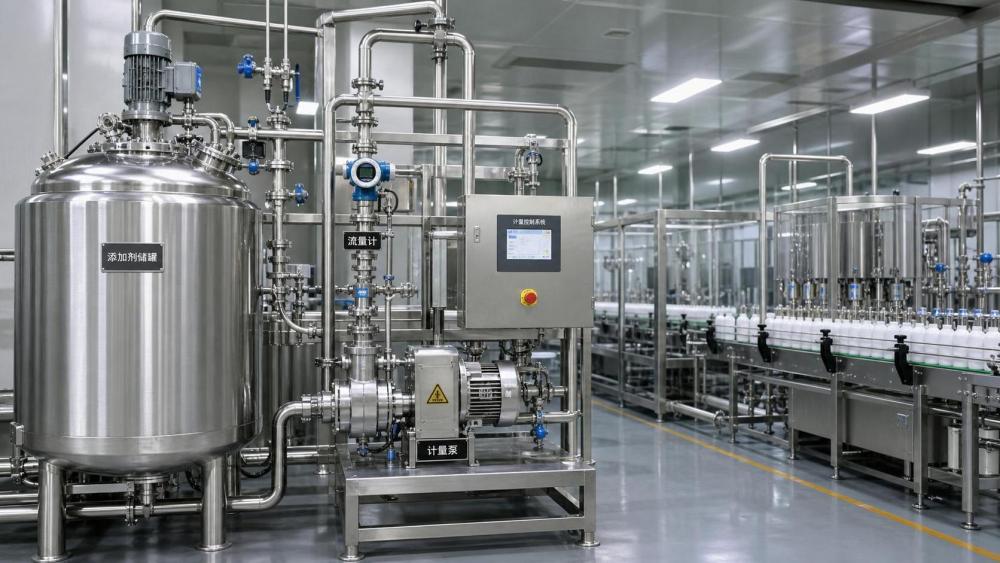
In practice, a food additive dosing system may feed preservatives, colors, enzymes, flavors, acids, sweeteners, stabilizers, or micronutrients. Some are added continuously into a pipe. Others enter a tank at a defined batch stage.
That difference matters. Continuous dosing needs steady turndown and fast control response. Batch dosing often needs high repeatability, quick charging, and clean changeover between recipes.
The target is not just “enough flow.” The target is repeatable dosing across the lowest, normal, and highest operating rates without creating hygiene risks or unnecessary downtime.
Why the industry pays close attention to dosing accuracy
Food manufacturers are managing tighter process expectations than before. Product consistency is more visible, ingredient costs are less forgiving, and compliance records need stronger traceability from receiving through final packaging.
A few percentage points of additive variation can change flavor balance, shelf life, texture, pH, or nutritional declaration. In sensitive products, even minor overfeed or underfeed can create rework, waste, or release delays.
This is also where food processing connects with the broader auxiliary equipment landscape. The same discipline applied to industrial weighing, batching, coding, and cleaning appears in a well-sized food additive dosing system.
Reliable dosing data supports line verification, quality investigation, and supplier qualification. It also helps when plants need to compare technologies, document process capability, or demonstrate that hygienic production controls are built into the system design.
Start with the additive, not the pump
The ingredient itself usually defines the real design envelope. Viscosity, density, temperature sensitivity, shear sensitivity, particulate content, and corrosiveness all influence the best pumping and metering approach.
Key properties that change sizing decisions
- Low-viscosity liquids may suit mass flow metering or fine positive displacement dosing at stable pressure.
- High-viscosity syrups often need larger lines, lower suction losses, and careful pump selection to avoid cavitation.
- Suspensions require attention to agitation, settling risk, and line geometry that prevents dead legs.
- Acids or aggressive additives can narrow the material options for seals, tubing, valve seats, and instrumentation.
- Heat-sensitive ingredients may need insulated tanks, short residence time, or low-shear transfer.
A food additive dosing system that works well for flavor concentrate may perform poorly with starch slurry or preservative solution. Good sizing begins with the fluid profile, then moves to the required production behavior.
Calculate the real flow window
Nominal throughput alone is not enough. The system should be sized around the full operating window, including startup, low-rate production, normal running, surge demand, and short-term upset recovery.
A practical sizing method is to link additive ratio to the highest and lowest product flow rate. Then check whether the selected pump, meter, and valve can maintain the required accuracy across that entire range.
For many lines, the best result comes from designing for controllability instead of chasing the largest possible capacity. A narrower but usable control band is often worth more than a large, unstable pump curve.
Accuracy depends on the full dosing loop
The pump is only one element. Meter type, pulsation damping, tank level control, suction condition, backpressure stability, valve selection, and PLC logic all affect final accuracy.
A food additive dosing system may use load cells, coriolis meters, magnetic flowmeters, timed dosing, or stroke-count approaches. The right choice depends on ingredient value, required precision, and how often the process changes speed.
Common design mistakes
- Selecting a pump with good nameplate capacity but weak low-end repeatability.
- Ignoring suction losses from long runs, elbows, filters, or viscous product temperature changes.
- Using metering devices that are difficult to clean or insensitive at the actual operating range.
- Treating calibration as a commissioning task instead of a routine operating discipline.
In real production, repeatability is often more valuable than laboratory-level precision. A system that delivers the same result under normal plant variation is easier to control and easier to trust.
Hygiene can reshape the equipment layout
Sanitary design is not an accessory after sizing. It changes what is practical. Pipe routing, seal arrangement, drainability, surface finish, and clean-in-place strategy all affect both hygiene and system performance.
For a food additive dosing system, dead zones are especially costly. They can trap concentrate, distort the next batch, and extend cleaning cycles. That means hygienic geometry should be evaluated alongside throughput targets.
It is often useful to confirm:
- Whether wetted materials meet product and cleaning chemical compatibility.
- Whether all product-contact areas can be drained, flushed, or verified during CIP.
- Whether instruments and valves add hidden hold-up or microbial risk points.
- Whether the system supports recipe changeover without excessive water, additive loss, or downtime.
This is one reason auxiliary process knowledge matters. The line can only be as clean and stable as its supporting systems allow.
Throughput is shaped by integration, not by one component
A food additive dosing system must fit the rhythm of upstream and downstream equipment. Tank refill timing, batching sequences, mixer residence time, filler speed, and CIP scheduling all influence the right capacity margin.
Sometimes a larger pump looks safer on paper, yet the line loses efficiency because it creates control hunting or higher recirculation. In other cases, a modest skid limits output because additive preparation cannot keep pace with the main process.
Useful integration questions include line stop behavior, fail-safe mode, buffer volume, recipe download logic, and how dosing data links with weighing, coding, or traceability systems. These are not side issues. They determine whether the system performs well after installation.
A practical framework for evaluating options
When comparing suppliers or internal design options, a short decision framework keeps sizing discussions grounded in production reality.
Check these points before freezing the specification
- Define additive range, viscosity band, temperature window, and cleaning chemistry.
- Set minimum, normal, and peak dosing rates with required accuracy at each point.
- Confirm whether continuous or batch operation drives the design.
- Map hold-up volume, drainability, and expected changeover loss.
- Review controls, alarms, calibration method, and traceability output.
- Request evidence from a similar food additive dosing system application, not just a general brochure claim.
That last point matters. Performance in chemicals or water treatment does not automatically translate into hygienic food processing. Application fit is usually where project risk becomes visible.
Where to focus next
A well-sized food additive dosing system supports more than accurate ingredient addition. It strengthens process stability, cleaning confidence, product consistency, and the documentation needed for modern manufacturing control.
The most useful next step is to turn process assumptions into a sizing sheet. Capture actual flow windows, additive properties, sanitation requirements, and line integration constraints before discussing equipment models.
From there, compare options by controllability, hygienic design, and operational evidence, not capacity alone. That approach usually leads to a food additive dosing system that performs reliably long after commissioning.