
Select the powder dosing system by starting with the slurry formula, not with feeder catalog capacity. In lithium battery mixing lines, the behavior of graphite, conductive carbon, lithium metal oxides, binders in powder form, and minor additives can differ sharply even when the target mass per batch looks similar on paper. A system that doses free-flowing material well may become unstable when handling low-bulk-density conductive carbon or cohesive fine powder with poor deaeration. The first decision is therefore whether the line needs loss-in-weight feeding, gain-in-weight vessel charging, vacuum conveying with intermediate weighing, or a staged architecture that separates transfer from final metering. That choice usually determines accuracy under real plant conditions more reliably than nominal throughput alone.
The opening requirement is to define what “acceptable dosing” means inside the mixing process. Some lines need tight control of every micro-additive addition because conductivity, viscosity, or dispersion sequence may shift if a component arrives too early or too late. Other lines are dominated by larger powder loads where batch repeatability matters more than sub-second feed dynamics. When reviewing lithium battery dosing systems powder configurations, it helps to map each material against five variables: target batch weight, dosing speed window, refill frequency, powder sensitivity to moisture, and cleaning interval. Without that map, the selected machine may look correct in specification sheets and still create unstable slurry preparation.
Material behavior should drive feeder selection
Powder characteristics matter more than many evaluations initially assume. Graphite may bridge differently from lithium iron phosphate. Nickel-rich cathode materials may require tighter containment due to fine particle handling and housekeeping concerns. Conductive carbon can show very low apparent density, strong dusting, and inconsistent screw filling if the hopper geometry is too simple. If the system is expected to handle several recipes, one feeder type may not suit all materials unless agitation, twin-screw design, hopper vibration control, and refill strategy are matched carefully.
A useful technical review goes beyond particle size and asks for flow function, tendency to rat-hole, electrostatic behavior, and sensitivity to compaction. Some powders flood after deaeration; others densify during transport and then underfeed at startup. A feeder tested only with standard industrial powder may not represent actual battery material performance. If representative sample trials are available, the trial should include long-duration dosing, repeated refill cycles, and start-stop sequences rather than a short continuous run under ideal conditions.
For abrasive powders, wear surfaces deserve early attention. Screw flights, hopper outlets, agitators, seals, and rotary valves may gradually change feed consistency as clearances increase. That matters when the line is expected to keep calibration over extended campaigns. Stainless steel grade alone does not answer the wear question; liners, surface treatment, and service access may have more operational value.
Batch charging and continuous metering are different problems
Many mixing lines are described loosely as dosing systems, but the technical burden differs depending on whether material is charged into a mixer by batch or metered continuously upstream of a continuous process. In a batch line, the concern is often net ingredient mass, sequence control, and containment during transfer into the mixing vessel. In a continuous line, refill disturbance, feeder response time, control loop stability, and turndown ratio become much more important.
If the process is batch-based, a gain-in-weight vessel or weighed transfer hopper can work well when materials are difficult to meter directly at low rates. This arrangement can reduce the sensitivity of final weight to short-term screw pulsation. If the process is closer to continuous or semi-continuous operation, loss-in-weight feeders usually offer better control over instantaneous feed rate, but they demand stable refill design and careful mechanical isolation from upstream conveying equipment.
One common misjudgment is treating refill as a secondary event. In practice, refill often causes the largest deviation in powder feed performance. The dosing unit may perform smoothly until the hopper level falls, then surge or drift as fresh powder enters. Selection should therefore include refill valve behavior, venting, dust extraction balance, and whether the control system compensates properly when gross weight changes during refill.
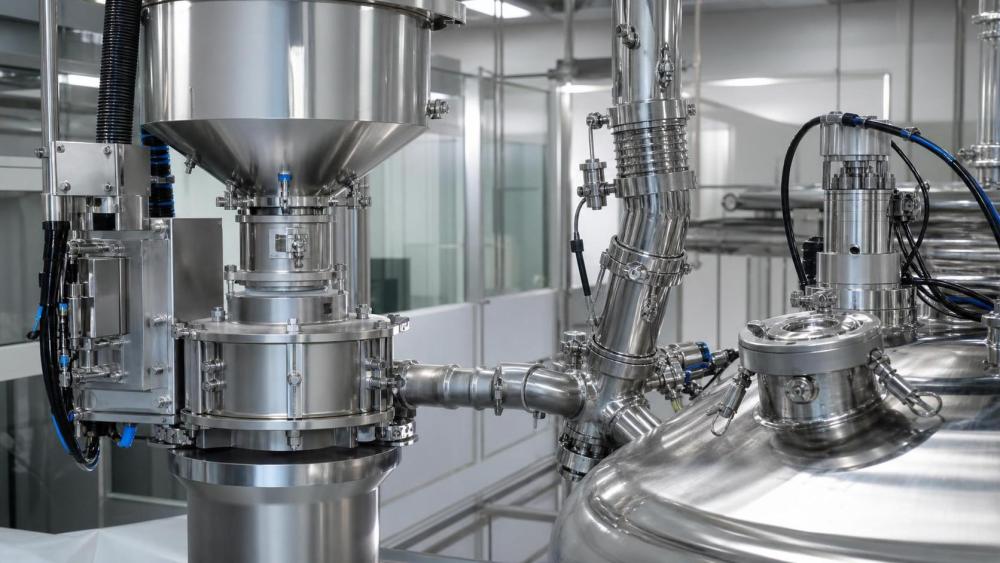
Containment, dust control, and housekeeping affect equipment choice
Powder handling in battery production is tied directly to cleanliness and safety. Even where a specific material does not create a high hazard classification, airborne fines can contaminate adjacent processes, interfere with weighing accuracy, and increase maintenance load on drives, sensors, and enclosures. A dosing system that appears compact and economical may become difficult to live with if bag dumping, conveying inlets, discharge connections, or hopper lids are poorly sealed.
Containment should be assessed at the whole subsystem level: raw material charging, conveying, interim storage, weighing, dosing, and discharge into the mixer. Attention usually needs to go to gasket compatibility, filter cleaning method, negative pressure balance, access doors, and whether powder deposits accumulate in dead zones. If nitrogen inerting is considered for certain powders or operating conditions, that affects rotary valve sealing, pressure relief concept, oxygen monitoring provisions, and instrument selection.
Dust collection interfaces also need review. Excessive suction near a weigh hopper can distort readings. Insufficient extraction at a manual dump station can create visible emissions and hidden material loss. Fine carbon powder may challenge filter media differently from denser cathode powders, so a single dust control setup may not perform equally across the full recipe range.
Accuracy claims need context
Quoted dosing accuracy is often presented without enough detail to support selection. The result may depend on test duration, material type, feed rate, refill state, and whether the claim refers to cumulative batch weight or instantaneous rate. For lithium battery mixing, both can matter. A system may hit final batch mass while still delivering unstable short-term feed, which can alter wetting and dispersion when powders enter binder solution or solvent at the wrong pace.
It is useful to ask under what conditions the machine holds accuracy:
- near maximum rate only, or also at low-rate trimming;
- with actual production powder rather than a surrogate material;
- before and after refill cycles;
- during a clean, freshly serviced state and after extended operation.
Resolution of the weighing module, mechanical decoupling from connected pipework, and control algorithm quality all influence the result. A high-resolution load cell does not solve problems caused by feeder surging, hopper bridging, or frame vibration. Likewise, very fast screw speed changes may improve control response in theory while reducing mechanical life or creating segregation in practice.
Integration with the mixer is often where good systems fail
The discharge point into the mixing line deserves more scrutiny than it usually gets. If powder enters a high-speed mixer through a long drop leg, material may separate, smear along the wall, or release a dust pulse at the vessel inlet. If it enters a pre-wet stage too quickly, floating agglomerates can form and extend dispersion time. If the mixer lid arrangement forces a convoluted feeder position, maintenance access and seal integrity may degrade.
Selection should therefore consider the full mechanical path from feeder outlet to mixer entry. Short, steep, well-contained transfer sections generally behave better than long horizontal connections. Flexible sleeves help isolate vibration but can also trap powder if poorly shaped. Valve placement matters when sequence control requires one powder to pause while another is added. In some layouts, an intermediate surge hopper above the mixer simplifies charging; in others, it adds another retention zone that complicates cleaning and mass balance.
Control integration is equally practical. Recipe management should define setpoints, addition order, interlocks, and permission signals from the mixer, dust collector, and conveying devices. If feeder alarms are too generic, troubleshooting becomes slow. It helps when the system distinguishes underweight trend, refill timeout, load cell instability, motor overload, and hopper low-level condition rather than reporting them as a single fault.
Cleaning method changes the preferred design
Some powder dosing systems are evaluated almost entirely on throughput and precision, then later prove unsuitable because cleaning takes too long or leaves residual material in contact surfaces. That is especially relevant where recipe changes involve different cathode chemistries or where cross-contamination tolerance is tight. Even if full washdown is not planned, the design should still be reviewed for dry cleaning access, removable screws, tool-free inspection covers, and the number of dead pockets around seals, agitators, and discharge valves.
Quick disassembly can be valuable, but only if reassembly preserves alignment and weighing stability. Frequent teardown of a delicate loss-in-weight feeder can introduce calibration drift if supports, cables, or flexible connections are disturbed. In some cases, dedicating certain feeders to specific powders may be more reliable than forcing one universal unit to handle every material with repeated cleaning cycles.
Surface finish inside the hopper is another detail that affects both flow and cleaning. A smoother finish may reduce powder hang-up for some materials, but highly cohesive powders can still adhere if humidity control is weak or electrostatic charge builds up. Access for visual verification matters because residual dark powder in corners may be difficult to detect under poor lighting.
Conveying and storage upstream of dosing should not be treated separately
The feeder may be precise, yet the overall lithium battery dosing systems powder arrangement can still perform badly if upstream storage and transfer are unstable. Bulk bags, sacks, drums, or bins each create different refill behavior. Pneumatic conveying can compact powder or change entrained air content before it reaches the dosing hopper. Vacuum transfer is often chosen for containment, but the receiving hopper and filter must release air and powder consistently or the downstream screw feed will fluctuate.
There is also a transport and installation dimension. Tall integral hoppers may look efficient in layout drawings and then become difficult to ship, move into a dry room, or service under ceiling restrictions. Skid design, lifting points, and modular assembly become relevant where the line is installed in constrained spaces or where vibration-sensitive weighing modules must be aligned after placement. If the system must pass through airlocks, narrow doors, or upper-floor structures, that should be addressed before finalizing the frame size and hopper volume.
Moisture management belongs in the same discussion. Some powder streams may need controlled exposure during unloading and feeding. That can influence whether enclosed bag dump stations, sealed transfer containers, dehumidified enclosures, or inert gas blanketing are required. A feeder that operates well in a general workshop may behave differently in a low-humidity room with static-prone powder.
Maintenance access is part of process stability
When evaluating long-term suitability, look closely at the parts that will need routine attention: flexible connectors, screw seals, filter elements, gearbox lubrication points, agitator bearings, level probes, and load cell cable routing. If these items are buried behind structural members or close to hot surfaces and moving equipment, routine service tends to be delayed, and feed repeatability usually suffers before a clear fault appears.
Spare parts strategy also affects selection, especially for wear-prone contact components. A feeder that depends on custom screws with long replacement lead times may expose the line to unnecessary downtime. It is also worth checking whether calibration can be restored on-site after replacing wear parts, load cells, or motors, and whether that procedure requires special software access or only standard maintenance tools.
Condition monitoring can be helpful when it reports something actionable. Motor current trend, refill count, vibration, filter differential pressure, and deviation between commanded and actual feed rate can indicate developing problems. But instrumentation should be matched to the environment; excess sensors in dusty zones can increase failure points without adding much diagnostic value.
Questions that expose weak proposals
Technical proposals often look similar until they are tested against awkward operating details. A stronger evaluation usually asks for material-specific evidence, not generic machine descriptions. Useful questions include whether the quoted throughput is based on the densest or easiest-flowing powder, how refill is managed without disturbing the weighing signal, what the minimum stable feed rate is after extended runtime, and how much retained material remains after a standard cleaning procedure.
It is also worth asking how the system behaves during upset conditions. If a bridge forms in the hopper, does the machine detect starvation early or continue rotating while underfeeding? If a conveying cycle finishes late, does the recipe pause cleanly or create a sequence conflict with the mixer? If negative pressure changes when dust extraction filters load up, will that influence the weigh signal or feeder discharge pattern? These questions usually reveal more about real suitability than a broad statement about precision and automation level.
The best selection outcome is usually the one that matches actual powder behavior, refill method, containment needs, cleaning discipline, and mixer integration in a coherent way. In lithium battery mixing lines, dosing equipment should be judged as a process node rather than an isolated machine. That is where stable slurry preparation usually starts.