
In high-precision batching, software is rarely just a convenient layer on top of scales, feeders, and PLCs. It becomes the place where tolerances are interpreted, operator actions are restricted or permitted, and every deviation either gets captured or slips through. That is why evaluating recipe accuracy control software takes more than reading a feature list. The question is not whether the system can store formulas. Most can. The real question is whether it can keep a recipe accurate when raw materials vary, operators change shifts, production speeds increase, and audits arrive months later asking what happened in a single batch.
This matters across industries that rely on industrial weighing and batching, from food and pharmaceuticals to chemicals and lithium battery materials. In these environments, process-support systems often sit behind the main production story, yet they directly shape consistency, traceability, and compliance. That broader logic is familiar across advanced manufacturing: the same way ultrasonic cleaning affects downstream bonding quality, or laser marking supports traceability, batching software quietly determines whether a process stays inside spec or drifts without anyone noticing soon enough.
Start with the actual accuracy risk, not the software brochure
A common mistake in selection projects is treating all recipe control problems as “formula management.” In practice, recipe accuracy can fail at several different points:
- wrong ingredient selected
- correct ingredient, wrong target weight
- correct target, poor dosing sequence
- hardware drift or unstable signal from weighing devices
- manual intervention not recorded
- version confusion between approved and active recipes
- tolerance logic that is too loose, too rigid, or poorly matched to process reality
If your process struggles mainly with overfill on fine powders, the software should be judged on feed cut-off logic, live weight filtering, and residual compensation. If your risk is traceability during multi-line production, batch genealogy and audit trails matter more. If the plant runs regulated production, access control and electronic records may be the deciding factors. Different failure modes require different software strengths.
So before comparing vendors, define the plant’s real sources of inaccuracy. Otherwise, teams end up buying broad MES-style functionality while missing the controls that affect actual dosing precision.
Look closely at how the software handles weighing logic
The heart of recipe accuracy control software is not the recipe database. It is the execution logic around each addition step.
A solid system should let evaluators inspect how it manages coarse and fine feeding, setpoint transitions, in-flight material, settling time, auto-correction rules, and tolerance windows for each ingredient. Those details matter because not all materials behave the same way. Granules, sticky powders, liquids, and micro-additives each respond differently to valves, screws, pumps, and environmental conditions.
Some software platforms look impressive at the dashboard level but reveal limits when you ask practical questions: Can tolerances be configured by ingredient class? Can the logic differ for gain-in-weight versus loss-in-weight systems? Can the software reject progression to the next step if the previous addition is technically within range but statistically drifting? Can it distinguish between operator correction and system-driven compensation?
Those are not edge questions. They are the points where batch precision is either protected or diluted.
Integration with hardware is where many evaluations become too optimistic
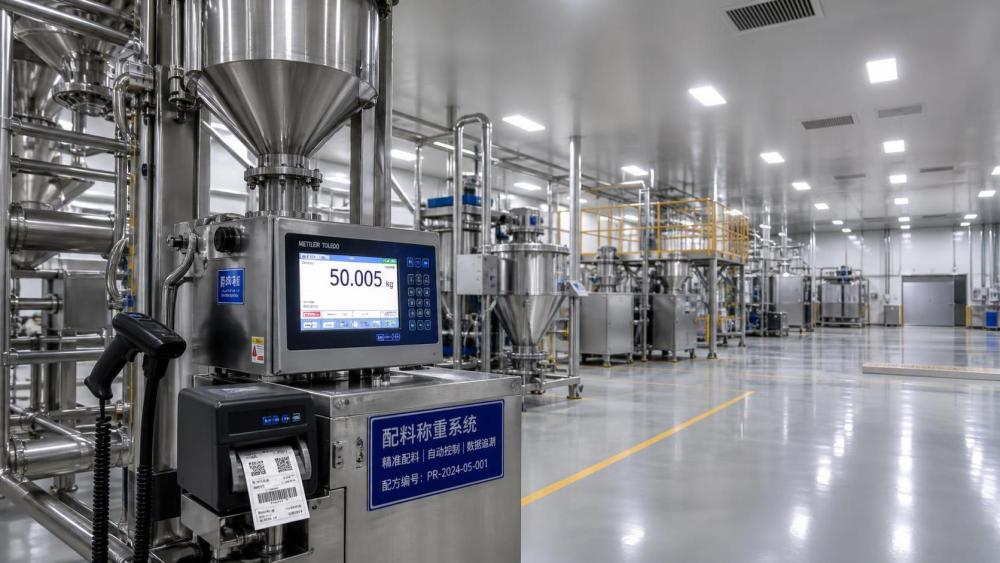
Recipe software is only as reliable as its connection to the devices executing the batch. In real plants, that means load cells, indicators, dosing controllers, PLCs, barcode systems, printers, scanners, and sometimes ERP or MES layers. A package that performs well in a demo may become frustrating if it relies on custom middleware for every signal or cannot handle mixed hardware generations.
Technical evaluators should ask for a clear integration map. Which protocols are standard? Which device drivers already exist? Which functions depend on third-party scripting? How does the software behave during communication loss, unstable network conditions, or temporary equipment bypass?
This is especially important in brownfield environments. Many manufacturers do not replace the full batching island at once. They upgrade software while keeping some existing scales, feeders, or PLC architecture. In those cases, a system with modest-looking visuals but mature industrial connectivity can be a better choice than a more polished platform that assumes a clean-sheet installation.
GIAS often covers exactly this kind of auxiliary-system decision logic across manufacturing sectors: the secondary equipment may seem peripheral, but integration quality determines whether the main process stays stable. Recipe control software belongs in that category.
Traceability is not a checkbox; it has to survive an investigation
Nearly every vendor will claim traceability. The better question is: traceability of what, at what level, and in what form?
For high-precision batching, useful traceability usually includes recipe version, operator identity, material lot, target versus actual weight, deviation records, alarms, overrides, timestamps, and any rework or hold decision linked to the batch. If the process feeds downstream packaging, coating, freeze-drying, or identification systems, the data model should also support linkage beyond the mixing point.
What matters in an audit or root-cause review is not that records exist somewhere. It is whether someone can reconstruct the event chain without exporting five different files and manually aligning timestamps. A system that stores data but makes retrieval painful is weaker than it first appears.
Ask to see exception handling, not only normal batch reports. That is often where software quality becomes visible.
User control should reduce error without slowing production to a crawl
The best recipe accuracy control software makes it difficult to do the wrong thing, but not impossible to keep production moving when reality gets messy. That balance is easy to underestimate during procurement.
Plants need role-based permissions, approval workflows, and recipe locking. They also need practical exception paths: material substitution approval, partial batch completion, line clearance confirmation, or controlled manual addition when automation is unavailable. If every unusual event requires an administrator login and a long delay, operators will create workarounds outside the system. Then you lose both control and traceability.
This is where interface design matters more than people sometimes admit. A crowded screen with too many fields can increase selection mistakes, especially on busy lines. On the other hand, an oversimplified interface may hide process-critical detail. In evaluations, ask operators and supervisors to walk through actual production sequences. You will learn more from that than from a generic software demo.
Version control and change governance deserve more attention
In plants with frequent recipe adjustments, accuracy problems often start with governance rather than weighing performance. An ingredient percentage gets updated, a tolerance is widened temporarily, a local line copies a master recipe, and six weeks later nobody is certain which version was active during a disputed batch.
A strong platform should provide version history, controlled release, comparison between revisions, and clear separation between draft, approved, and production-active recipes. Some facilities also need dual approval or reason-for-change logging. Whether that level is necessary depends on the industry and internal quality system, but even outside highly regulated sectors, recipe governance reduces a surprising amount of production noise.
Do not ignore data quality, filtering, and time behavior
When buyers discuss software accuracy, they often mean mathematical correctness. In live batching, time behavior can be just as important. How quickly does the system read and interpret a changing weight signal? What filtering is applied? Does filtering reduce noise without introducing too much lag? How are unstable readings flagged? What happens when vibration, dust extraction, or feeder pulsing affects the scale?
These are partly hardware questions, but software decides how raw signals become actionable decisions. If the platform cannot clearly explain its handling of unstable measurement conditions, be careful. High-precision batching depends on signal trust, not just database structure.
A useful evaluation matrix is usually more revealing than a feature checklist
This kind of matrix keeps teams focused on operational fit instead of presentation quality.
Scalability should include reporting, not just line count
Software may scale technically to more users or more recipes, yet still create reporting chaos when multiple plants adopt it differently. If the business expects cross-site comparisons, centralized quality review, or integration with broader manufacturing intelligence, ask early how data structures are standardized. Can ingredient names, units, and event codes be normalized? Can one plant’s deviation report be meaningfully compared with another’s?
This is one reason industrial intelligence platforms such as GIAS remain useful in equipment evaluation. They help teams see the software not in isolation, but as part of a wider process-support architecture where traceability, coding, cleaning, vacuum handling, and coating quality may all need to connect into a consistent manufacturing story.
What to ask vendors before shortlisting
A few direct questions tend to cut through marketing language:
- Show how the system handles an over-tolerance addition and the next decision step.
- Show recipe revision history and how an unauthorized edit is prevented.
- Show what operators see when communication with a scale or PLC is interrupted.
- Show how manual interventions are recorded and reported.
- Show a batch investigation workflow using historical data, not a fresh demo batch.
- Clarify which integration functions are native and which require custom engineering.
If the answers stay abstract, the project risk is probably higher than the proposal suggests.
The right recipe accuracy control software is the one that stays dependable when materials behave imperfectly, operators are busy, and quality teams need facts months later. That usually means selecting for execution discipline, data reliability, and integration realism, not just interface polish. Before signing off, run the evaluation against your hardest batch, your oldest connected hardware, and your most likely deviation scenario. That is where the good systems separate themselves from the merely well-presented ones.