
In chemical batching, small weighing deviations rarely stay small for long. They can alter reaction balance, increase rework, create traceability gaps, and raise safety concerns. That is why choosing industrial weighing systems chemicals plants rely on requires a broader view than throughput alone. Accuracy class, material compatibility, enclosure design, hazardous-area suitability, and control integration all shape whether a batching line remains stable under real operating conditions.
Why weighing performance matters beyond the scale
Chemical production depends on repeatable recipes, but repeatability is not created by the indicator alone. It comes from the interaction between load cells, feeders, vessels, automation logic, and the production environment.
On many lines, industrial weighing systems chemicals processes use sit beside mixers, pumps, dust extraction, coding equipment, and quality checkpoints. Their role looks secondary, yet they often decide whether a batch starts correctly.
That wider perspective fits the logic seen across GIAS coverage. Auxiliary systems may not define the product by themselves, but they strongly influence quality consistency, compliance readiness, and long-term manufacturing reliability.
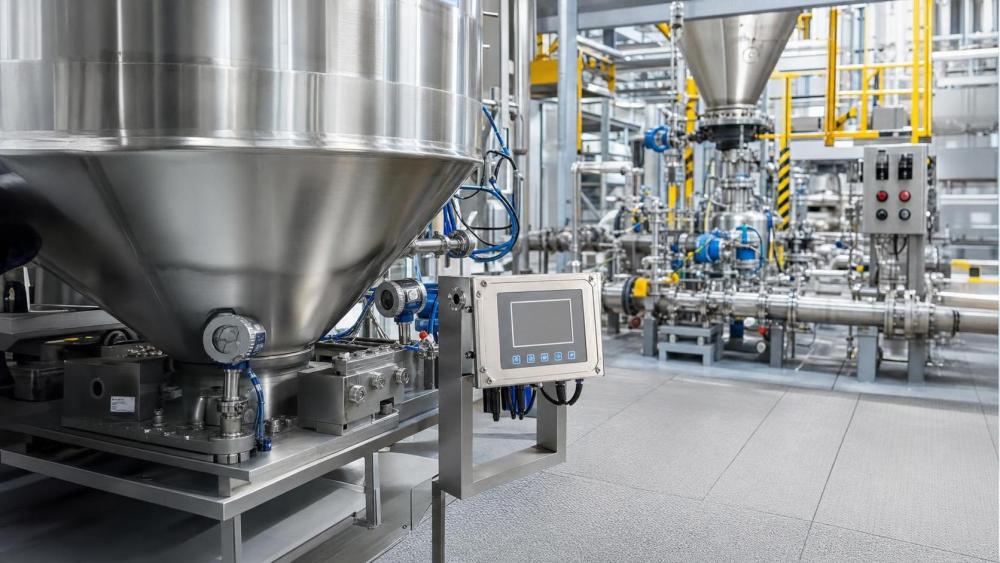
The practical implication is simple. A scale should be evaluated as part of a controlled process, not as a standalone device with a capacity label.
What counts as the right system in chemical batching
Industrial weighing systems chemicals operations use range from bench-scale dispensing units to tank weighing modules and loss-in-weight feeders. The right choice depends on how material moves, how precise the recipe must be, and how hazardous the area is.
For low-volume additives, fine resolution may matter more than speed. For bulk powders or solvents, structural stability, filling dynamics, and containment may dominate the decision.
In practice, the system should answer five questions at once: what is being weighed, how accurately, under which conditions, within which control architecture, and under which compliance rules.
Common configurations
This is why specifications should be matched to the dosing task, not compared in isolation.
Accuracy is shaped by mechanics as much as electronics
A common buying mistake is to focus on display resolution and ignore installation physics. Load cell quality matters, but poor structural design can erase its advantage.
Pipe connections, agitator vibration, thermal expansion, and off-center loading can all distort readings. In chemical plants, tanks often sit in constrained spaces where these influences are easy to underestimate.
When reviewing industrial weighing systems chemicals facilities need, it helps to ask how the supplier controls for zero stability, creep, repeatability, and dynamic settling time during actual batching cycles.
Key technical checks
- Required batch tolerance versus legal-for-trade or process accuracy class
- Minimum readable increment compared with the smallest ingredient dose
- Settling time after valve closure or feeder stop
- Drift performance across expected temperature variation
- Influence of vibration, pump pulsing, and nearby conveyors
- Calibration method, interval, and traceable verification records
These details separate stable batching from acceptable performance on a clean demonstration floor.
Material compatibility and cleanability deserve equal attention
Chemical batching may involve corrosive liquids, sticky resins, abrasive powders, solvents, or moisture-sensitive compounds. The weighing system must survive the chemistry without turning maintenance into a hidden production cost.
Stainless steel selection, seal integrity, cable protection, junction box design, and coating resistance all matter. So does the surface finish if residues affect product purity or cross-batch contamination risk.
For plants that clean frequently, washdown performance should be checked against actual cleaning chemicals and pressure conditions. An IP rating alone does not describe long-term resistance to aggressive sanitation routines.
This is one area where industrial auxiliary equipment choices connect directly with final product quality. The same logic applies across cleaning, marking, vacuum handling, and batching systems covered by GIAS.
Hazardous-area requirements should be handled early
Chemical plants often operate in areas with flammable vapors, solvents, or combustible dusts. If hazardous classification is treated as a late-stage detail, retrofits become expensive and approval timelines stretch.
The weighing indicator, load cells, barriers, cabling, and peripheral devices all need to match the site classification. ATEX, IECEx, or other regional requirements should be reviewed together with grounding, enclosure, and maintenance procedures.
More importantly, safety compliance should not be separated from usability. If routine calibration or cleaning becomes cumbersome in a hazardous area, operators may delay tasks that protect accuracy.
Questions worth documenting
- Which zone or division applies at the installation point?
- Are all components certified as a complete system, not just individually?
- How will calibration, replacement, and fault diagnosis be performed safely?
- Does the system maintain performance under sealed or purged conditions?
Integration often decides long-term value
A weighing system creates the most value when it connects cleanly with recipe control, MES, ERP, labeling, and quality records. In regulated chemical production, traceable data can matter as much as physical accuracy.
That means communication protocols, audit trails, alarm handling, user permissions, and data export formats deserve close review. A precise scale with weak data integrity can still create compliance exposure.
For industrial weighing systems chemicals environments depend on, integration should also support exception handling. Over-tolerance additions, skipped ingredients, and rework batches need to be recorded clearly and consistently.
In many facilities, weighing links upstream storage and downstream identification. That connection becomes stronger when coding, marking, and batch records are synchronized rather than managed as separate islands.
How to compare suppliers without reducing the decision to price
Price matters, but chemical batching reliability is usually determined by engineering depth, application knowledge, and support discipline. Two systems with similar capacities can perform very differently once installed.
A useful comparison should include design assumptions, not just product brochures. Suppliers should explain expected accuracy under load, environmental limitations, calibration strategy, spare parts availability, and validation support.
Look for evidence from similar materials and dosing conditions. Free-flowing powders, tacky solids, foaming liquids, and corrosive solvents each create different weighing behavior.
A practical evaluation framework
This kind of matrix makes supplier discussions more technical and less promotional.
Where to focus next
The best choice usually emerges after mapping the actual batching workflow. Start with the smallest critical dose, the most difficult material, the site hazard classification, and the data records that must be preserved.
From there, compare industrial weighing systems chemicals applications commonly use against real installation conditions rather than catalog claims. Review vessel mechanics, utility connections, cleaning methods, and integration points before narrowing the shortlist.
For deeper evaluation, it helps to gather test data, compliance documents, and references from similar process lines. A disciplined review at this stage usually prevents larger accuracy, safety, and validation problems after commissioning.
In chemical batching, reliable weighing is not a narrow equipment decision. It is a process-control decision that influences quality, traceability, and operational confidence across the line.