
The Lowest Equipment Price Is Rarely the Lowest Dust-Collection Cost
An industrial vacuum system for dust collection should be evaluated as a process-control and risk-management asset, not as a standalone suction unit. A quotation can look competitive while excluding the duct design, source capture points, explosion protection, discharge arrangement, controls, commissioning work, replacement filters, or local service needed to make the system perform as specified. Those omissions often surface only after installation, when correcting them is expensive and disruptive.
The central question is whether a supplier can take responsibility for the required result at the point of dust generation: safe capture, stable airflow, acceptable emissions, manageable maintenance, and reliable operation under real production conditions. That requires more than comparing motor power, airflow figures, or filter area on a data sheet. It requires confirming how the supplier has translated the actual dust hazard and process layout into a complete system design.
An industrial vacuum system supplier may provide a portable unit, a central vacuum network, a high-vacuum conveying system, or a conventional low-pressure dust collector. These systems serve different duties. Confusing them is one of the earliest causes of specification errors. A system intended for housekeeping pickup may not provide the capture volume needed for a large open process enclosure, while a large dust collector may be poorly suited to conveying heavy settled material through a long pipe run. Supplier evaluation should begin by making the duty unambiguous.
Define the Duty Before Comparing Suppliers
A meaningful request for quotation should describe the process rather than simply request a stated airflow or vacuum level. The supplier needs to know what material is being collected, where it is released, how often collection is required, and whether the purpose is source capture, machine cleaning, material recovery, vacuum conveying, or a combination of these functions.
Dust characteristics determine much of the system architecture. Fine, dry powder behaves differently from fibrous material, sticky residue, abrasive particulate, metal swarf, damp dust, or hot process fumes. Important inputs include particle size range, bulk density, moisture sensitivity, abrasiveness, tendency to bridge or compact, expected loading rate, and whether the dust has product value or must be disposed of as waste. A supplier that asks only for “dust type” without exploring these conditions is not yet designing around the actual operating risk.
Process variability also matters. A system designed around average loading can fail during cleaning cycles, product changeovers, bag dumping, startup, or high-output shifts. The specification should identify simultaneous pickup points, peak collection demand, operating hours, batch versus continuous duty, and whether the plant expects future line expansion. Oversizing every component is not automatically prudent, but a supplier should show how the design accommodates credible operating peaks and reasonable future changes.
At this stage, compare suppliers on the quality of their questions. Strong technical engagement is not unnecessary complexity; it is evidence that the supplier is testing the assumptions behind the request. A reliable design basis should identify the capture objective, airflow or vacuum requirement at each point of use, pipe or duct routing assumptions, separation stages, final filtration, discharge method, and the boundaries between supplier scope and site responsibilities.
Separate Airflow, Vacuum, and Capture Performance
Published performance figures can be misleading when they are compared outside their operating context. Airflow, static pressure, vacuum level, filter resistance, hose diameter, pipe length, bends, pickup tools, and material loading interact. A unit may show a high maximum vacuum with little usable airflow at the collection point, or a high free-air volume that declines sharply once connected to a long network and loaded filter.
For central vacuum systems, suppliers should provide a system curve or equivalent duty-point calculation showing the expected operating condition, not merely the fan or pump’s maximum rating. The calculation should account for losses through pipes, bends, branches, separators, filters, valves, pickup tools, and any flexible hose. It should also state the assumed condition of the filter: a clean filter figure is not enough if normal operation occurs at substantially higher pressure drop.
For source-capture applications, the relevant question is whether the hood, enclosure, or pickup arrangement captures dust before it enters the work area. Air movement at a distant fan does not prove capture at the emission source. Suppliers should explain the proposed hood geometry, enclosure openings, required face velocity where relevant, and the effect of cross-drafts from doors, cooling air, forklifts, or nearby machinery. Reference methods such as the principles in ACGIH’s Industrial Ventilation manual can help frame engineering discussions, but the final design must fit the actual installation.
For vacuum conveying or cleanup, transport velocity and material behavior deserve close attention. If the system cannot keep the collected material moving through horizontal sections and vertical risers, deposits can build in the piping. If velocity is excessive, abrasive dust can erode elbows and separators while energy use rises. The supplier should state the design assumptions and identify locations where wear-resistant components, cleanout points, or altered routing are needed.
Filtration Claims Need a Defined Test Basis
“High-efficiency filtration” is not a sufficient requirement. Filter performance must be linked to particle size, test method, final emissions requirement, dust loading, cleaning mechanism, and the condition in which the filter is expected to operate. Cartridge, bag, panel, and HEPA stages are not interchangeable simply because they all remove particulate.
Ask each supplier to specify the primary filter media, surface treatment, filtration area, air-to-media ratio or other sizing basis, cleaning method, and expected differential-pressure control range. Pulse-jet cleaning may be appropriate for dry, free-flowing dust, but it can be ineffective or damaging when the dust is oily, hygroscopic, adhesive, or prone to forming a hard cake. In such cases, media selection, pre-separation, lower filter loading, or a different collection approach may be more important than pulse intensity.
Where a HEPA final stage is required, the requirement should name the applicable classification and test framework rather than relying on the term alone. EN 1822 and ISO 29463 are commonly used standards for high-efficiency particulate air filter classification and testing. A supplier should also explain whether the final filter is protecting people, protecting a downstream process, enabling recirculation, or preventing contamination of the vacuum generator. Each purpose may call for a different arrangement.
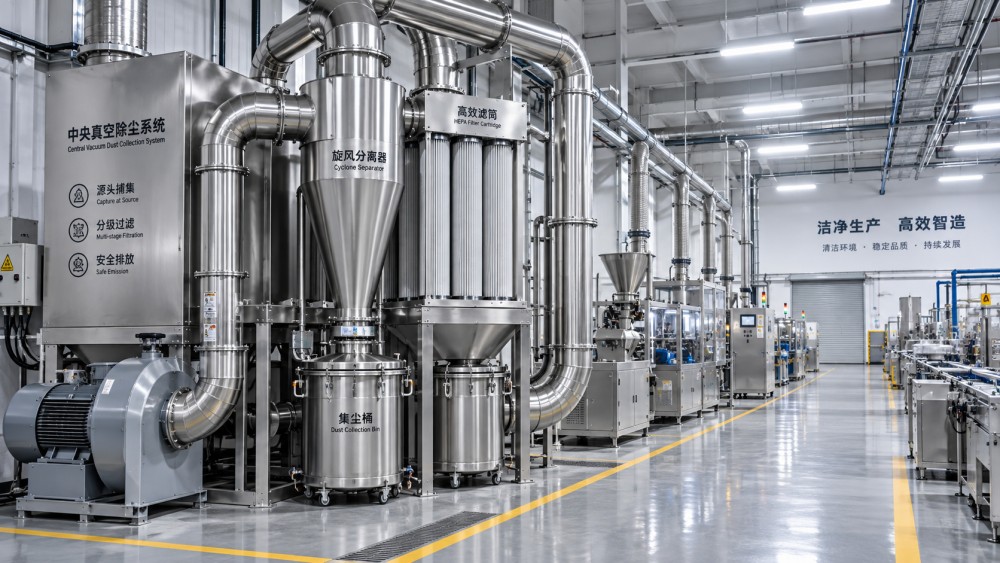
Do not evaluate filtration only by expected outlet cleanliness. A very fine final filter can create recurring replacement cost and excessive pressure drop if upstream separation is inadequate. Cyclones, drop-out chambers, pre-filters, or secondary separators can reduce the burden on the final filter when handling coarse, dense, or high-loading material. The best arrangement is often a staged system in which each component performs a defined role.
Combustible Dust Cannot Be Treated as an Optional Add-On
Where dust may be combustible, supplier qualification must include hazard understanding and system integration. The issue is not limited to visibly explosive powders. Fine particulate from food ingredients, wood, paper, polymers, chemicals, pharmaceuticals, metals, and other materials can create a combustible-dust risk under certain conditions. Material safety data, particle characteristics, process temperatures, ignition sources, and dust-test information should be reviewed before selecting a collection concept.
A supplier should not make a generic assurance that a unit is “explosion proof.” That phrase does not describe the full protection strategy. Depending on the jurisdiction, material, and risk assessment, the design may need grounded conductive components, ignition-source control, explosion venting, flameless venting, isolation devices, suppression, suitable electrical equipment, pressure-resistant construction, or safe outdoor placement. These measures are interdependent. A vented collector connected to indoor ductwork, for example, may still require isolation to prevent flame propagation.
Applicable obligations differ by country and installation. In the European Union, equipment intended for potentially explosive atmospheres may need to meet ATEX requirements; elsewhere, local workplace, fire, electrical, and environmental rules govern the installation. NFPA standards are widely referenced for combustible dust management, but their legal status depends on local adoption. The supplier should identify which requirements are included in its scope, what site-specific hazard information it relies upon, and which approvals remain the owner’s responsibility.
A useful test of supplier capability is whether it is willing to state design limits in writing. If dust explosibility data are unavailable, a responsible supplier should identify that uncertainty rather than quietly treating the material as non-hazardous.
Examine the System Boundary, Not Just the Collector
Dust collection projects often underperform because responsibilities are fragmented. One party supplies the vacuum generator, another installs ducting, a third makes electrical connections, and the production line contractor modifies machinery. Unless the interfaces are defined, essential details can fall between scopes.
The quotation should distinguish included and excluded items with enough precision to price the project realistically. Areas that merit particular attention include:
- ductwork or vacuum piping, supports, flexible connections, isolation valves, and cleanout access;
- hoods, pickup nozzles, machine enclosures, and modifications needed for effective source capture;
- collection bins, drums, rotary valves, bagging stations, and safe waste handling;
- compressed air, electrical supply, controls integration, alarms, and emergency shutdown functions;
- noise control, outdoor weather protection, corrosion protection, and drainage arrangements;
- installation supervision, commissioning, operator training, airflow balancing, and acceptance testing.
Controls deserve a separate review. A simple local start/stop arrangement may be sufficient for an isolated cleanup unit, but a central system serving several machines may need automatic demand control, interlocks with production equipment, filter differential-pressure monitoring, bin-level alarms, and fault reporting to plant systems. Variable-speed control can reduce energy use in some duties, but it should not be assumed to solve an incorrectly designed network. The supplier should explain the control logic and the minimum conditions required to maintain collection performance.
Compare Lifecycle Cost Through the Operating Burden
Capital cost is visible at bid stage; operating burden becomes visible later. The relevant comparison includes electrical consumption, compressed-air demand for filter cleaning, replacement filters, waste disposal, downtime for maintenance, labor required to empty collection containers, spare parts availability, and the consequences of poor capture on cleaning, product quality, or worker exposure.
Energy estimates should be tied to a stated duty cycle, motor efficiency assumption, operating pressure, and control mode. A supplier that presents annual consumption without declaring these inputs is providing a number that cannot be compared reliably. For systems with multiple pickup points, it is also important to know whether the unit will operate at full load continuously or whether the controls reduce power when demand is lower.
Maintenance access is a practical cost driver that is easy to miss during technical review. Filter change access, safe handling of contaminated media, hopper clearance, bin removal space, access to pulse valves, fan bearings, and service isolation points affect both labor time and safety. A compact layout can be attractive on a drawing but costly if it forces awkward maintenance work or requires production equipment to be moved for service.
Request a recommended spare-parts list for the first operating period and classify parts by criticality. Filters, seals, gaskets, pulse valves, gauges, sensors, fan belts where applicable, and control components should be identified with lead times. If proprietary consumables are required, their availability and price history matter as much as the initial system price.
Validate Delivery and Service Capability Before Award
Technical capability has limited value if the supplier cannot execute the project through design freeze, manufacturing, shipment, installation support, and handover. Review the supplier’s engineering resources, manufacturing location, quality-control process, export documentation capability, and ability to provide drawings in the required format. For cross-border projects, clarify Incoterms, packaging, shipment dimensions, tariff classification responsibilities, installation-site access constraints, and the party responsible for damage claims during transit.
Factory acceptance testing should be proportionate to the system. It may include verification of motor and control operation, pressure testing where relevant, electrical checks, safety functions, and documentation review. Site acceptance should focus on the installed result: airflow or vacuum at designated points, differential pressure, leakage checks, control sequence, noise where specified, and operation under representative process conditions. Acceptance criteria should be agreed before the purchase order, not negotiated after the system arrives.
Reference checks are more useful when they match the proposed application. A supplier with strong experience in general workshop cleanup is not automatically qualified for fine pharmaceutical powder, abrasive metal dust, corrosive chemical particulate, or combustible material handling. Ask for evidence of comparable duty, but evaluate it for engineering relevance rather than brand recognition alone.
A Strong Supplier Makes Assumptions Visible
The most dependable industrial vacuum system supplier is not necessarily the one offering the largest catalogue or the fastest quotation. It is the one that makes the design basis, exclusions, performance limits, safety assumptions, and operating costs visible enough to be tested before contract award.
That transparency creates a better commercial comparison. It reveals whether two quotations describe the same functional scope, whether filtration and safety claims have a defensible basis, and whether the promised performance can be verified at commissioning. In dust collection projects, the decisive value is not suction capacity on paper. It is a system that continues to capture the intended dust, within its stated conditions, without creating an unplanned safety, compliance, or maintenance liability.