
Why vacuum technology applications freeze drying matter in real production settings
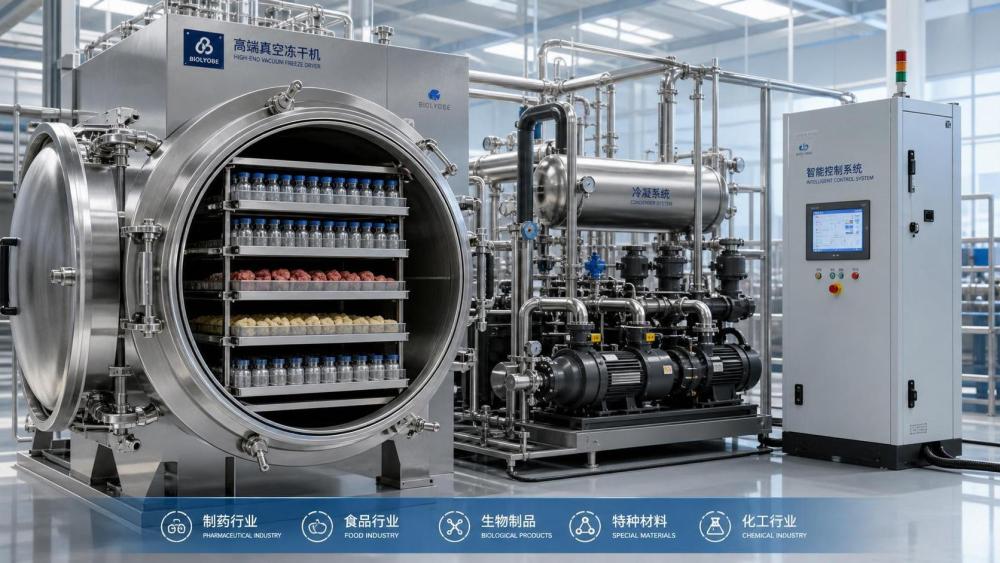
Vacuum technology applications freeze drying shape far more than moisture removal.
They influence product structure, thermal exposure, cleaning demands, traceability, and the stability of downstream packaging.
In practice, freeze drying is rarely judged by chamber pressure alone.
The better question is whether the vacuum system supports the actual material, batch profile, and operating rhythm.
That is why vacuum technology applications freeze drying are closely connected with broader auxiliary systems.
A stable vacuum may protect sensitive ingredients, but weak cleaning control or poor coding after drying can still compromise final quality.
This wider process view is increasingly important across food, pharmaceutical, biotech, chemical, and specialty materials production.
Within advanced manufacturing, auxiliary equipment often decides whether a process remains repeatable when conditions change.
Freeze drying is a strong example because vacuum behavior directly affects sublimation speed, residual moisture, and batch uniformity.
Actual use cases start with different process risks
Different operations ask different things from vacuum technology applications freeze drying.
A high-value injectable product usually prioritizes sterility, pressure control accuracy, and validation records.
A fruit ingredient line may care more about throughput, aroma retention, and energy efficiency over long campaigns.
Specialty chemicals often sit somewhere between those two extremes.
They may require deep vacuum performance, but they also raise concerns about solvent handling, corrosion, and pump protection.
The common mistake is to treat all freeze-drying lines as if they shared the same vacuum profile.
They do not, because material behavior changes with pore structure, loading depth, shelf temperature, and contamination risk.
In real projects, vacuum technology applications freeze drying should be evaluated as part of a process chain.
That chain includes weighing accuracy before loading, chamber cleanliness between batches, and reliable identification after packaging.
When product sensitivity drives the decision
Biologics, enzymes, probiotics, and certain diagnostic materials react quickly to heat stress and pressure instability.
Here, vacuum technology applications freeze drying are judged by control smoothness rather than headline pumping speed.
Short pressure spikes can trigger collapse, foam formation, or uneven cake structure.
That often creates rework, visual rejects, or unstable storage performance.
When output volume changes the priority
Bulk food ingredients, coffee extracts, and contract drying operations usually focus on cycle economics.
In these settings, the vacuum system must stay efficient during long runs and variable loading patterns.
A technically excellent vacuum design can still underperform if condensers overload or maintenance intervals are too short.
High-frequency scenarios reveal where the benefits are real
The strongest benefits of vacuum technology applications freeze drying appear when pressure control matches the product’s drying window.
That sounds obvious, but the operational effect differs by scenario.
For sterile and regulated production
The benefit is process repeatability under controlled validation conditions.
Vacuum stability helps maintain predictable sublimation, while cleanable system design reduces contamination carryover.
This is where dry pumps, isolation strategies, and documented monitoring become more important than simple equipment size.
For food and nutraceutical processing
The benefit is preserving color, shape, aroma, and active compounds with less thermal damage.
Vacuum technology applications freeze drying can also support lower oxidation risk during sensitive stages.
Still, product gains depend on upstream preparation and downstream moisture protection.
If dosing is inconsistent or packaging seals vary, the drying advantage weakens quickly.
For specialty chemicals and advanced materials
The benefit often lies in controlled solvent removal and structure preservation.
This matters in catalysts, porous materials, and some electronic or laboratory intermediates.
In these lines, vacuum system material compatibility and condensate management become central design questions.
Different scenarios do not ask for the same vacuum setup
A side-by-side comparison usually makes the differences clearer.
This is why vacuum technology applications freeze drying should not be selected from brochure parameters alone.
The same base pressure can serve one application well and fail another because the risk profile is different.
Where the practical limits usually appear first
Most limits do not show up in ideal trial conditions.
They appear during routine production, scale changes, and maintenance cycles.
One common limit is assuming deeper vacuum always means faster or better drying.
In reality, shelf heat transfer, ice load, and product resistance may become the true bottleneck.
Another limit is contamination control inside pumps and pipelines.
If vapor capture is weak, oil backstreaming, condensate buildup, or particulate carryover can damage consistency.
Noise, utilities, and service access also matter more than expected in continuous industrial settings.
For multi-product sites, cleaning validation and changeover time may become the real capacity constraint.
That broader view fits well with the logic behind industrial auxiliary systems.
Final quality depends on process support equipment working together, not on a single machine parameter.
Misjudgments seen before implementation
- Selecting by pump capacity without checking vapor load, solvent type, and condenser duty.
- Focusing on purchase cost while ignoring seal replacement, cleaning time, and downtime risk.
- Treating pilot success as proof of full-scale stability under different tray depth and batch size.
- Ignoring how coding, packaging, and storage conditions affect the value created by freeze drying.
A better way to match vacuum technology applications freeze drying to the site
A workable decision process starts with operating conditions, not marketing labels.
Before final selection, it helps to map the actual application against several checkpoints.
- Define product sensitivity, target residual moisture, and acceptable structural change.
- Measure real batch variation instead of assuming nominal loading conditions.
- Confirm whether dry, oil-sealed, or hybrid pump arrangements fit contamination and maintenance limits.
- Check integration with weighing, cleaning, coding, packaging, and traceability systems.
- Review utility stability, service access, spare part timing, and operator handling requirements.
This approach is especially useful when freeze drying is only one step in a tightly controlled manufacturing route.
In those cases, vacuum technology applications freeze drying must support both product performance and process documentation.
What to review next before locking the process window
The strongest freeze-drying decisions usually come from comparing scenarios, not chasing a universal best setup.
Vacuum technology applications freeze drying deliver clear benefits when pressure control, cleanliness, and maintenance strategy match the real load.
Their limits become visible when teams overlook site conditions, contamination pathways, or long-cycle operating costs.
A practical next step is to separate products by sensitivity, throughput pattern, and compliance burden.
Then compare vacuum requirements against condenser capacity, pump design, cleaning method, and batch traceability needs.
That kind of structured review makes vacuum technology applications freeze drying easier to scale, easier to validate, and less likely to create hidden process risk.