
Vacuum Level Control Explained: Parameters, Sensors, and Common Stability Problems
Vacuum level control directly affects process stability, product quality, and equipment efficiency in many industrial settings.
When vacuum drifts, processes become less predictable. Scrap rises, cycle time changes, and troubleshooting often takes longer than expected.
That is why vacuum level control matters in packaging, coating, degassing, drying, semiconductor work, and precision handling.
This guide breaks down the main parameters, sensor choices, and common stability problems in a practical way.
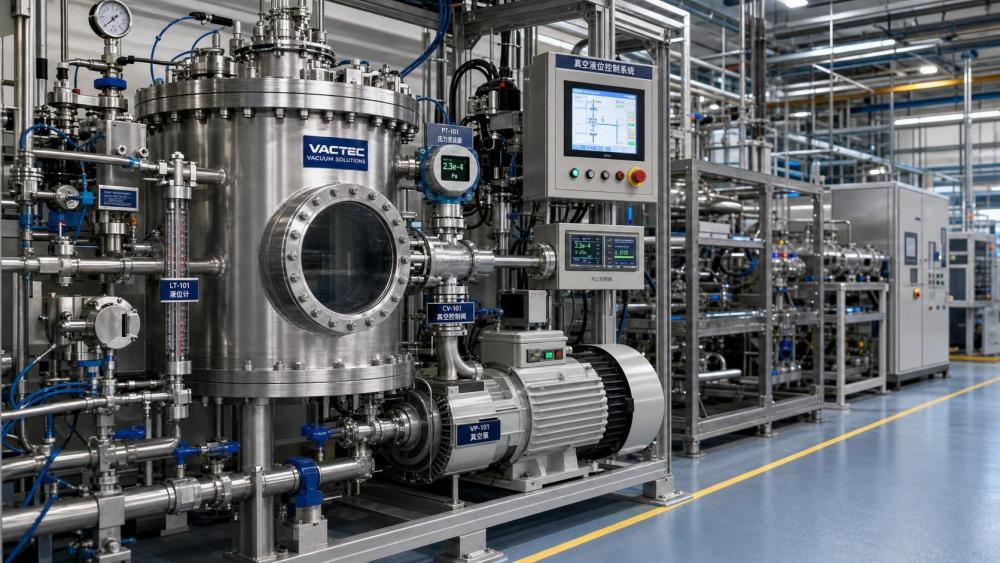
The goal is simple: help you read vacuum behavior correctly and respond before small fluctuations become production issues.
What Vacuum Level Control Actually Means
Vacuum level control is the process of maintaining a target pressure below atmospheric pressure inside a system.
In daily operation, it is not just about reaching a vacuum level. It is about holding that level with minimal variation.
A stable vacuum supports repeatable results. An unstable one creates hidden variation, even when the machine still appears to be running.
More specifically, vacuum level control combines measurement, feedback, valve action, pump response, and leak management.
This also means good control depends on the entire system, not only on the pump.
Key Parameters Behind Vacuum Level Control
To improve vacuum level control, start with the parameters that directly shape stability.
Setpoint
The setpoint is the target vacuum level the controller tries to maintain.
If the setpoint is unrealistic for the process load, the system will hunt, overshoot, or recover too slowly.
Pressure Range
Different applications operate in rough, medium, or high vacuum ranges.
A sensor that performs well in one range may be inaccurate or slow in another.
Response Time
Response time shows how quickly the system reacts to pressure changes.
Slow response causes lag. Fast but poorly tuned response can create oscillation.
Deadband and Tolerance
Deadband is the acceptable pressure window around the setpoint.
A narrow deadband improves precision, but it can also increase valve cycling and wear.
Pump Capacity and Conductance
Pump size alone does not guarantee stable vacuum level control.
Line diameter, valve restriction, pipe length, and chamber geometry all affect conductance and real performance.
Gas Load
Gas load includes air leaks, process vapors, moisture, outgassing, and product release.
In actual production, changing gas load is one of the biggest reasons vacuum level control becomes unstable.
Common Sensor Types Used for Vacuum Level Control
Reliable vacuum level control starts with reliable measurement. If the reading is wrong, the control action will also be wrong.
Pirani Sensors
Pirani sensors are widely used in rough and medium vacuum applications.
They are practical, affordable, and suitable for many industrial vacuum level control tasks.
However, gas composition can affect readings, so calibration matters.
Capacitance Manometers
These sensors provide highly accurate absolute pressure measurement.
They are useful when vacuum level control needs tight repeatability and low drift.
They often perform well in coating, semiconductor, and analytical processes.
Piezoelectric and Strain Gauge Sensors
These are common in industrial equipment where ruggedness and cost matter.
They are often used for basic vacuum level control, especially near atmospheric pressure.
Cold Cathode and Hot Cathode Gauges
These gauges serve high vacuum applications.
They are less common in general factory settings, but critical where very low pressures must be monitored.
How to Choose the Right Sensor
- Match the sensor range to the real operating pressure.
- Check compatibility with vapors, dust, and process gases.
- Review accuracy, repeatability, and response speed.
- Confirm maintenance needs and calibration intervals.
- Place the sensor where it reflects true chamber conditions.
Why Vacuum Level Control Becomes Unstable
When vacuum level control becomes unstable, the symptom is usually visible. The root cause is often hidden.
Leaks in the System
Even small leaks can create slow pressure drift or continuous pump loading.
Common leak points include seals, fittings, valves, flanges, hoses, and door gaskets.
Sensor Drift or Contamination
A dirty or drifting sensor can mislead the controller.
This is especially common where oil mist, condensate, powder, or process residue reaches the sensing element.
Poor Controller Tuning
PID settings that are too aggressive can cause oscillation.
Settings that are too conservative can make vacuum level control slow and weak during load changes.
Undersized or Worn Pumping Equipment
If the pump cannot handle peak gas load, stability will drop.
Wear, internal leakage, oil degradation, and blocked filters also reduce effective pumping speed.
Improper Valve Action
Control valves that stick, react slowly, or cycle too sharply can destabilize vacuum level control.
The same issue appears when valve sizing does not match process demand.
Changing Process Conditions
Warm product loads, moisture release, solvent evaporation, and batch variation all affect pressure behavior.
From a practical view, stable vacuum level control requires stable upstream conditions too.
How to Troubleshoot Vacuum Level Control Step by Step
A structured check usually solves vacuum level control problems faster than changing parts one by one.
- Confirm the symptom. Is pressure drifting, oscillating, recovering slowly, or failing to reach setpoint?
- Verify the sensor reading with a reference gauge.
- Inspect seals, hoses, fittings, and chamber doors for leaks.
- Review pump condition, oil quality, exhaust filters, and service history.
- Check valve movement and controller output signals.
- Compare actual gas load with design assumptions.
- Retune the controller only after measurement and hardware checks.
This order matters. Many teams tune the controller first, even when the real problem is leakage or poor sensing.
Practical Tips to Improve Vacuum Level Control
Small operational changes can make vacuum level control much more stable.
- Use the correct sensor technology for the pressure range.
- Install sensors away from direct contamination and strong local turbulence.
- Trend pressure data instead of relying only on alarm events.
- Replace worn seals before they create major instability.
- Keep pump maintenance intervals consistent.
- Review valve sizing when process cycles change.
- Adjust setpoints to realistic process needs, not theoretical minimum pressure.
In many plants, the clearest improvement comes from better trend analysis. Pressure curves often reveal issues before operators hear or see them.
Quick Reference Table for Common Vacuum Level Control Problems
Final Takeaway
Good vacuum level control is never just a control setting. It is the result of balanced measurement, healthy hardware, and realistic process conditions.
If stability problems keep returning, start with the basics: verify the sensor, check for leaks, confirm pump performance, and review actual gas load.
That approach usually saves time and reduces unnecessary replacement costs.
In day-to-day production, stronger vacuum level control means fewer surprises, better consistency, and more confidence in every cycle.