
On June 6, 2026, Singapore’s amended Energy Conservation framework entered into force, turning energy registration and labeling into a practical market-entry requirement for regulated goods that now extend to self-use imports. For Dry Screw/Claw Pumps and other industrial vacuum pump equipment entering the Singapore market, the immediate compliance points are NEA registration, MEPS testing, and energy labeling. This matters not only to exporters, but also to procurement teams, distributors, testing-related service providers, and delivery planners, because the change affects export workflow, certification timing, and compliance cost assumptions rather than serving as a simple policy headline.
What the June 6 implementation confirms
The event date provided is June 6, 2026. According to the supplied information, Singapore promulgated the amended Energy Conservation law in March 2026 and formally implemented it on June 6. The regulatory scope for “regulated goods” was expanded to cover self-use imports, alongside categories such as air conditioners, commercial refrigeration equipment, and three-phase motors.
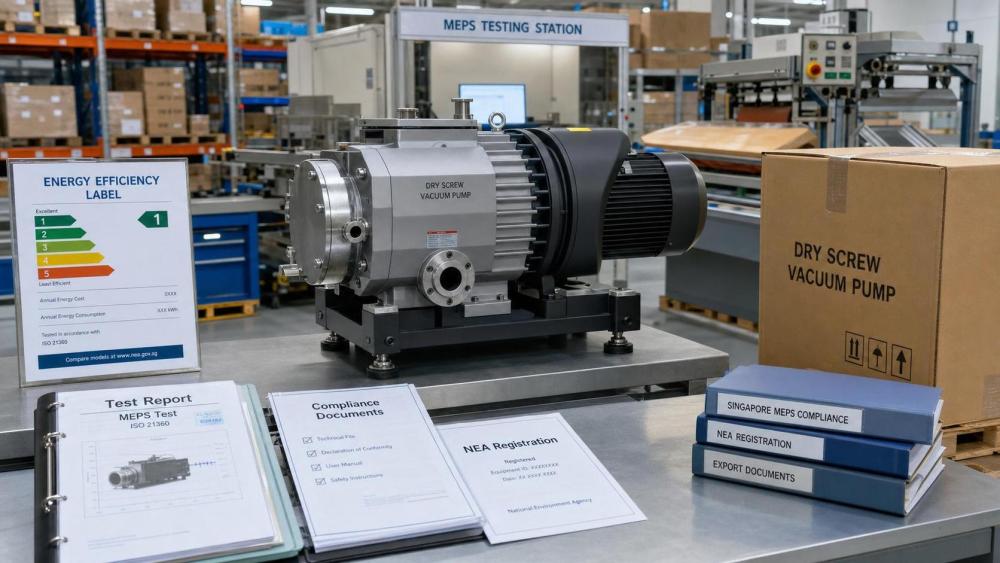
The same supplied information states that Dry Screw/Claw Pumps and other industrial vacuum pump equipment entering the Singapore market must complete registration with Singapore’s National Environment Agency (NEA), pass MEPS energy-efficiency testing, and carry an energy label. It also states that non-compliant products may be removed from e-commerce platforms, and that a single violation may result in a fine of up to SGD 10,000.
The supplied summary further notes that this rule directly affects how Chinese suppliers plan new export procedures, certification lead times, and compliance costs.
Where the rule change is likely to be felt first
Export shipment planning now depends on compliance readiness
From an industry perspective, exporters of Dry Screw/Claw Pumps and related industrial vacuum pump equipment are among the first groups affected because the rule links market access to registration, testing, and labeling. The operational impact is most visible in pre-shipment review, product document preparation, and delivery scheduling. What deserves closer attention is whether goods intended for the Singapore market are being prepared with the required compliance path in mind, rather than treated as a routine shipment.
Procurement and channel teams face a stricter acceptance threshold
For buyers, importers, and channel operators, the rule change raises the practical acceptance threshold for products entering sale or use in Singapore. Analysis shows that procurement decisions may need closer alignment with NEA registration status, MEPS testing progress, and label readiness, because non-compliant products face platform removal risk and financial exposure. The effect is not limited to product selection; it also touches vendor screening, order timing, and acceptance checks before listing or delivery.
Compliance and testing-related services become part of delivery timing
Certification-related firms, testing service providers, and supply-chain coordinators may also feel the impact because compliance is no longer peripheral to the transaction. Observably, documentation flow, testing arrangements, and handoff timing become more tightly connected to shipment planning and customer commitments. Even where the supplied information does not provide a detailed implementation procedure, the rule clearly shifts part of the delivery risk toward compliance preparation.
What companies should watch in current transactions
Review whether the product path already includes NEA and MEPS steps
Analysis shows that companies shipping Dry Screw/Claw Pumps and similar equipment to Singapore should first examine whether their existing export process already accounts for NEA registration, MEPS testing, and energy labeling. If those steps were previously outside the standard workflow, the main issue is not only compliance itself, but also whether internal approval and shipment release procedures need adjustment.
Check technical files and trade documents against the new requirement
What deserves closer attention is the consistency between technical materials and trade documentation. Where products are intended for the Singapore market, companies should pay attention to whether test-related materials, product specifications, labels, and transaction documents can support the required compliance review. The supplied information does not provide detailed document lists, so this should be understood as a current compliance checkpoint rather than a confirmed filing template.
Reassess lead time and cost assumptions for Singapore-bound orders
Observably, the supplied summary already points to certification cycle and compliance cost pressure for Chinese suppliers. Companies involved in quotation, procurement planning, or delivery commitments should therefore review whether existing lead-time assumptions remain realistic once registration, testing, and labeling are treated as mandatory market-entry steps. This is especially relevant where orders were previously planned under a simpler export timeline.
Keep monitoring execution language and downstream purchasing signals
From an industry perspective, companies should continue watching how the rule is reflected in downstream procurement language, platform compliance expectations, and practical transaction checks. The supplied information confirms the legal implementation date and core requirements, but it does not provide detailed enforcement wording for every scenario. That means current attention should stay on execution signals rather than assumed outcomes.
Why this looks more like an execution signal than a distant policy note
Analysis shows that this development is better understood as a rule that has already crossed from policy text into market execution. The key reason is that the June 6 implementation date is explicit, the compliance elements are concrete, and the consequences for non-compliance are identified in the supplied information. At the same time, it would be premature to describe the full market impact as settled, because the supplied content does not include broader enforcement patterns, detailed procedural interpretation, or transaction-level feedback from all affected participants.
It is more appropriate to understand this as a clear execution signal with ongoing observation value. The immediate shift is real: regulated access to the Singapore market now depends more directly on registration, MEPS testing, and labeling readiness. The parts that still require attention are the consistency of implementation language, purchasing-side response, and how companies absorb the added compliance workload in live orders.
How the market should read the June change
In practical terms, this event should be read as a compliance-driven adjustment to market access conditions for relevant equipment entering Singapore, including Dry Screw/Claw Pumps. It does not by itself confirm uniform outcomes across every transaction, but it does establish that registration, energy-efficiency testing, and labeling can no longer be treated as secondary matters for affected products.
From an industry perspective, the most balanced conclusion is that the June 6 implementation marks a landed rule change with direct implications for export planning, procurement checks, and delivery coordination. The next phase is not speculation about broad market transformation, but close attention to how the requirement is applied in certification practice, commercial documents, and downstream purchasing behavior.
Basis of this article and points still to verify
This article is generated based on the user-provided news title, event date, and event summary. For events of this type, commonly relevant source categories may include official regulatory announcements, releases from supervisory authorities, customs or trade administration information, industry association updates, standard-setting documents, and reporting by authoritative media.
No specific official source link was provided in the input, so the exact official reference path still requires ongoing verification. Observably, the areas that still merit follow-up include detailed policy wording, certification implementation practice, changes in tender or procurement documents, industry feedback, and how affected companies are carrying the rule into actual export and delivery processes.