
Industrial Vacuum Pump Exporter Checklist: What Buyers Should Verify Before Ordering
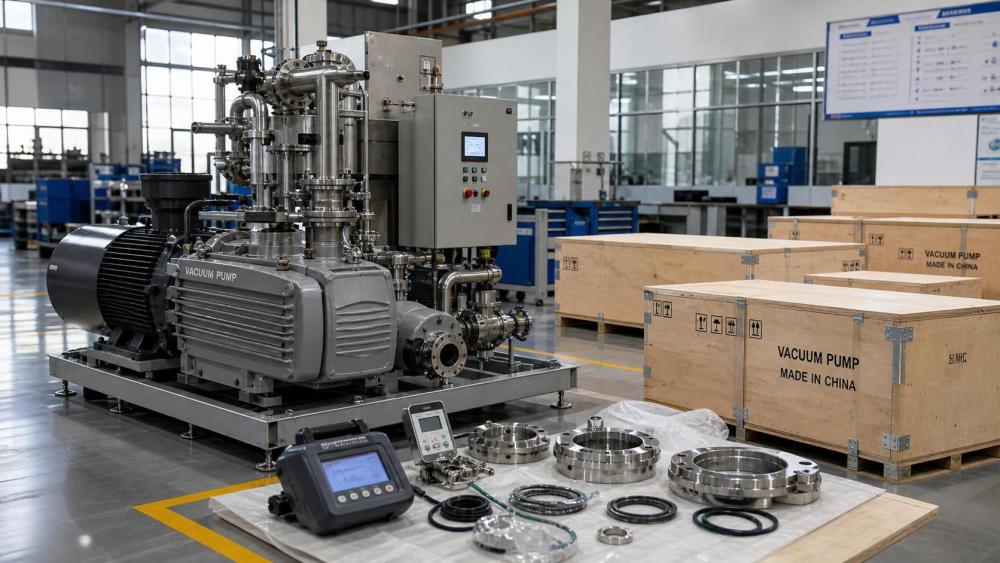
Choosing an industrial vacuum pump exporter is not just about price or lead time.
The real job is confirming quality, fit, compliance, and delivery reliability before money is committed.
A vacuum pump often supports packaging, drying, degassing, coating, or process transfer.
If the selected exporter misses technical details, the cost shows up later as downtime, scrap, or delayed installation.
That is why a practical industrial vacuum pump exporter checklist matters.
It helps reduce sourcing risk and keeps the order aligned with production reality.
Start With the Actual Process Requirement
Before comparing suppliers, define what the pump must do inside the process.
This sounds obvious, yet many buying problems begin with incomplete application data.
A capable industrial vacuum pump exporter should ask for operating pressure, flow rate, cycle pattern, gas composition, and ambient conditions.
If those questions never come up, that is an early warning sign.
- Required ultimate vacuum and working vacuum range
- Pumping speed at the real operating point
- Continuous or intermittent duty cycle
- Presence of vapor, dust, corrosive gas, or condensate
- Noise limits, energy targets, and site utility conditions
The right specification prevents oversizing and undersizing.
Both can damage total cost of ownership.
Confirm the Exporter Understands Pump Technology Selection
Not every industrial vacuum pump exporter is equally strong across technologies.
Some are effective with oil-sealed rotary vane units.
Others know dry screw, liquid ring, roots booster, or claw systems better.
The exporter should explain why one technology matches the application better than another.
That explanation should cover contamination risk, maintenance interval, vapor tolerance, and energy use.
In real procurement work, a clear technical comparison is often more valuable than a low opening quote.
Questions worth asking
- Why is this pump type recommended for this duty?
- What failure modes appear in similar applications?
- How does process vapor affect performance over time?
- Is a booster, filter, condenser, or separator required?
Verify Performance Data, Not Just Catalog Claims
Catalog values are a starting point, not a decision point.
A reliable industrial vacuum pump exporter should provide test data or performance curves tied to the proposed model.
This is especially important when the process has narrow pressure windows or sensitive product quality demands.
Check whether the quoted flow rate is measured at atmosphere or near the actual working pressure.
That difference can materially change system behavior.
Check Manufacturing Quality and Material Control
A serious industrial vacuum pump exporter should be transparent about manufacturing control.
That includes machining accuracy, rotor balance, seal quality, leak testing, and final inspection records.
Material selection also needs attention.
Different gases, cleaning agents, or moisture loads may require different elastomers, coatings, or internal materials.
This is where export sourcing becomes practical, not theoretical.
A supplier that cannot document component control may struggle with repeatability across batches.
- Request inspection reports for key dimensions
- Confirm material grades for wetted and sealing parts
- Ask how traceability is maintained during assembly
- Check whether factory testing is standard or optional
Review Certifications, Compliance, and Export Documents
Compliance is where many orders become slower than expected.
An industrial vacuum pump exporter should know which documents are required for the destination market.
Depending on the region, that may include CE, ISO records, test certificates, packing declarations, or origin documents.
For regulated sectors, documentation discipline matters almost as much as hardware performance.
Ask the exporter to list deliverables before order confirmation.
That prevents late disputes about manuals, drawings, nameplates, and customs paperwork.
Minimum document set to request
- Technical datasheet with model and operating limits
- General arrangement drawing and utility requirements
- Inspection and test record
- Spare parts list and maintenance guide
- Export packing list and certificate support
Evaluate Service, Spares, and Failure Response
Price pressure often pushes service questions to the end.
That is usually a mistake.
A good industrial vacuum pump exporter should define warranty scope, spare parts lead time, and response channels clearly.
Vacuum equipment can fail from contamination, misuse, utility instability, or wear.
What matters is whether the exporter can support diagnosis fast enough to protect production.
More buyers now ask for recommended spare kits with the first shipment.
From a cost perspective, that is usually justified for critical lines.
Look Beyond Unit Price to Total Delivered Cost
The cheapest quote can become the most expensive order.
An industrial vacuum pump exporter should be compared on total delivered cost, not only equipment price.
That means power use, maintenance parts, oil or seal consumption, shipping method, duties, installation extras, and downtime exposure.
This is where two similar offers often separate.
One supplier may quote a lower pump price but exclude accessories needed for stable operation.
Another may include filtration, instrumentation, and startup guidance that reduces future cost.
A simple cost review should include
- Quoted equipment scope
- Consumables and spare parts over twelve months
- Expected maintenance frequency
- Energy demand at normal operating load
- Freight, taxes, and installation impact
Assess Export Reliability and Communication Discipline
A technically good pump can still become a difficult purchase if export execution is weak.
A dependable industrial vacuum pump exporter should communicate lead time assumptions, inspection timing, packing method, and shipment terms clearly.
Look at how they answer detailed questions.
Fast replies matter, but complete replies matter more.
More importantly, check whether the same facts remain consistent across quotations, drawings, and email records.
That consistency is a strong signal of export maturity.
Use a Short Final Checklist Before Issuing the PO
Before placing the order, pause for one last review.
This final step often catches specification gaps that become expensive after shipment.
- Application data is complete and confirmed in writing
- Pump technology matches gas load and duty cycle
- Performance data is tied to the selected model
- Materials, certifications, and documents are defined
- Warranty, spares, and service response are agreed
- Delivered cost and lead time assumptions are transparent
A strong industrial vacuum pump exporter does more than send a quotation.
They help reduce technical uncertainty and support a smoother import process.
When that standard is applied early, ordering becomes faster, safer, and easier to defend internally.