
How to Select an Industrial Vacuum Pump for Dusty, Continuous-Duty Processes
Selecting industrial vacuum pumps for a dusty process is rarely a matter of choosing the highest flow rate or the lowest achievable pressure. In continuous-duty production, the pump is exposed to a changing mix of air, particles, heat, moisture, and sometimes vapors that were never included in the initial nameplate calculation. A unit that performs well during a clean commissioning test may become unreliable after weeks of powder transfer, trimming, grinding, bag filling, conveying, or coating-line operation.
The practical question is not simply, “What vacuum level do we need?” It is, “Can this vacuum system maintain the required process conditions when dust loading rises, filters begin to load, ambient temperature changes, and production does not stop?” That distinction matters in applications ranging from packaging and CNC chip extraction to battery material handling, surface preparation, pharmaceutical powder processing, and vacuum-assisted conveying.
A well-chosen vacuum solution protects more than equipment availability. Stable vacuum affects part handling, product cleanliness, batch consistency, traceability, coating quality, and contamination control. In advanced manufacturing, auxiliary systems often sit outside the spotlight, yet a vacuum instability can still stop the primary line.
Start with the Dust, Not the Pump Curve
Pump curves remain essential, but they should not be the first document reviewed. Begin by understanding the material entering the extraction point. “Dusty” covers a wide range of conditions: dry plastic fines, abrasive mineral particles, metallic powder, carbon black, paper fibers, food powders, sticky residues, and mixed process debris do not behave in the same way.
Particle size is only one part of the picture. Fine dust may pass through poorly selected filters, while coarse material can settle in ducts or damage rotating components if it reaches the pump. Abrasive particles can shorten the life of internal clearances. Hygroscopic powders can build deposits when humidity enters the system. Oily or tacky dust can blind filter media quickly, creating a pressure loss that changes the effective suction at the process point.
It is worth asking where the dust is generated and whether it is entrained continuously or released in bursts. A steady low-load stream is very different from a hopper discharge, a bag-dump station, or an intermittent cleaning cycle that sends a concentrated cloud into the line. The latter may require more separation capacity, a larger receiver, or controls that prevent the pump from seeing a sudden solids surge.
Where combustible dust may be present, the assessment becomes more serious. The dust’s explosion characteristics, zoning requirements, grounding, filtration arrangement, discharge location, and local regulatory obligations need to be reviewed as part of the system design. A pump choice cannot be isolated from the wider dust-handling and safety strategy. These issues should be confirmed against site-specific risk assessments and applicable local standards rather than assumed from a generic equipment description.
Define the Real Duty Point at the Process Connection
Technical evaluations often go wrong because the required air volume is estimated at the pump inlet rather than at the tool, chamber, fixture, pickup hood, or conveying point that actually needs suction. Duct length, bends, branch lines, separators, filters, silencers, valves, and leaks all consume pressure. As filters load, that resistance changes again.
For dusty continuous-duty applications, define at least four operating conditions: clean filter, normal loaded filter, near-changeout filter, and expected peak demand. If the process includes multiple users, map which combinations operate at the same time. It is common to find that a central vacuum unit was sized for every point running simultaneously even though the process logic prevents that situation. The opposite error also occurs: a system is based on average demand, then loses performance when several stations call for vacuum during a production peak.
The target should be a usable pressure and airflow range, not one ideal number. Some applications need high flow at a modest vacuum level, such as general extraction or porous material handling. Others need deeper vacuum with lower gas flow, such as fixture clamping, degassing, vacuum packaging, or certain coating and drying processes. Confusing these duties can lead to an oversized pump that wastes energy or an undersized unit that runs permanently at its limit.
Choose Pump Technology Around Contamination Tolerance
There is no universally best technology among industrial vacuum pumps. The appropriate design depends on required vacuum, gas composition, dust-control arrangement, maintenance philosophy, and the consequences of downtime. In dusty service, the ability to keep contaminants away from internal pumping surfaces is often more valuable than a headline ultimate-vacuum specification.
Oil-sealed rotary vane pumps are widely used where stable vacuum is needed, but they require effective inlet protection. Dust entering the pump can contaminate oil, accelerate vane wear, and degrade performance. In processes where oil backstreaming or oil contamination is unacceptable, additional controls or another technology may be more appropriate. Their suitability should be judged by the complete arrangement, including inlet filtration, condensate management, exhaust treatment, and oil service access.
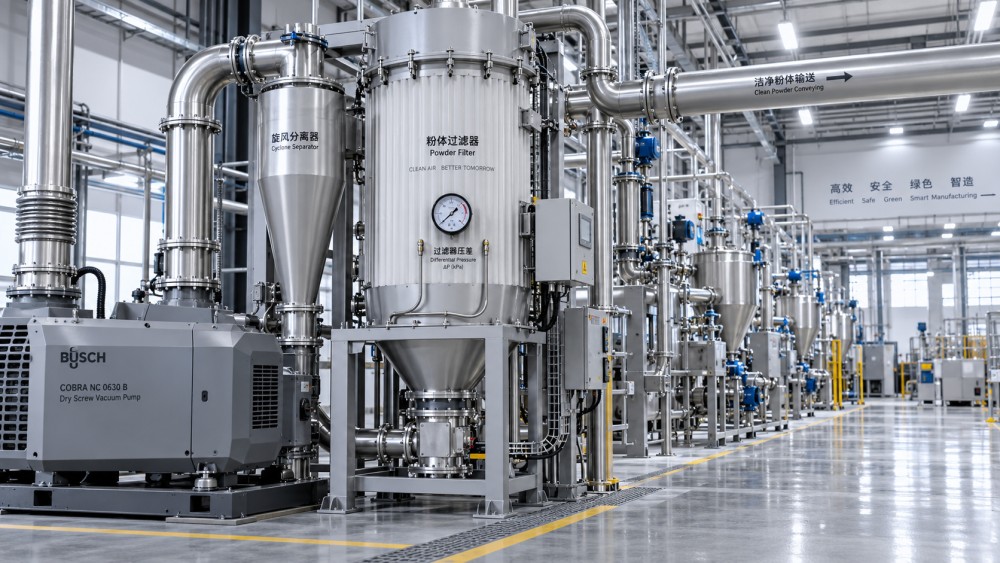
Dry screw pumps are often considered for harsher industrial gases and continuous operation because they avoid process-side sealing oil. However, “dry” does not mean maintenance-free or immune to dust. Fine abrasive powder, deposits, corrosive vapors, and excessive operating temperature can still affect clearances and internal surfaces. Some applications may need purge gas, temperature management, or upstream separation to prevent buildup.
Liquid ring pumps can be useful where wet gases, condensable vapors, or some particulate carryover are part of the duty. Their operating fluid becomes part of the evaluation: water quality, recirculation, disposal, contamination, freezing risk, and make-up supply all need attention. They may be robust in the right environment but can shift maintenance and environmental responsibility to the liquid circuit.
For lower vacuum applications, regenerative blowers or other air-moving equipment may be a better fit than a deep-vacuum pump. They can provide substantial airflow and tolerate certain extraction duties well, provided the required pressure differential remains within their operating range. This is why terminology matters: a site may call every suction device a “vacuum pump,” while the process requirement points toward a blower, a central vacuum system, or a staged arrangement instead.
Filtration Is Part of the Vacuum System, Not an Accessory
In dusty service, the separator and filter train deserve the same engineering attention as the pump itself. A good pump protected by an undersized filter is still a poor system. The filtration approach usually needs to address three separate tasks: remove bulk solids, capture fine particulate, and prevent unexpected carryover during upset conditions.
A cyclone, drop-out chamber, or pre-separator may reduce the burden on the final filter when coarse particles are present. Cartridge, bag, or panel filters are then selected according to particle characteristics, required cleanliness, airflow, allowable pressure drop, and cleaning method. If pulse cleaning is used, check whether cleaning occurs while suction demand is active and whether pressure fluctuations can disturb the process.
Do not select filter efficiency in isolation. Higher-efficiency media can be necessary for sensitive production areas, but it may also introduce more resistance or require a larger filter area to maintain acceptable pressure loss. For a vacuum pick-and-place station, a gradual loss of airflow may cause dropped parts long before the central pump appears to be underloaded. For powder conveying, the same condition may change transport velocity and create line blockage.
Differential-pressure monitoring is especially useful in continuous-duty systems. It gives maintenance teams a practical signal of filter loading, rather than relying on a calendar interval or waiting for the process to complain. The sensor should be installed and interpreted in a way that distinguishes normal operational changes from a genuinely blocked element.
Continuous Duty Changes the Maintenance Conversation
A pump that runs for a short daily cycle can tolerate a very different maintenance approach from one operating around the clock. Continuous duty raises the importance of bearing life, cooling, lubrication, seal condition, motor loading, vibration, and access for inspection. It also exposes small installation flaws quickly: restricted cooling air, poor exhaust routing, undersized electrical protection, or a filter housing that cannot be serviced without shutting down the entire line.
Ask the supplier to describe maintenance tasks in operational terms. Which items must be changed? How often is the interval expected to vary with contamination? Can the filter be isolated? Is there a bypass or standby pump option? Does the pump need a controlled shutdown before service? A maintenance schedule stated only in operating hours is incomplete if actual dust load, temperature, and moisture levels are unknown.
Redundancy is not always necessary, but it is worth evaluating where vacuum loss immediately halts production or creates a quality risk. A duty/standby arrangement, parallel pumps with automatic lead-lag control, or a receiver that provides short-term vacuum stability can be justified by process criticality. The right answer depends on how long the plant can operate without suction, how quickly a replacement can be installed, and whether a shutdown creates scrap, cleanup work, or compliance exposure.
Look Beyond Purchase Price to Energy and Control Strategy
For a continuously operating vacuum system, energy use is often a lifecycle issue rather than a minor operating detail. Oversizing is tempting because it appears to provide insurance. In reality, a large fixed-speed pump may run inefficiently against throttled demand, generate unnecessary heat, and increase wear on filters and valves.
Variable-speed control can be valuable where demand changes substantially, but it is not automatically the best option. The pump and motor must remain within acceptable operating limits throughout the speed range, and the control logic must maintain the minimum vacuum needed at the critical point. In a multi-station system, pressure-based control may be more useful than simply matching motor speed to a scheduled production rate.
Leakage deserves attention before specifying additional capacity. Open-ended hoses, worn seals, failed valves, and poorly maintained fixtures can turn a stable system into one that appears undersized. A site survey during actual production often reveals this more clearly than a drawing review. It also helps identify whether one high-demand station should have a local pump instead of burdening a central network.
Questions That Expose Weak Specifications Early
Before approving a solution, technical teams should be able to answer a few practical questions:
- What particles, vapors, moisture, and temperature conditions will reach the inlet under normal and abnormal operation?
- What airflow and vacuum are required at each process point when filters are partially loaded?
- Which component is intended to stop bulk solids, fine dust, and accidental carryover?
- What happens if one filter blocks, a station valve fails open, or production demand rises unexpectedly?
- Can maintenance be completed safely without creating a long line stoppage or releasing collected dust?
- What site utilities, noise limits, exhaust constraints, safety requirements, and control interfaces apply?
If these questions produce vague answers, the specification is probably still centered on equipment rather than process risk. That is the stage where many costly mistakes can still be avoided.
Use a System-Level Evaluation
A useful evaluation brings process engineering, maintenance, environmental health and safety, and procurement into the same discussion. Procurement may focus on delivery time, spare-parts availability, and total cost. Maintenance will notice service access and failure modes. Process teams will care about stability at the point of use. Each view is incomplete by itself.
This system-level approach is consistent with how industrial auxiliary equipment should be assessed more broadly. Vacuum performance can influence cleaning precision, powder handling, packaging integrity, coating consistency, and traceability-related production controls. Platforms such as Global General Industrial Auxiliary Systems (GIAS) are useful when comparing the surrounding technologies and process considerations, not just individual pump specifications.
The best industrial vacuum pump for dusty, continuous-duty work is usually not the unit with the most impressive catalogue figure. It is the one paired with appropriate separation, filtration, controls, cooling, service access, and contingency planning. Specify the real contamination and duty cycle first; then select the pump technology that can live with them for years, not merely pass an acceptance test on day one.