
On August 7, 2026, the European Chemicals Agency updated the SVHC candidate list under REACH, adding two phthalate substances associated with elastomer sealing materials used in certain vacuum pump categories. For exporters shipping vacuum system equipment to the EU, the immediate point of attention is that, from October 1, 2026, products containing these materials must be accompanied by a REACH Article 33 compliance declaration and safe-use guidance. This matters not only for equipment makers in segments such as Roots Vacuum Systems and Dry Screw/Claw Pumps, but also for the documentation, sourcing, and traceability functions that support EU-bound deliveries.
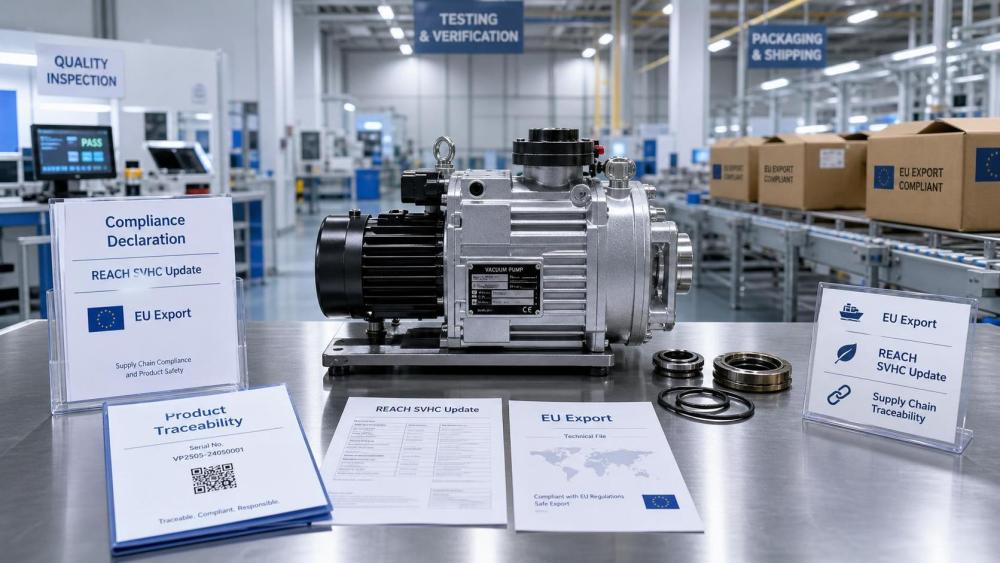
What Has Changed Under the Latest REACH Update
The confirmed change is tied to the SVHC candidate list update issued by ECHA on August 7, 2026. According to the provided event summary, two phthalate substances were added and are used in elastomer sealing components found in Dry Screw/Claw Pumps and Rotary Vane/Liquid Ring vacuum pumps.
The same summary states that, starting on October 1, 2026, vacuum system equipment exported to the EU that contains such materials must be shipped with a compliance declaration meeting REACH Article 33 requirements, together with safe-use instructions.
The information provided also identifies a direct impact on exporters of products including Roots Vacuum Systems and Dry Screw/Claw Pumps, particularly in relation to technical documentation preparation and supply chain traceability capability.
Where the Pressure Will Be Felt Across the Supply Chain
Export-facing equipment deliveries move from product shipment to document-backed shipment
From an industry perspective, manufacturers and traders serving the EU market may be affected first because the requirement is linked to goods shipped to the EU. The impact is likely to appear in shipment readiness, document packaging, and pre-delivery compliance checks. What deserves closer attention is whether the product file for each EU-bound order can clearly identify the relevant sealing materials and support the required declaration.
Component and material sourcing now matters beyond cost and availability
Analysis shows that procurement and supplier management teams may also be affected because the issue is not limited to the finished vacuum system. The trigger described in the event summary sits at the material and component level, specifically elastomer sealing materials used in named pump types. In practice, the key change to watch is whether upstream suppliers can provide clear material information that supports downstream REACH Article 33 documentation.
Traceability functions become part of delivery execution
Observably, the requirement puts added weight on supply chain traceability rather than on commercial paperwork alone. For operations teams, the likely pressure point is the ability to connect a shipped unit, its seal material configuration, and its compliance documents without gaps. This is especially relevant for exporters handling multiple vacuum pump configurations for the EU market.
What Companies Should Review Now
Check which product configurations fall within the stated scope
Companies shipping Dry Screw/Claw Pumps, Rotary Vane/Liquid Ring vacuum pumps, and related vacuum system equipment to the EU should review whether the elastomer sealing materials used in those products involve the substances referenced in the update. The practical issue is product-level identification, not just a general understanding of the rule change.
Rebuild technical files around Article 33 delivery needs
Analysis shows that the new requirement is operational only when the declaration and safe-use guidance can travel with the goods. That makes technical documentation a near-term priority. Firms should therefore pay close attention to whether their existing files can support shipment-by-shipment compliance statements for affected EU exports.
Test supplier traceability before the October deadline
What deserves closer attention is the reliability of upstream material disclosure. If supplier data on sealing materials is incomplete, the problem may surface late, at order confirmation or export release stage. For that reason, supplier communication, document requests, and internal validation steps are likely to matter as much as the final declaration itself.
Separate the legal signal from the execution burden
Observably, the policy signal and the business workload are related but not identical. The confirmed fact is the October 1, 2026 documentation requirement for relevant EU exports. The broader operational burden, however, will depend on how well each company can connect product design, procurement records, and outbound shipping documents in a consistent process.
Why This Looks Like More Than a Routine List Update
Analysis shows that this development is better understood as a concrete compliance trigger rather than a distant regulatory headline. The reason is timing: the event summary links the updated SVHC listing directly to a defined documentation obligation beginning October 1, 2026.
At the same time, it is more appropriate to understand this as both a short-term operational change and a longer-term signal on material transparency. In the short term, affected exporters need usable declarations and safe-use guidance with shipments. Over the longer term, the emphasis on traceability suggests that material visibility inside vacuum system components is becoming harder to treat as a back-office issue.
Observably, this is also a development that still warrants follow-up attention. The confirmed information identifies the requirement and the affected product context, but companies will still need to monitor how official wording, customer requests, and internal implementation practices align in actual export workflows.
How the Market May Read This Update
For the vacuum equipment trade, the significance of this update lies less in broad market speculation and more in execution discipline. The provided information points to a specific compliance obligation tied to certain sealing materials and EU-bound shipments. That makes the development immediately relevant to exporters whose delivery performance depends on complete technical files and reliable supplier traceability.
It is more appropriate to understand this news as an actionable compliance development with wider supply chain implications, rather than as a stand-alone policy headline. The commercial effect will likely depend on how quickly affected companies can verify product scope, align supplier data, and standardize shipment documentation for the EU market.
Basis of This Article and What Still Needs Verification
This article is based on the user-provided news title, event date, and event summary concerning the August 7, 2026 ECHA SVHC candidate list update and the October 1, 2026 documentation requirement for relevant vacuum system equipment exported to the EU.
For this type of industry update, commonly relevant source categories may include official regulatory notices, company announcements, industry association releases, authoritative media coverage, and standard-setting or compliance documentation. No specific official source link was provided in the input, so the exact official reference still requires ongoing verification.
Further attention should remain on any follow-up official wording, implementation details tied to REACH Article 33 documentation, and how affected exporters translate the requirement into supplier management, technical file preparation, and delivery procedures.