
Choosing vacuum support for semiconductor processing is no longer a narrow equipment decision. It shapes yield stability, contamination risk, energy demand, and maintenance planning across the fab lifecycle.
When dry pumps and Roots systems are compared, the real issue is not which technology is universally better. The practical question is how each supports process pressure, gas composition, uptime targets, and future expansion.
That is why semiconductor processing support vacuum has become a wider industrial topic. On platforms such as GIAS, vacuum is treated like other auxiliary systems: not always visible, yet directly tied to process control and final product quality.
Why vacuum support matters beyond the pump itself
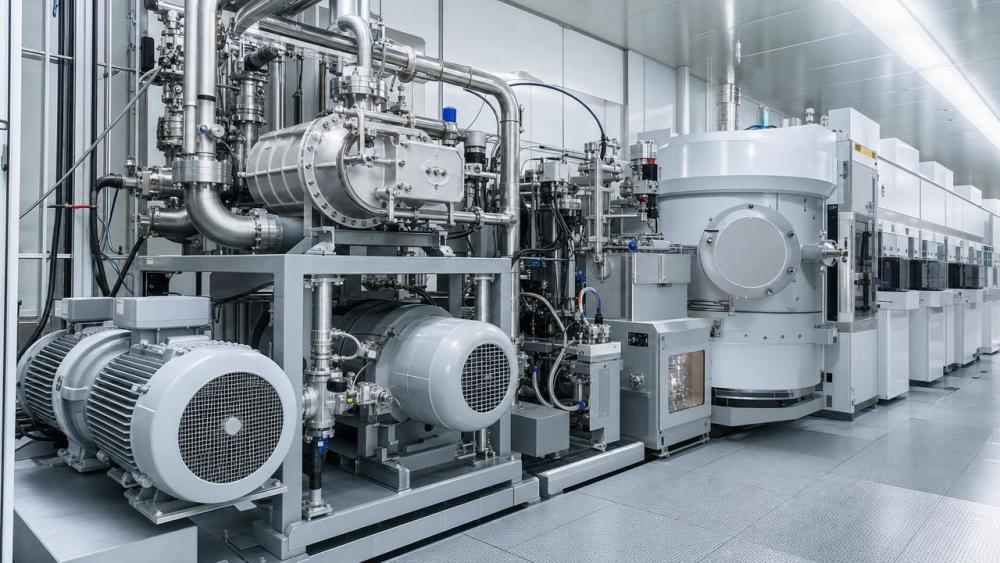
In semiconductor production, vacuum is part of the process environment. It affects etching, deposition, load lock transfer, degassing, and chamber recovery between cycles.
A weak semiconductor processing support vacuum strategy can create hidden costs. These include unstable pressure control, premature wear, particle generation, and difficult exhaust management.
A stronger strategy improves more than process conditions. It also helps balance utility consumption, footprint planning, preventive service, and compliance with clean manufacturing requirements.
This wider view fits advanced manufacturing more broadly. Just as cleaning systems protect surface integrity and coding systems support traceability, vacuum infrastructure protects microscopic process consistency.
Dry pumps and Roots systems in practical terms
Dry pumps create vacuum without sealing oil inside the compression chamber. That makes them attractive for cleaner handling of corrosive, condensable, or particle-forming process gases.
Roots systems, in most semiconductor settings, are usually booster stages paired with backing pumps. They increase pumping speed at selected pressure ranges rather than replacing the full vacuum train.
Simple comparisons often miss this system logic. A dry pump may work alone in some duties, while a Roots stage can strengthen throughput, pump-down time, or chamber cycling when matched correctly.
How each technology is typically understood
Why the comparison matters now
The pressure on semiconductor processing support vacuum has increased for several reasons. Process recipes are more complex, uptime expectations are tighter, and utility costs receive more executive attention.
Another shift is the growing focus on total auxiliary system performance. Buyers no longer review pumps as isolated hardware. They compare emissions treatment, monitoring capability, service access, and lifecycle predictability.
This is especially relevant in facilities that scale quickly. A vacuum choice that works in pilot production may become inefficient when chamber counts increase, process mixes change, or central utilities are reconfigured.
For that reason, semiconductor processing support vacuum decisions now sit closer to broader manufacturing strategy. They intersect with EHS planning, spare parts policy, digital maintenance, and global supplier qualification.
Where dry pumps usually make more sense
Dry pumps are often preferred when contamination control is a first-order concern. The absence of oil in the compression space reduces one common source of backstreaming and simplifies process cleanliness management.
They are also widely chosen for harsh chemistries. In etch and CVD-related duties, the ability to manage corrosive gases and by-products is often more important than headline pumping speed alone.
In actual use, the value of dry pumps depends on details. Internal coating durability, temperature control, purge design, and exhaust line management can determine whether reliability stays high over time.
- Better fit for contamination-sensitive chambers and clean transfer environments.
- Useful where corrosive or condensable gases would challenge oil-sealed designs.
- Often easier to align with modern fab cleanliness and compliance expectations.
- Can support decentralized or tool-level vacuum architectures effectively.
Where Roots systems add clear value
Roots boosters are valuable when faster pump-down and higher volumetric performance matter. They can improve cycle efficiency in load locks, transfer modules, and other pressure-transition steps.
That advantage becomes meaningful in high-throughput operations. Even small reductions in evacuation time can accumulate into stronger equipment utilization over many daily cycles.
Still, Roots systems are not plug-in upgrades. Their performance depends on correct pairing with backing pumps, thermal protection, inlet conditions, and controls that prevent overload during process swings.
In other words, semiconductor processing support vacuum built around Roots stages works best when the full system is engineered, not when one component is selected in isolation.
Typical situations that favor a Roots-assisted layout
- Frequent chamber cycling where pump-down time affects takt time.
- Applications with moderate pressure ranges that benefit from booster speed.
- Centralized vacuum designs serving multiple process tools.
- Expansion projects needing capacity gains without full redesign.
What should be evaluated before choosing
A useful comparison starts with process reality, not brochure claims. Gas load, pressure targets, solids formation, moisture behavior, and cleaning cycles all shape the correct semiconductor processing support vacuum approach.
The second layer is operational. Service intervals, local technical support, energy profile, alarm integration, and spare part availability affect ownership risk more than nameplate data suggests.
It also helps to review adjacent systems. Abatement, exhaust piping, cooling utilities, and facility controls can either support or limit the benefit of a chosen vacuum architecture.
Decision points that deserve early alignment
Reading the choice through a broader manufacturing lens
GIAS approaches auxiliary technologies as connected layers of production quality. That perspective is useful here because vacuum performance is rarely independent from cleaning, traceability, batching precision, or coating quality.
A facility investing in advanced process control usually benefits from the same discipline in vacuum selection. Stable vacuum conditions support repeatable recipes, cleaner chamber behavior, and better confidence in downstream inspection results.
This is also why semiconductor processing support vacuum should be reviewed as an information problem, not only a hardware problem. Good decisions depend on comparable data, supplier transparency, and application-specific evaluation.
A practical next step for evaluation
Start with a process map rather than a product shortlist. Separate chambers by gas type, pressure behavior, cycle frequency, contamination sensitivity, and expected maintenance burden.
Then compare whether a dry-pump-centered layout, a Roots-assisted configuration, or a mixed architecture fits each cluster. The goal is not uniformity. The goal is stable performance with manageable lifecycle complexity.
For teams reviewing semiconductor processing support vacuum options today, the most useful next move is to build a decision matrix that includes process risk, utility cost, service model, and expansion readiness.
That framework creates better discussions with suppliers, better alignment across technical and commercial stakeholders, and a more durable basis for vacuum planning in advanced semiconductor manufacturing.