
In thin-gauge appliance housings, welding is one of those processes that looks simple on a drawing and becomes unforgiving on the shop floor. A panel seam that is only slightly overheated may still hold mechanically, but it can print through paint, distort a door opening, interfere with downstream assembly, or create cosmetic rejects that nobody wants to explain later. That is why appliance panel welding is rarely judged by strength alone. The real question is whether the process can produce a stable, repeatable seam on light sheet metal without sacrificing fit, finish, corrosion performance, or throughput.
For technical evaluation, the most useful way to look at the process is not “which welding method is best” in the abstract. It is to ask what matters most when joining a specific thin-gauge housing design: material grade, coating condition, seam geometry, heat input, fixturing, access, visual standards, and inspection method. In appliance production, those factors are tightly linked.
Thin sheet changes the welding problem
Once metal thickness drops into the range commonly used for appliance outer panels, back covers, side walls, and internal brackets, the margin for error gets small. Heat does not have much mass to dissipate into, so distortion appears quickly. Gap variation becomes more visible. Surface condition matters more than many teams expect. Even when the final enclosure is not structural in the heavy-industry sense, it still has to meet dimensional targets, survive handling, and look clean after coating or assembly.
This is why experienced manufacturers often evaluate welding together with upstream cleaning, sheet preparation, and downstream finishing rather than as an isolated station. Platforms such as GIAS tend to cover these process-support links for a reason: microscopic contamination, unstable surface treatment, or poor traceability can show up later as weld inconsistency, coating defects, or difficult root-cause analysis.
The first real decision is process fit, not machine size
Appliance housings may be joined by resistance spot welding, seam welding, MIG or TIG in selected areas, laser welding in higher-control environments, or even hybrid joining strategies where welding is used only where mechanical fastening is not acceptable. The right choice depends less on headline speed and more on how the part behaves.
For example, resistance spot welding is common because it is fast and well understood, but it assumes access from both sides and stable contact conditions. Laser welding can reduce total heat input and produce a narrower heat-affected zone, but it is more sensitive to joint fit-up, reflectivity, and surface contamination. Arc processes offer flexibility, though on very thin sheet they can become difficult to control cosmetically unless parameters and operator discipline are very strong.
So when evaluating appliance panel welding, it helps to judge process compatibility against five practical questions:
- Can the process tolerate expected gap variation from stamping and forming?
- Will the visible side remain acceptable after coating or polishing?
- Is access available from one side or both?
- How sensitive is the process to coated, oiled, or slightly contaminated surfaces?
- Can the line maintain repeatability at production takt time, not just in a sample trial?
A process that looks excellent in a controlled demo can become costly if it demands tighter part consistency than the upstream sheet-metal operation can realistically hold.
Material and surface condition often decide weld quality before the arc starts
Thin-gauge housings are frequently made from cold-rolled steel, galvanized steel, stainless steel, or pre-treated sheet depending on the appliance category and corrosion requirements. Each behaves differently under heat. Zinc-coated materials, in particular, can complicate welding because the coating affects electrical contact, fume generation, and surface appearance around the joint.
This is where technical evaluators should push beyond the simple material label on the drawing. Ask about lubricant residue from forming, oxide condition, storage environment, and whether parts are cleaned before welding. In practice, minor contamination is one of the most common reasons a stable parameter window becomes unstable. Ultrasonic cleaning and other precision cleaning methods are not always associated with appliance sheet-metal fabrication, but for certain sensitive joints or cosmetic surfaces, cleaning quality can directly influence weld consistency and rework rates.
If a supplier claims very low defect rates, it is worth checking whether that performance depends on a tightly controlled pre-weld cleaning and handling routine. That is not a weakness; it is just part of the actual process envelope.
Heat input is the center of the whole evaluation
In thin sheet, too much heat rarely fails quietly. The immediate defect may be burn-through, warping, undercut, expulsion, or excessive indentation. The delayed defect is often worse: a panel that no longer sits flat, a hinge area that misaligns, a coating surface that telegraphs the seam, or a dimensional stack-up that makes final assembly harder than it should be.
That is why evaluators should look for evidence of process window control rather than one-time weld success. In resistance welding, this means watching current, force, time, electrode condition, and part contact stability as a system. In laser welding, it means paying attention to beam stability, focal position, clamping quality, and gap management. In arc welding, travel speed, wire feed, shielding gas behavior, and operator variation matter a great deal.
A useful shop-floor question is simple: what changes first when weld quality starts drifting? If the answer is vague, the process may not yet be under full control.
Fixturing does more than hold the part
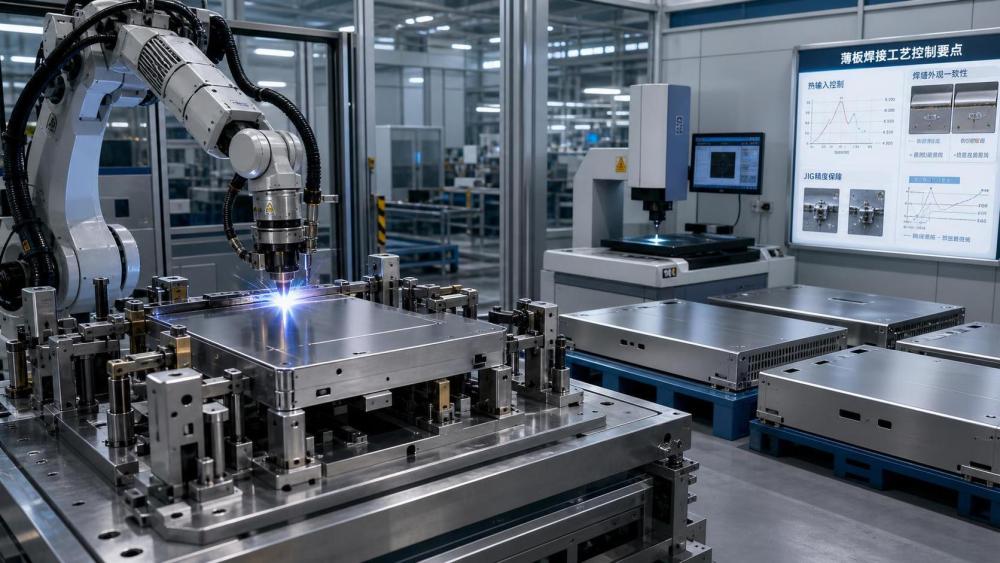
On appliance housings, fixturing is part of the welding process itself. It controls gap, restrains thermal movement, protects reference datums, and often determines whether cosmetic surfaces stay acceptable. Thin panels spring, twist, and react to heat quickly. If clamping is inconsistent, a good weld schedule can still produce unstable results.
Some teams focus heavily on power source selection and pay too little attention to fixture wear, locating-pin tolerance, or clamp sequence. That is usually a mistake. A mature evaluation should include how the part is loaded, how repeatable the clamp force is, whether electrode access changes as the fixture ages, and whether the welded part is measured immediately after release or only after cooling. For thin-gauge assemblies, those details are not secondary.
Appearance standards need to be defined early
A seam that passes a mechanical pull test may still fail in appliance manufacturing because the visible finish is unacceptable. White goods, kitchen equipment, and consumer-facing metal housings are judged by surface flatness, print-through, spatter, discoloration, and edge cleanliness. If appearance criteria are vague, welding teams and quality teams often argue over defects that should have been specified from the start.
This becomes even more important when panels will be powder coated, painted, brushed, or otherwise surface treated. Surface treatment technologies and electrostatic coating systems can improve durability and appearance, but they do not erase poor weld geometry. In some cases, they make defects more visible. A slight depression, inconsistent seam contour, or heat tint can stand out after finishing, especially on large flat panels under showroom lighting.
So a technical review should include not just weld acceptance, but finish acceptance after the actual downstream process. Looking at bare metal alone is often misleading.
Inspection should match the failure mode you care about
Not every appliance housing requires advanced nondestructive testing, but every line needs a reasonable way to detect drift before it becomes a batch problem. Visual inspection is necessary but limited. Destructive peel or chisel tests may be suitable for spot weld validation. Dimensional checks can reveal heat distortion even when the weld itself looks acceptable. Electrical monitoring, weld trace data, and parameter logging are increasingly valuable because they help connect a defect back to a specific time, station, or condition.
That traceability point is often underestimated. In broader industrial process support, marking and coding systems matter because they let quality teams track lots, operators, settings, and rework history. For welding evaluation, the same logic applies. If a plant cannot reliably link a failed housing to its production conditions, process improvement becomes slower and more expensive.
Common evaluation mistakes
A few mistakes come up repeatedly in thin-sheet projects.
- Approving the weld on sample parts that were better prepared than normal production parts.
- Focusing on tensile or nugget performance while overlooking visual deformation and assembly fit.
- Assuming the same settings will work across different sheet suppliers or coating conditions.
- Ignoring electrode wear, lens contamination, or fixture degradation during long runs.
- Evaluating the weld before paint or coating, but not after finishing.
None of these are exotic failures. They are ordinary production realities, and that is exactly why they deserve attention.
What a strong technical assessment usually includes
A good assessment of appliance panel welding for thin-gauge metal housings usually combines design review, sample validation, process capability thinking, and downstream impact review. It asks whether the joint design suits the chosen process, whether upstream cleaning and handling are controlled, whether heat input stays inside a realistic operating window, and whether appearance remains acceptable after finishing and assembly.
It also recognizes that welding quality is rarely created by the welding station alone. Cleaning precision, surface preparation, fixturing discipline, process data capture, and coating behavior all influence the result. That broader view is increasingly important in manufacturing environments where auxiliary systems quietly determine whether the final product feels reliable or problematic.
If there is one practical takeaway, it is this: for thin-gauge appliance housings, the best welding process is the one that stays stable when the line is running normally, material variation is real, cosmetic standards are enforced, and downstream finishing is included in the judgment. Anything less is only a partial qualification.