
The ultrasonic welding process sits at a practical intersection of speed, cleanliness, and repeatable assembly. It joins thermoplastic parts without adhesives, solvents, or added fasteners, which makes it highly relevant wherever product quality depends on tight tolerances, traceability, and stable cycle control.
Across medical devices, automotive electronics, consumer products, packaging, and precision components, small variations in welding behavior can influence leak performance, appearance, particulate risk, and downstream inspection results. That is why material selection, joint design, and defect analysis matter as much as machine power or advertised cycle time.
Why the ultrasonic welding process draws sustained attention
In advanced manufacturing, auxiliary processes often decide whether a final product looks consistent and performs reliably. Ultrasonic welding is a good example. It is not always the largest machine on the line, yet it can determine sealing quality, cosmetic finish, and assembly throughput.
For platforms such as GIAS, this matters because process-support systems shape the microscopic conditions behind visible product performance. A weak weld line, flash, or particle generation issue can become a larger problem in compliance, returns, or export quality review.
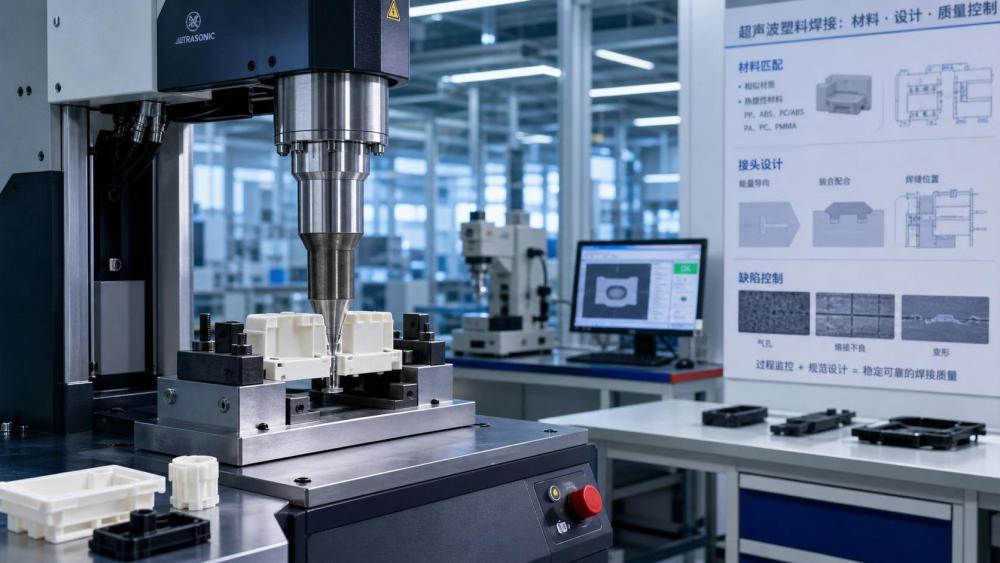
The same logic applies when comparing suppliers. A machine may achieve a short cycle, but the real question is whether the ultrasonic welding process remains stable across part variation, resin batches, cavity differences, and production shifts.
What actually happens during welding
The ultrasonic welding process converts high-frequency mechanical vibration into localized heat at the interface of two plastic parts. Under clamping force, that heat softens or melts the contact zone, and the material resolidifies into a bond.
In simple terms, success depends on controlled energy delivery. Too little energy leaves an incomplete bond. Too much energy can deform the part, create flash, or damage internal features.
Several variables interact at once:
- Material stiffness and melt behavior
- Joint geometry and contact area
- Horn amplitude and frequency
- Weld force, hold time, and trigger settings
- Fixture support and part dimensional consistency
This is why evaluating an ultrasonic welding process requires more than checking nominal equipment specifications. The process window is defined by the interaction between machine settings and part design.
Material compatibility is the first filter
Not all plastics respond equally well to ultrasonic energy. Amorphous thermoplastics generally weld more easily because they soften over a broader temperature range. Semi-crystalline materials can be welded, but they often need tighter control and more deliberate joint design.
Materials commonly suited to the ultrasonic welding process include ABS, PC, PS, SAN, and some grades of acrylic. Nylon, polypropylene, polyethylene, and PBT can also be welded, though process robustness may be more sensitive to moisture, fillers, and energy concentration.
Blends and additives deserve close attention. Glass fiber, flame retardants, lubricants, colorants, and recycled content can change stiffness, damping, melt flow, and final bond appearance. A material that looks similar in datasheets may behave differently during welding.
Material pairing also matters. Similar polymers usually bond more reliably than dissimilar ones. When dissimilar materials must be joined, trials should verify strength, appearance, and environmental performance instead of relying on theoretical compatibility alone.
Joint design often decides whether the process will be forgiving
A strong ultrasonic welding process starts with a joint that concentrates energy where melting should begin. If the interface is too broad or too flat, energy may spread instead of focusing, which leads to erratic weld formation.
Energy directors and shear joints
An energy director is a small triangular ridge molded into one part. It creates a defined initial contact point, which promotes rapid localized melting. This is common in amorphous plastics and compact assemblies.
A shear joint is often preferred for semi-crystalline materials or for applications needing stronger sealing behavior. The geometry guides one wall into another, maintaining friction and heat generation as the parts collapse together.
Support features beyond the weld line
Joint geometry does not work alone. Part rigidity, rib placement, wall thickness, and fixture contact points affect how vibration moves through the assembly. A good weld line can still fail if the surrounding structure flexes too much.
This is where technical review becomes more useful than headline machine comparisons. The ultrasonic welding process is only as stable as the combined design of resin, molded part, fixture, and horn.
Where process value shows up in real production
The business value of the ultrasonic welding process changes by application, but several patterns repeat across industries. It supports short cycle times, clean assembly, and reduced consumable dependence. Those advantages are meaningful when yield and traceability are under pressure.
- Medical housings benefit from low particulate assembly and repeatable sealing features.
- Automotive sensors and connectors require stable weld quality across temperature and vibration exposure.
- Consumer electronics use the process for compact joints and cleaner appearance than screws or adhesives.
- Packaging components rely on fast cycle performance and controlled tamper or seal characteristics.
In many lines, ultrasonic welding also connects to adjacent control points. Parts may be ultrasonically cleaned before assembly, then laser marked or inkjet coded for traceability after welding. The weld station therefore becomes part of a broader quality chain, not an isolated task.
Common defects and what they usually indicate
Most welding defects are not random. They usually point to a mismatch between material behavior, joint design, tooling condition, or machine settings. Reading those signals correctly saves time during trials and supplier validation.
A recurring mistake is treating every defect as a parameter issue. Sometimes the ultrasonic welding process is already near its practical limit because the molded parts vary too much or the joint was never designed for energy concentration.
How to evaluate process stability more effectively
A useful evaluation goes beyond sample strength. It examines whether the process can absorb normal production variation without drifting into cosmetic or functional defects.
Signals worth comparing
- Weld consistency across multiple cavities and resin lots
- Monitoring capability for energy, peak power, and collapse distance
- Fixture repeatability and changeover discipline
- Horn durability and frequency matching under load
- Failure mode after environmental or mechanical testing
It also helps to ask where the process sits within the wider line. If traceability, cleanliness, or compliance is important, the ultrasonic welding process should be reviewed together with inspection, marking, cleaning, and documentation steps.
A practical next step for comparison and decision-making
The most reliable path is to build a comparison framework before selecting equipment or approving a design freeze. Start with the resin system, expected weld function, joint geometry, cosmetic limits, and test method. Then compare machine control features against those requirements.
When trial results are reviewed in that context, the ultrasonic welding process becomes easier to judge on real production terms. The goal is not simply to make two parts stick. It is to confirm that the bond remains repeatable, measurable, and compatible with the full quality strategy around the product.
That is usually the point where better decisions begin: not at the catalog level, but at the intersection of material behavior, joint intent, defect risk, and line-level process control.