
Selecting plastic welding equipment is rarely a simple sourcing task. It shapes joint strength, cycle stability, scrap rates, maintenance planning, and line throughput. In advanced manufacturing, that choice also connects with traceability, surface quality, cleanliness, and long-term process control. A well-matched system supports reliable delivery. A poor match creates hidden cost across tooling, quality inspection, and production recovery.
Why Equipment Selection Matters Beyond the Weld
Plastic welding sits inside a wider auxiliary process chain. Parts may be cleaned before joining, marked after assembly, checked for leak integrity, or integrated into regulated products. That is why equipment decisions should not be isolated from the rest of the line.
Platforms such as GIAS highlight this broader view. In many factories, welding quality depends on microscopic contamination, fixture repeatability, and downstream identification requirements as much as on welding power alone.
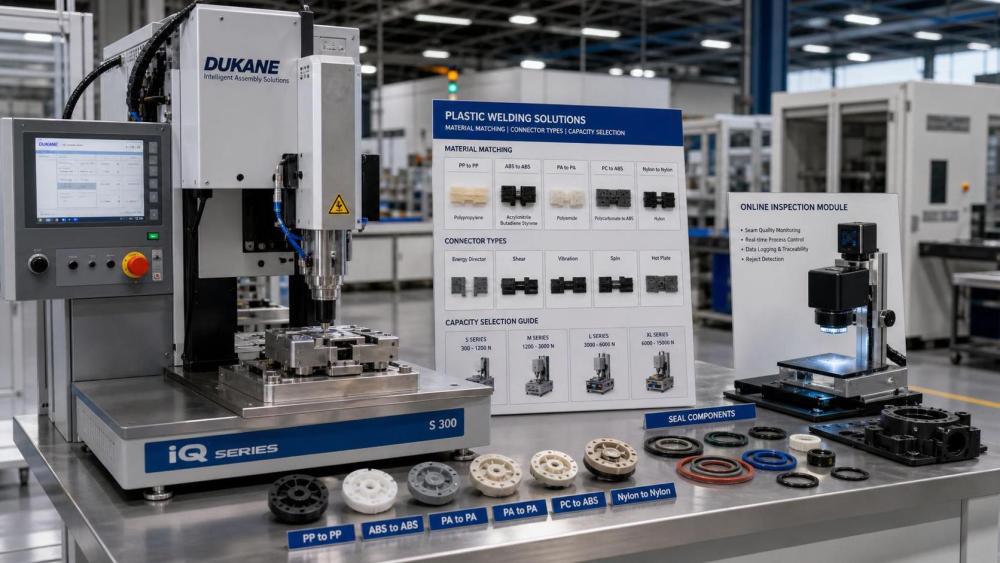
When comparing plastic welding equipment, the real question is not only which machine can make a bond. It is which process can make the right bond, at the right speed, with the right documentation and process margin.
Start With the Material, Not the Machine
Material behavior is the first filter. Different plastics respond differently to ultrasonic energy, heat, friction, vibration, or laser transmission. A machine that performs well on one resin may struggle on another.
Amorphous materials such as ABS, PC, and PS usually weld more easily with ultrasonic methods. Their wider softening range gives a more forgiving process window.
Semi-crystalline materials such as PP, PE, and nylon are more demanding. They often require tighter control, higher energy input, or alternative joining methods such as hot plate, spin, or vibration welding.
Filled materials add another layer. Glass fiber, flame retardants, colorants, and recycled content can change melt behavior, damping, and final appearance. For visible parts, cosmetic tolerance may be as important as bond strength.
Material compatibility also matters in multi-part assemblies. If two components are different polymers, a direct weld may be weak or inconsistent unless the process is designed for that interface.
Material Questions That Shape the Decision
- Is the resin amorphous, semi-crystalline, or filled?
- Does the part require cosmetic surface protection?
- Will moisture absorption affect welding consistency?
- Are there contamination risks from molding, handling, or storage?
- Must the joint meet leak, pull, burst, or regulatory requirements?
Joint Design Often Decides Process Success
Many welding issues blamed on equipment begin with the joint. Plastic welding equipment performs best when the part geometry is designed for the chosen energy path and melt flow.
Ultrasonic welding usually relies on energy directors, shear joints, or carefully controlled contact features. These help localize heat and shorten cycle time. Without them, energy may scatter, leading to flashing, weak fusion, or part damage.
Hot plate welding suits larger parts and hermetic joints. It handles more challenging resins well, but footprint, cycle time, and tooling complexity are higher.
Vibration welding is often used for larger, irregular components in automotive and fluid management applications. It offers strong structural joints, though particle generation and noise may require extra controls.
Spin welding remains efficient for round parts such as caps, valves, and reservoirs. It is simple in concept, but only practical when geometry supports rotation.
Matching Joint Type to Common Processes
Output Needs Change the Best Choice
The right plastic welding equipment for pilot production may be the wrong choice for scale-up. Output targets influence automation level, fixture strategy, maintenance intervals, and acceptable cycle variation.
Low-volume production often values flexibility. Quick changeover, programmable recipes, and compact tooling may matter more than pure speed.
Higher-volume lines usually prioritize repeatability, uptime, and process monitoring. Servo-controlled systems, recipe locking, integrated reject handling, and data logging become more valuable.
Output planning should include more than hourly target numbers. It should cover warm-up time, tool wear, operator intervention, spare parts availability, and recovery after an alarm condition.
Throughput Questions Worth Settling Early
- What is the required parts-per-hour rate under stable production?
- How many product variants share the same welding cell?
- Is manual loading acceptable, or is automation already planned?
- What downtime can the project tolerate during tool replacement?
- Will process data need to connect with MES or quality records?
Process Control, Validation, and Line Integration
Selection should also consider how the welding station behaves inside the full manufacturing environment. In sectors with traceability and compliance pressure, process evidence matters almost as much as the weld itself.
Modern plastic welding equipment may record amplitude, time, energy, collapse distance, pressure, or temperature. Those data points help distinguish a capable process from a merely functioning one.
This is where auxiliary systems become relevant. Ultrasonic cleaning may reduce contamination before joining. Laser marking or inkjet coding can identify each assembly after welding. Vacuum leak testing may confirm seal performance where fluid integrity is critical.
A strong equipment decision therefore links joining, inspection, and identification into one controlled workflow. GIAS focuses on exactly these connections across manufacturing support systems.
Typical Selection Risks
Several recurring mistakes appear in plastic welding projects. None are unusual, but each can delay launch or inflate cost after installation.
- Choosing by machine power alone without reviewing resin behavior.
- Approving equipment before confirming joint design with molded samples.
- Ignoring fixture rigidity and part presentation.
- Assuming laboratory welds will translate directly to production speed.
- Underestimating documentation and validation needs for downstream audits.
- Treating pre-cleaning and part marking as separate issues too late in the project.
The most effective mitigation is early cross-checking between material data, part drawings, test samples, and real output expectations.
A Practical Way to Compare Plastic Welding Equipment
A useful comparison framework balances four dimensions: material fit, joint suitability, output capacity, and control capability. Price should be reviewed inside that structure, not before it.
Begin with test parts that reflect actual resin, wall thickness, and tolerance conditions. Request process data, not only sample assemblies. Review fixture concepts and maintenance points early.
It also helps to compare how each supplier addresses cleaning sensitivity, marking integration, validation records, and future scale-up. These details often decide long-term ownership cost.
Useful Evaluation Criteria
What to Clarify Before the Final Decision
Before committing to plastic welding equipment, define the non-negotiables. That usually includes acceptable weld appearance, minimum joint strength, target output, validation evidence, and future product variation.
Then map those needs against real process trials and the surrounding auxiliary systems. In many cases, the best result comes from a coordinated solution rather than a single machine comparison.
A disciplined shortlist should leave little ambiguity about material response, joint behavior, monitoring depth, and integration effort. That makes the next step clearer: build the decision around tested conditions, measurable controls, and the actual production envelope.