
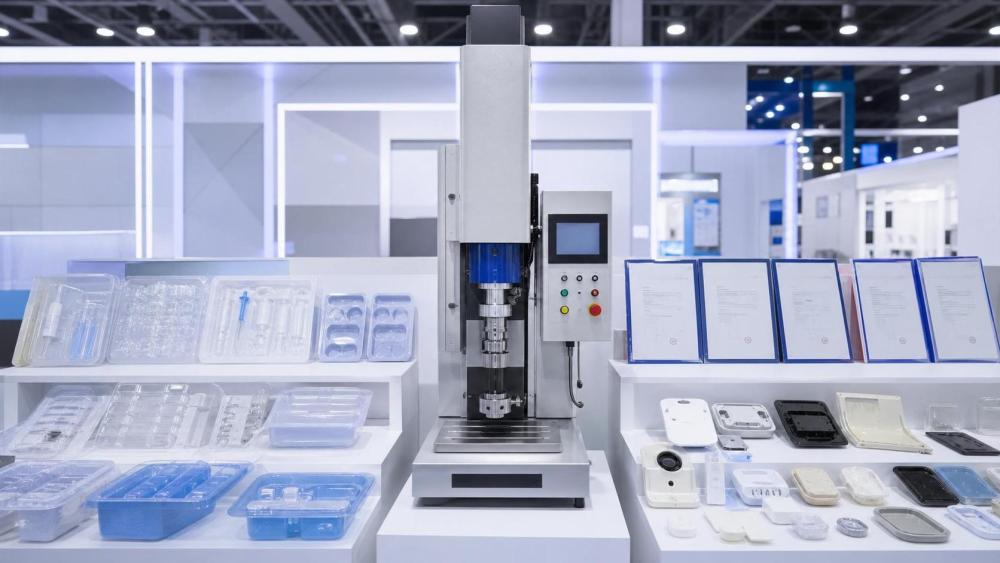
At the procurement matchmaking sessions opened on June 16, 2026 at the Langfang trade fair, overseas buyer groups from more than ten countries, including Russia, Vietnam, and Malaysia, were already signaling concrete demand in a narrow but commercially relevant equipment segment: Plastic Ultrasonic Welders. The release of bulk procurement interest from a Russian elderly care equipment integrator and a Vietnamese medical device OEM, combined with stated requirements around ISO 13485 and CE+UKCA compatibility, makes this development worth watching for equipment makers, medical manufacturing suppliers, compliance teams, and cross-border delivery partners.
What the Langfang Meetings Confirmed
Confirmed information from the June 16, 2026 event shows that the procurement matchmaking program at the Langfang trade fair brought together buyer delegations from more than ten countries, including Russia, Vietnam, and Malaysia. Among the clearest signals at the event were bulk purchasing needs for Plastic Ultrasonic Welders from a Russian elderly care equipment integrator and a Vietnamese medical device OEM.
The application focus disclosed at the event centered on medical consumables packaging and welding for small housings. The buyers also specified certification and market-access expectations, including ISO 13485 and dual compliance with CE and UKCA. According to the event summary, 37 preliminary technical matching intentions had already been reached on site.
Why This Matters Across the Supply Chain
Equipment suppliers face a more defined demand signal
From an industry perspective, the most immediate impact falls on manufacturers and exporters of Plastic Ultrasonic Welders. The reason is not only the appearance of overseas demand, but the fact that the demand is tied to identifiable use cases and compliance conditions. What deserves closer attention is whether suppliers can align technical specifications, documentation, and communication around medical consumables packaging and compact housing welding rather than treating the inquiry as a general-purpose machinery opportunity.
Medical manufacturing partners may need closer process alignment
For medical device OEMs, contract manufacturers, and related processing partners, the relevance lies in production compatibility. Analysis shows that when buyer interest is linked to medical consumables and small enclosure welding, equipment evaluation is likely to extend beyond output capacity to process stability, validation support, and documentation readiness. Even without confirmed orders, the matching activity indicates that production-side coordination may become an early discussion point.
Compliance and delivery service providers also come into view
Certification, export documentation, and market-access support functions may also be affected. The stated requirement for ISO 13485 and CE+UKCA suggests that procurement decisions are being framed with downstream regulatory use in mind. Observably, this does not confirm completed transactions, but it does raise the importance of technical file preparation, conformity-related communication, and delivery planning for service providers working alongside equipment vendors.
What Companies Should Watch Next
Track whether certification requests stay central
Companies should pay close attention to whether future matchmaking updates continue to emphasize ISO 13485 and CE+UKCA. If these remain consistent in follow-up exchanges, that would indicate that compliance positioning is not a peripheral request but part of the core purchasing filter.
Prepare application-specific technical communication
For suppliers engaging with overseas buyers, a practical priority is to organize product communication around the scenarios already identified at the event: medical consumables packaging and small housing welding. This is more useful than broad product promotion because the disclosed demand is scenario-based rather than open-ended.
Separate initial matching from executable business
Analysis shows that the 37 preliminary technical matching intentions should not be read as completed procurement results. Companies should distinguish between early technical fit, formal qualification, and actual purchasing execution, especially where certification, acceptance criteria, and cross-border documentation may influence timelines.
Check readiness in documentation and fulfillment coordination
Export-facing teams should review whether supplier qualifications, technical documents, certification materials, and customer communication processes are ready for follow-up. What deserves closer attention is not only whether inquiries increase, but whether internal teams can respond in a way that supports evaluation, negotiation, and eventual delivery.
How to Read the Signal at This Stage
As an editorial observation, this development is more appropriate to understand as an early-stage market signal rather than a finalized demand outcome. The information released so far confirms targeted buyer interest, defined application scenarios, and specific certification expectations. It does not yet confirm signed contracts, shipment volumes, or long-term purchasing continuity.
From an industry perspective, the value of this update lies in the structure of the demand signal. The combination of overseas buyer participation, medical-related application focus, and explicit compliance requirements suggests that future competition in this niche may depend as much on documentation and qualification readiness as on equipment capability itself. That is why the event deserves continued attention even at the preliminary matching stage.
What This Update Ultimately Suggests
In practical terms, the June 16 Langfang matchmaking activity points to a concrete but still developing opportunity around Plastic Ultrasonic Welders in cross-border medical-related applications. The current information supports a cautious reading: this is not yet a confirmed market outcome, but it is more than a routine exhibition inquiry because buyer profiles, use cases, and compliance expectations have already been identified. For now, it is best understood as a short-term business signal with possible longer-term implications, pending further confirmation from follow-up transactions and qualification progress.
About the Basis of This Article
This article is based on the user-provided news title, event date, and event summary. For this type of industry update, commonly relevant source categories may include official event announcements, company statements, industry association releases, authoritative media coverage, and standard-related documents. A specific official source link was not provided in the input, so further verification remains necessary. The main follow-up points to watch are whether the preliminary technical matches progress into formal procurement steps and whether certification-related requirements remain central in subsequent disclosures.