
Adhesive-free casing welding becomes the stronger choice when the assembly must hold a seal under thermal cycling, chemical exposure, or long service life without the uncertainty of cured adhesive layers. The practical decision starts with the failure mode: if leakage, delamination, solvent attack, or outgassing would be unacceptable, a welded joint often offers a cleaner path than bonding. That does not make welding universally better. It means the joint design, material pair, and production controls have to match the sealing demand with less room for variation.
For leak-sensitive housings, the first check is material compatibility. Thermoplastics with a stable melting range and predictable flow behavior are the easiest candidates. Materials such as ABS, PC, PP, PE, PA, and certain filled blends can be welded, but each behaves differently under heat and pressure. High glass fiber content, flame retardant additives, pigments, and recycled resin content can narrow the process window. If a casing relies on dissimilar plastics, or if one half carries a surface treatment that interferes with energy transfer, adhesive-free casing welding may still work, but the joint has to be validated with actual material lots rather than nominal resin data.
Leak performance depends less on the label of the process than on interface design. A good weld needs enough energy to create a continuous melt line without over-compressing the part or trapping voids. Joint geometry matters: energy directors, shear joints, and tongue-and-groove features behave differently in terms of collapse distance, flash control, and final dimensional stability. If the seal line is too narrow, the joint can be fragile; if it is too broad, the required energy rises and the risk of thermal deformation increases. That tradeoff is often overlooked when a casing is borrowed from a non-welded design and only the fastening method is changed.
The process choice should also reflect the type of leakage risk. A small enclosure that only needs dust resistance has different demands from a housing that must retain gas, protect an electrolyte path, or isolate a fluid chamber from vibration. In a leak-sensitive assembly, surface contamination becomes a larger issue than many teams expect. Mold release, oil film, handling residue, and moisture on the weld interface can all create local weak spots. Adhesive-free joining removes cure-related variability, but it does not remove cleanliness requirements. In practice, it may raise them, because the weld depends on intimate contact and controlled melt fusion.
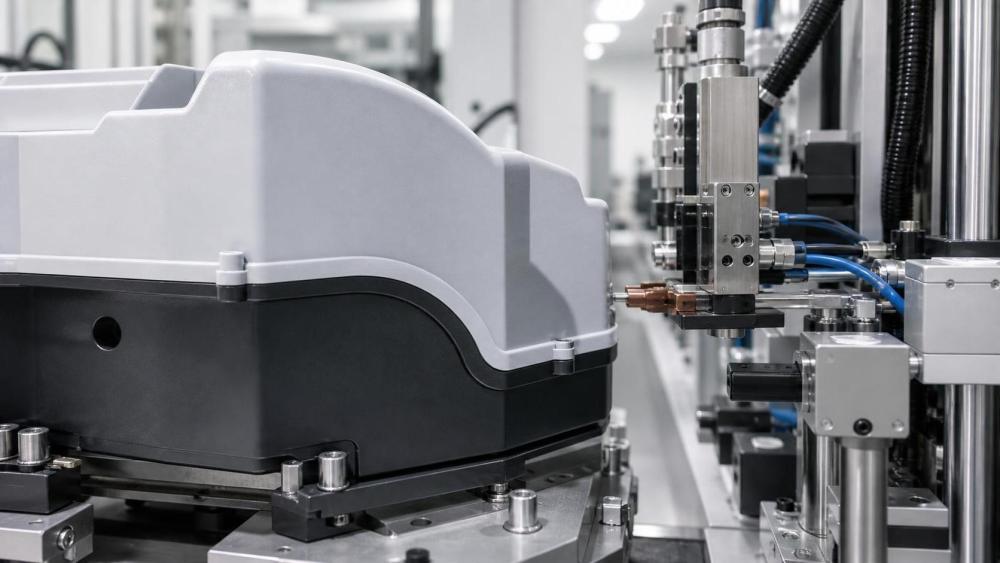
From a manufacturing perspective, welding can improve line consistency when the parts are repeatable and the process window is well defined. Ultrasonic welding is often considered for smaller casings with relatively rigid joint features and short cycle times. It works best when the weld area can transmit vibration efficiently and the part stack-up is stable. Laser welding is more attractive when one component can transmit the beam and the other absorbs it, especially where the joint needs localized heating and low particulate generation. Hot plate and vibration welding can suit larger casings, but they add thermal mass, tooling complexity, and a greater need to manage warpage. The better choice depends on geometry, cycle time, cosmetic requirements, and whether the assembly can tolerate contact marks or flash.
For technical evaluation, seal integrity should not be judged by appearance alone. A shiny weld bead can still hide incomplete fusion, voids, or local overheating. Pressure decay, helium leak testing, dye penetrant checks, and sectioning are all useful depending on the size and sensitivity of the enclosure. A brittle weld may pass an initial leak test and fail later after drop shock, torsion, or thermal aging. That is why short-term sealing results need to be paired with mechanical retention checks and aging exposure that resembles the real service environment. If the casing must survive repeated assembly handling, the weld line also needs enough margin against nicking, clamp distortion, and tool wear.
Adhesive-free welding is usually favored when secondary cure time, solvent handling, or adhesive shelf-life control would complicate production. It is also preferable when the final product must avoid adhesive squeeze-out, contamination near optics or sensors, or odor-related complaints during packaging. In contrast, adhesives may still be the more practical route when parts are large, uneven, or made from materials that do not weld cleanly. A complex housing with inserts, thick metal interfaces, or very broad bonding surfaces may be difficult to weld without residual stress. In those cases, the issue is not that welding is weak; it is that the geometry is hostile to a stable thermal joint.
There is also a maintenance angle. Welded casings are generally harder to rework, which can be an advantage or a constraint depending on the assembly. If the enclosure is expected to be opened for service, a welded seal may conflict with repair strategy. If the casing is meant to remain closed for its full life, that same irreversibility can be a strength because it removes an entire class of loosening and contamination risks. The decision becomes clearer when maintenance policy is defined early. Retrofitting weldability into a design that still expects repeated disassembly usually creates avoidable friction.
Common misjudgments start with assuming that adhesive failure and weld failure are interchangeable. They are not. Adhesives fail through cure defects, creep, substrate contamination, and long-term chemical attack; welds fail through poor fusion, excessive heat input, joint mismatch, or hidden voids. Another frequent mistake is treating cosmetic seam continuity as proof of sealing continuity. A sealed exterior line can coexist with internal discontinuities if the energy path was inconsistent. For that reason, process validation should include part-to-part variation, not just nominal samples from a fresh tool setup.
Material color and filler package may also influence selection more than expected. Dark pigments can affect laser transmission, while certain fillers can dampen ultrasonic energy or create nonuniform heating. Additives that improve stiffness or flame resistance may reduce weldability even when the base polymer is otherwise suitable. If the casing must meet both sealing and environmental exposure requirements, the formulation should be reviewed together with the weld method, not after the geometry is finalized. This is where adhesive-free casing welding can become either elegant or frustrating, depending on how early those constraints are handled.
For shipment and installation, welded assemblies usually handle handling stresses better when the joint is continuous and the internal load path is well distributed. But they also leave less room for field correction. Misalignment, trapped debris, or an insert that shifts during welding can turn into a permanent defect. That means incoming part quality, fixture accuracy, and operator discipline are not peripheral details. They are part of the sealing strategy itself. If those controls are weak, adhesive-free welding may create a more repeatable failure mode rather than a better joint.
In leak-sensitive assemblies, the better choice is often the one that reduces uncertainty at the joint line and keeps performance stable across material lots, shifts, and service conditions. Adhesive-free casing welding tends to win when the plastic system is weldable, the geometry supports a controlled melt interface, and the product can benefit from a closed, low-contamination seal. It is less attractive when the substrate is inconsistent, the enclosure must be serviceable, or the design has not been built around the realities of thermal joining. The deciding factor is usually not the joining method alone, but whether the whole casing architecture was designed to let that method seal reliably.