
From June 1, 2026, Multi-tank Wash Lines entering Vietnam fall under a mandatory end-to-end traceability requirement administered by the Ministry of Industry and Trade. For importers, exporters, equipment makers, and downstream users of industrial cleaning systems, this is not just a labeling update: it links product entry, technical documentation, and on-site compliance use through a registration and QR-based data process that can directly affect customs clearance and delivery timing.
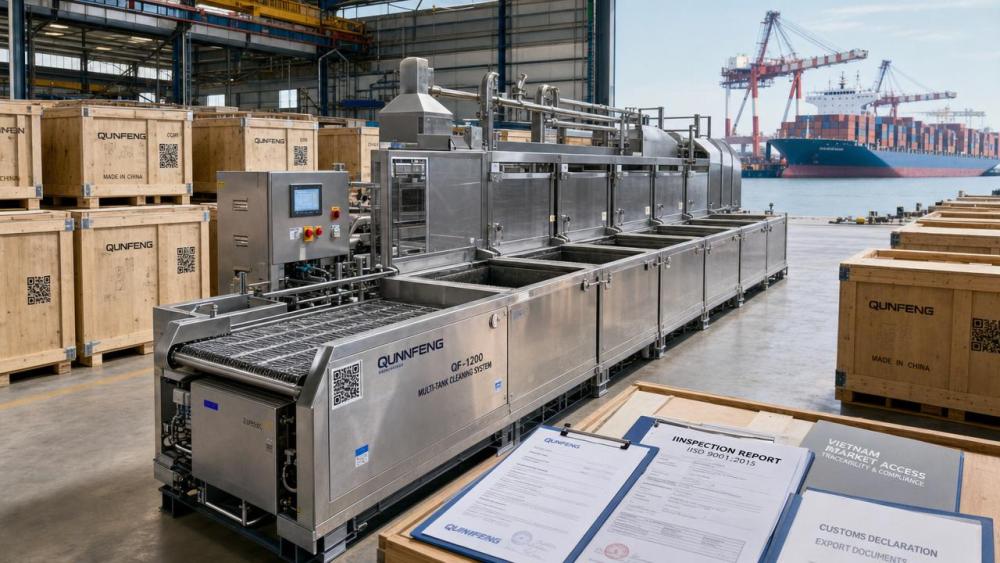
What the new requirement now makes mandatory
The confirmed change is that Vietnam’s Ministry of Industry and Trade will fully enforce a full-chain traceability regime for high-risk products from 2026-06-01, and Multi-tank Wash Lines are included within the covered industrial cleaning equipment scope. Importers are required to register product information on verigoods.vn, generate a unique QR code, and upload standardized data including raw material origin, process parameters, and test reports. Goods without the required label, or with incomplete information, will be rejected at the border and returned.
Where the compliance pressure is likely to be felt first
Export shipments face a documentation-to-clearance linkage
From an industry perspective, exporters of Multi-tank Wash Lines need to pay closer attention to whether shipment documents and product data can support importer registration before cargo arrival. The practical impact is likely to appear in pre-shipment coordination, customs readiness, and delivery scheduling, because a missing QR code or incomplete traceability file may interrupt handover even when the equipment itself is ready for dispatch.
Import-side execution becomes a gate for market entry
Importers are directly affected because the registration obligation sits with them. What deserves closer attention is the need to organize product information, traceability records, and supporting test documents in a standardized form for the platform workflow. This raises the importance of internal document review, supplier coordination, and timing control before goods reach the port.
Manufacturers and suppliers may need deeper data support
For equipment manufacturers and upstream suppliers, the rule change matters because the required uploads include raw material origin, process parameters, and test reports. Analysis shows that this can push compliance responsibility further back into the manufacturing and sourcing chain, especially where technical files were previously prepared mainly for commercial or factory acceptance purposes rather than for traceability registration.
End users and service teams also face downstream compliance implications
Terminal customers and after-sales service teams may also be affected because the summary provided indicates that the change can influence compliant use by end customers. In practice, buyers may pay more attention to whether imported equipment has completed the required traceability steps, while service teams may need to verify that delivered units match the registered identity and labeling status.
What companies should review now
Check whether technical files are registration-ready
Companies involved in exports to Vietnam should review whether product files for Multi-tank Wash Lines can be translated into the standardized data set required for platform registration. The immediate focus is not on adding broad compliance narratives, but on confirming whether raw material origin records, process parameters, and test reports are available, consistent, and deliverable to the importer in time.
Align trade documents with QR and traceability records
Analysis shows that businesses should pay attention to how the unique QR code requirement may connect with shipping, receiving, and handover processes. Even without further execution details in the input, it is reasonable to monitor whether internal document packages, labeling steps, and customer acceptance materials need adjustment to avoid gaps between physical goods and registered product identity.
Reassess delivery schedules and procurement sequencing
Because unlabeled goods or goods with incomplete information may be returned at the port, procurement and delivery teams should closely review schedule assumptions for projects involving these systems. What deserves closer attention is whether importer registration and document preparation need to be treated as a prerequisite before shipment release, especially for orders with tight installation or commissioning windows.
Watch for further clarification in implementation practice
The input confirms the mandatory direction and the consequences of non-compliance, but it does not provide more detailed operating guidance. For that reason, companies should continue tracking how the rule is described in official implementation language, how documentation is reviewed in practice, and whether procurement specifications or bid documents begin to reflect the traceability requirement more explicitly.
Why this looks more like an execution signal than a distant policy headline
Observably, this development is more appropriately understood as a concrete execution signal rather than a general policy discussion. The reason is that the information already connects three enforceable elements: a start date, a defined registration channel, and a direct port consequence for incomplete compliance. At the same time, this should not yet be read as a complete picture of all operating details, because the input does not provide the full implementation wording, review standards, or market feedback.
How the market may best read this stage
At this stage, the most balanced reading is that the Vietnam traceability requirement creates an immediate compliance checkpoint for Multi-tank Wash Lines moving into the market from 2026-06-01. It does not by itself answer every procedural question, but it clearly signals that product traceability data, QR identification, and document completeness are becoming part of practical market access and delivery control. For the industry, the issue is less about abstract policy direction and more about whether transaction, documentation, and shipment workflows can match the new requirement in time.
Basis of this article and points still requiring verification
This article is generated from the user-provided news title, event date, and event summary. For developments of this type, relevant source categories usually include official notices, releases from regulatory authorities, customs or trade administration information, industry association updates, standards-related documents, and reporting by authoritative media. A specific official source link was not provided in the input, so the precise official text and later implementation details still require ongoing verification. Further observation should focus on implementation guidance, documentation review standards, procurement document changes, market feedback, and how companies execute the requirement in practice.